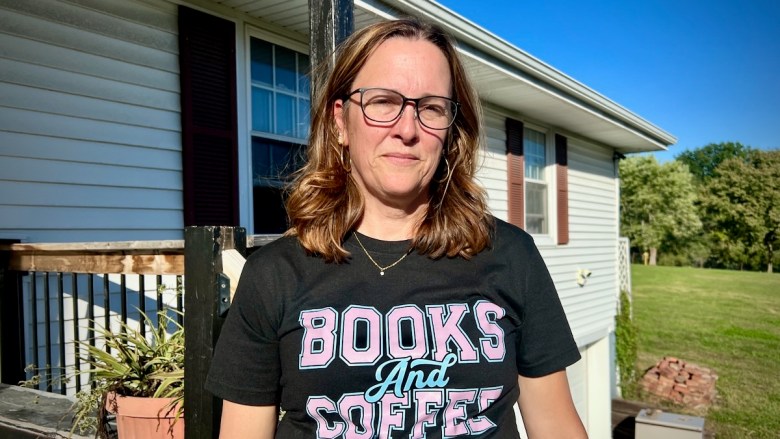
In December 2022, a surgeon at NKC Health removed Karrie Krause’s gallbladder. Three years later, a lawyer representing the hospital took her to court over her unpaid bill.
The middle school English teacher is far from alone. As the price of getting sick or injured keeps growing and the cost that patients are forced to shoulder increases, a new study finds that more than a quarter of adults have medical debt themselves or by way of a family member. And more than one in seven have health bills that are past due or that they cannot pay.
Lawsuits are a common response from hospitals, which argue that a rising wave of uninsured patients brought on by increasing insurance costs and cuts to federal health programs makes it crucial for their financial stability to get patients who can afford care to pay.
Krause’s surgery bill came out to more than $2,700 after her insurance paid its share. That was too much to afford all at once, so Krause remembers trying to set up a payment plan with the hospital.
Almost four years later, she admits the details are fuzzy. But Krause is sure that at some point she stopped getting bills from the hospital, leading her to think the debt could have been settled. Maybe her insurance had come through with an additional payment or the hospital had written off her part of the debt.
Then she lost track.
“You just don’t pay attention,” Krause said, standing outside the small Raytown home she shares with her husband.
But last year, she learned the truth. The hospital bill hadn’t gone away. It had gone to collections, had tanked her credit score and was heading to court.
Although court documents indicate that on Feb. 18 someone at her house was served with a court summons, Krause claims she didn’t learn about the lawsuit until it showed up on a credit check.
“When you get sacked with a lawsuit and you don’t know it’s coming, that freaks you out,” she said. “The stress of that alone was bad enough.”
But then she had to figure out how to pay off the debt, which with accrued 9% interest had ballooned to more than $3,500. The hospital’s law firm, Bessine Walterbach, told her the only way the case would be dropped was if she paid the bill with a certified check.
“They would not do a payment plan,” Krause said, “so I took out a loan.”
A responsibility to collect
NKC Health officials declined to discuss Krause’s case for privacy reasons, but CFO Austin Jones explained the hospital’s billing and collections policies, and he defended its efforts to collect unpaid debt from patients who can afford to pay.
NKC Health, Kansas City’s only independent hospital without the backing of a large health system, has a responsibility to protect its financial health, he said. In 2025, the hospital reported a $35 million operating loss.
“We can’t afford to give free care to people who don’t, frankly, qualify,” he said.
The hospital, which Jones said processes more than a million medical claims each year, has filed 92 debt collection cases in Missouri so far this year, according to a cursory count in the state’s court filing database. Annually, the hospital sees more than 80,000 emergency room visits and about 19,000 hospital admissions.
Before the hospital ever considers suing a patient, Jones said, it tries in multiple ways to reach them to resolve unpaid debt.

Its policy is to mail out three billing statements over 90 days before sending unpaid bills to an outside vendor that spends a year working to track down patients and settle bills. It also offers every patient — no matter their income — the option of paying off debt in installments. People can request a payment plan online without submitting any additional documentation, Jones said.
NKC offers free care to patients earning less than $32,239 a year, 202% of the federal poverty level. It gives graduated discounts to patients earning up to $63,840, 400% of the poverty level. And it works to help patients sign up for Medicaid or find other insurance coverage or outside assistance. That’s all before a lawsuit or other extraordinary collections tactics, such as wage garnishment or property liens, are considered, Jones said.
“There is always room for error because it’s such a human process,” he said.
But if patients call and ask for help, they will get help, he said.
“Just connect with us,” Jones said. “We’re here.”
Collecting debt becoming more critical
Pursuing unpaid bills has become more critical as shifting federal policies threaten to reduce patient revenue and add costs, Jones said.
NKC Health, like other hospitals, is already seeing a significant increase in the number of uninsured patients seeking care. As of August, the hospital had written off almost $78 million in patient bills, a 57% jump from the previous year.
Jones attributes the sharp rise to cuts in federal tax subsidies that had helped people buy insurance through the Affordable Care Act marketplace. After federal lawmakers declined to renew those enhanced premium tax credits at the end of 2025, more people dropped coverage or signed up for plans that have far higher copays, deductibles and other out-of-pocket costs.
The result, Jones said, is more patients needing financial assistance. He expects that trend to get worse next year when new Medicaid requirements kick in.
Those federal rules will force people getting Medicaid through Missouri’s expansion plan to document work hours and go through more frequent eligibility checks. It will likely lead to an even more significant increase in the number of patients who lack adequate insurance coverage, another financial blow to hospitals like NKC Health that rely on Medicaid patients and are bound by federal law to provide free care when patients can’t afford to pay.
NKC Health, which had net patient service revenue in 2025 of $788 million and reported an operating loss of $34.9 million, is anticipating $3 million in added annual costs from more uncompensated patient care starting next year.
“To a lot of health systems, they’re so huge nowadays, that’s a rounding error,” Jones said. “To us, it’s a lot.”
Not as simple as villains and victims
Katherine Hempstead, a senior policy officer with the Robert Wood Johnson Foundation, agreed that hospitals do have to get paid to stay in business. When they close, which has happened at least 19 times in Missouri and Kansas over the last decade, communities and patients suffer.
And hospitals are clearly facing new financial pressures. Policy changes made under the Trump administration will lead to revenue loss and added costs for many of them.
“I understand that hospitals are victims too in some ways,” Hempstead said. “It’s not a simple villains and victims kind of situation.”
But the solution can’t be putting more costs on the backs of poor and middle-class patients, she said.
Hempstead said passing regulations that cap out-of-pocket costs or the price of certain drugs could help people facing huge bills and growing debt. But ultimately, getting debt under control — while also helping hospitals — will require bigger systemic changes to tame healthcare costs.
Hospitals going after lower-income patients for unpaid bills they can’t afford won’t do much to solve the debt problem, she said. But the practice can be “life-altering” to the patients getting sued.
Krause understands that life-altering description all too well. She has dedicated hours to dealing with the NKC bill that wound up landing her in court. The collection efforts it sparked played havoc with her credit rating. And now, although the hospital bill has been paid off, she and her husband are dealing with a bank loan that is still outstanding.
On top of that, now Krause is facing new medical debt: Another $3,500 hospital bill that arrived after a recent emergency room visit to a St. Luke’s Health System facility.
Krause has learned her lesson and will pay close attention to this bill. But she doesn’t know yet how she’ll pay it off.
“I’ll get it figured out,” she said, shaking her head.
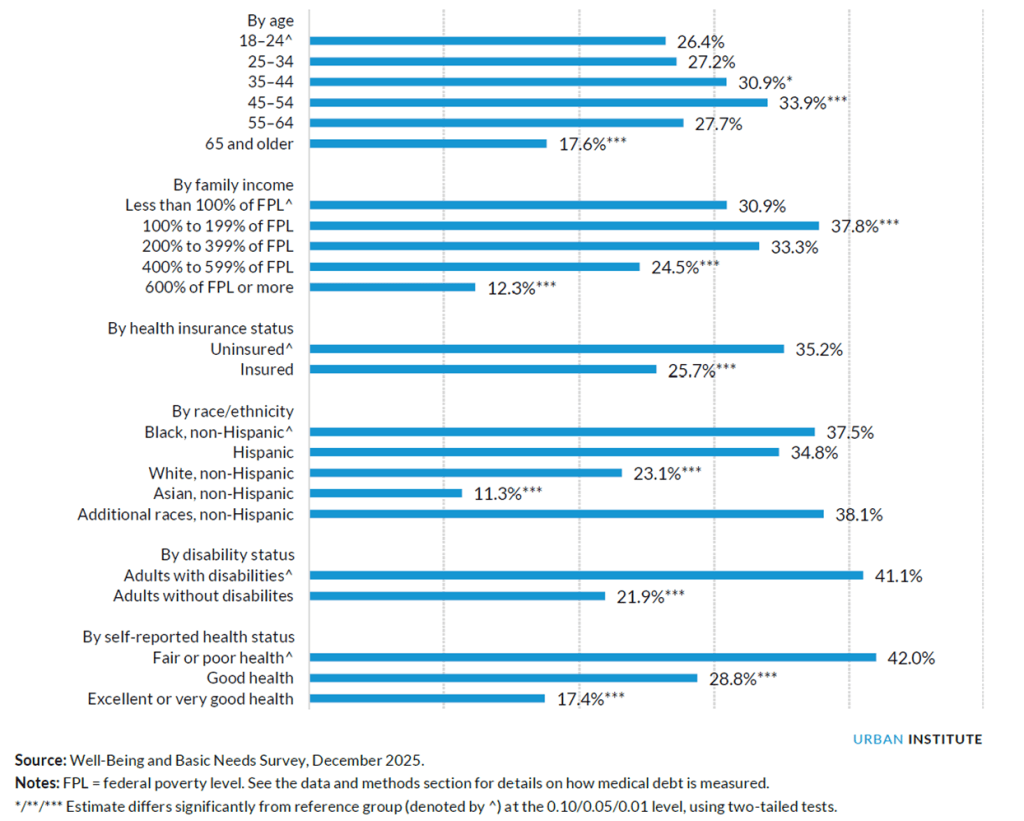
Share of U.S. Adults Who Had Medical Debt in December 2025
A new analysis from the Urban Institute, supported by the Robert Wood Johnson Foundation, found that 27% of surveyed adults reported that they or their family members had medical debt in 2025, including 26% of adults with health insurance.