
Nearly 86,500 fewer Missourians were paying for Affordable Care Act marketplace coverage in February compared to a year earlier, according to newly released federal data. It’s a nearly 25% decline that ranks among the steepest in the country.
The figures mark the steepest decline since marketplace enrollment surged during the COVID-19 pandemic, and comes after the expiration of the enhanced premium tax credits, which made plans more affordable for many shopping on the marketplace.
The new federal data shows how many people actually ended up paying premiums over the first few months of the year.
In Missouri, coverage fell from 347,424 in February 2025 to 260,999 in February 2026.
In Kansas, enrollment fell by more than 20% from 179,920 in February 2025 to 143,880 in February 2026.
Overall, nationwide enrollment fell from about 22.3 million people in 2025 to an estimated 17.5 million in February 2026.
“This is the first time we’ve seen a large decrease in enrollment since the introduction of the ACA marketplaces,” said Justin Lo, a senior researcher for the program on patient and consumer relations at KFF. “The declines aren’t fully realized yet. The actual amount of people enrolled may still decline over the year, which is overall in line with expectations.”
The impact is stark in rural areas of the country.
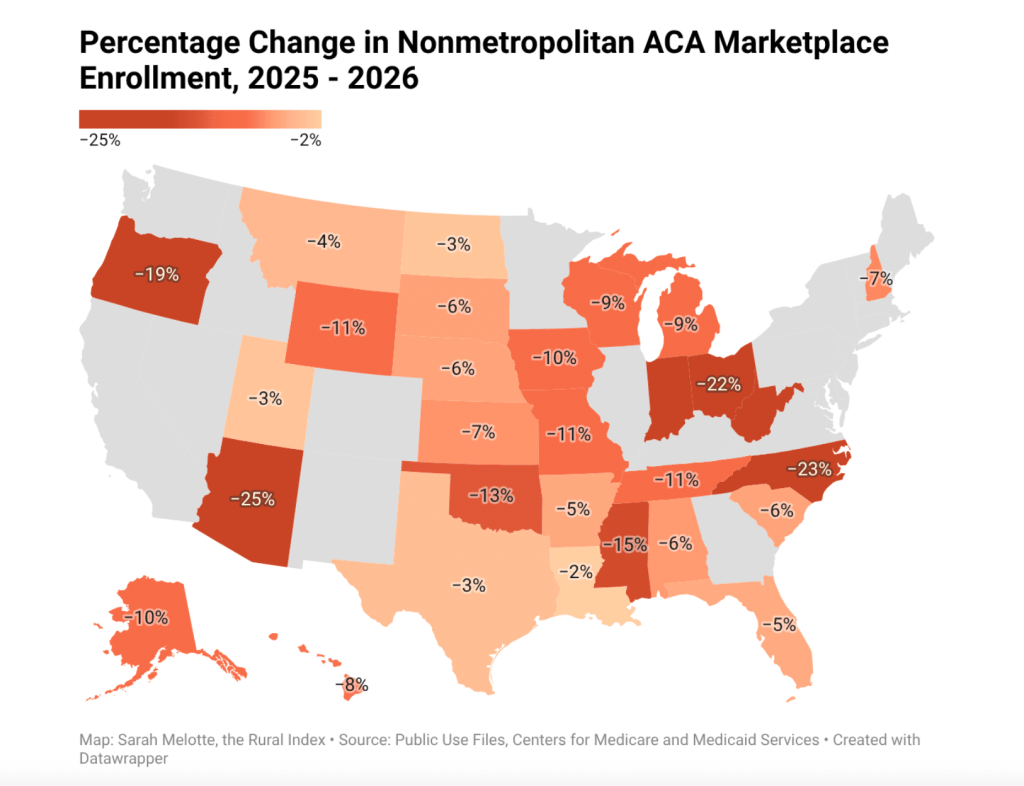
Higher costs changed consumer choices for 2026
The decline likely reflects several forces including higher premiums, changing consumer behavior and the Trump administration’s fraud prevention efforts. But experts say affordability is emerging as one of the clearest explanations for why fewer people are paying to keep their marketplace coverage.
The Trump administration points to fraudulent claims as the reason behind the drop in the numbers. The administration alleges that millions of people reported incomes just above the federal poverty level in order to qualify for subsidies to offset the cost of their coverage.
“The only people who lost coverage were people who were never entitled to coverage,” Health and Human Services Secretary Robert F. Kennedy said during a hearing in late April.
But experts say that doesn’t paint the full picture.
Data shows that the group the administration claimed were dishonestly reporting their income — those making 100% to 138% of the federal poverty limit — actually was larger for 2026.
Instead, people leaving the ACA marketplace are those making higher incomes, where the cuts to the enhanced premium tax credits led to spikes in premiums.
“The million-dollar question is the scale of the fraud evidence,” Lo said. “It really depends on how you look at it — there is no smoking gun explanation.”
The affordability pressures that drove many to drop or downgrade their coverage may not ease up soon.
Insurers are already requesting higher rates for 2027. Preliminary rate requests show marketplace insurers are proposing a median premium increase of 14% for 2027. Although negotiations will likely leave those numbers lower than what insurers requested, next year could mark a second year of double-digit increases, a new analysis of rate filings found.
For those with incomes just above four times the federal poverty level, the costs rose sharply. A 40-year-old in Indianapolis enrolled in an Anthem Silver plan, making $65,000 a year, saw premiums jump from $316 a month with subsidies in 2025 to $477 a month in 2026 without those subsidies, a KFF analysis found.
In 2027, if the requested rates are not negotiated down, that same customer could see premiums reach $546 a month, an increase of 41% in just two years.
For this year, people were forced to either accept higher monthly premiums, move into Bronze plans and take the risk with more expensive deductibles, or leave their coverage altogether.
“If they had a Silver plan in the past, they might have also been getting cost-sharing reductions, which reduce their deductible and also their out-of-pocket costs,” said Linda Sheppard, a senior analyst and strategy team leader at Kansas Health Institute.
“Their Bronze plan is a less rich plan than the Silver plan, just from the get-go, so they were probably having to pay more out of pocket if they were going to go access services,” Sheppard said.
Fewer people covered could increase everybody’s costs
Enrollment usually drops as the year goes on. People could change jobs, gain employer-sponsored coverage or stop paying their monthly premiums.
“We might expect, as we see every year, the enrollment can dwindle a little bit more as the year progresses,” Lo said. “That happens every single year.”
Just because enrollment drops doesn’t mean all of those people become uninsured. Still, for experts like Timothy McBride, the co-director of the Center for Advancing Health Services at the Washington University School of Medicine, the numbers raise a broader concern.
“What worries me about this particular group is where they’re going to go,” McBride said, “because these are people that are not eligible for Medicaid.”
“They’re probably on the marketplace because they don’t have employer coverage,” he said. “So if those doors are shut, where are they going to go?”
If healthier people are the first to leave the marketplace because of rising costs, insurers are left covering a smaller, sicker pool of patients. That can lead to even higher premiums, prompting more people to leave behind their ACA coverage.
“Having insurance is not the end of the story,” Lo said. “Because yes, you have coverage, but there are still a lot of additional health care costs.”
Brenda Sharpe, the president and CEO of Reach Healthcare Foundation, said that’s a concern moving forward. Rising premiums could force many people into plans with deductibles so high that having insurance no longer promises they can afford care.
“A lot of people go a year without making a claim on their insurance because they didn’t need it that year,” Sharpe said. “That’s what insurance is for.”
Those who move into cheaper plans often delay care because of those higher deductibles and other out-of-pocket costs.
“I just don’t think people are prepared for the level of access issues that are going to arise from everyday consumers who have affordability issues,” Sharpe said. “And most especially, those people who have been uninsured or had a marketplace plan.”
If premiums continue climbing into 2027 as insurers request, Sharpe worries more people will decide marketplace coverage isn’t worth the cost.
“I think there’s a lot of concern that people will drop insurance coverage altogether and just hope for the best,” Sharpe said.