



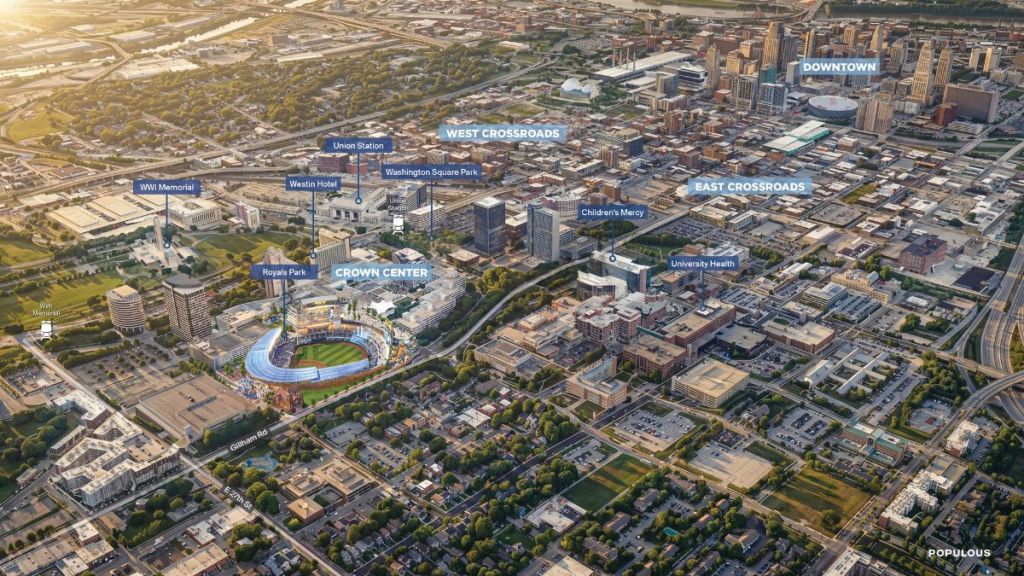
If everything goes according to the Kansas City Council’s plan, the new Royals stadium at Crown Center will drive economic activity in the surrounding area and beyond.
They hope it will inspire more people to spend time and money nearby, encourage new businesses to open and bring greater density and an overall more dynamic vibe in the neighborhoods just south of downtown.
During a presentation at the City Council’s finance, governance and public safety committee on Oct. 6 — just days before the council voted to approve a financing plan for the stadium — City Manager Mario Vasquez said he hopes the project will transform Crown Center and the neighborhoods around it the same way that Kansas City has recently reinvigorated other neighborhoods in the urban core.
“I’m an old-timer — I go back to the River Market area,” he said. “I think about the fact of what it was 30 years ago, and it’s much, much different from what it is today.”
He listed other examples of the Berkley Riverfront, the West Bottoms and the transformation of downtown following construction of the Power & Light District.
“I have seen population pulled away north and south,” he said, acknowledging the city’s sprawl. “It is important to maintain the heart of Kansas City strong. It’s important to invest in the core of the region.”
But with this much taxpayer money in the mix, it’s a gamble.
The City Council voted on Oct. 8 to redirect $1.4 billion of tax revenues over the next 30 years to pay off the debt used to build the Crown Center stadium.
Those tax redirections include the bulk of any sales tax increases in what the city is calling the “stadium impact area,” which is about four square miles around the stadium footprint. (To help you better understand what that all includes, The Beacon created a list of 12 examples of economic activity that will be labeled stadium impact.)
In order for the city — and taxpayers — to come out ahead financially, the stadium will need to hit three big benchmarks.
1. Paying off the debt
Kansas City announced in April that it intended to contribute a total of $600 million to pay for a portion of the new Royals stadium.
But in reality, the city will have to pay more than double that amount.
The city is issuing bonds, a type of debt that governments use to pay for large projects like roads, infrastructure, housing or, in this case, a baseball stadium.
And like any kind of debt, the city will need to pay extra to cover interest over the next three decades.
Interest will add about $800 million to the total cost of the Crown Center stadium, for a total cost of $1.4 billion.
To make its debt payments, the city is counting on the ballpark and surrounding impact area to generate the needed amount of tax revenue each year.
If that doesn’t happen, the city will need to dip into other parts of its budget to make those stadium payments, similar to the way it has been pulling from its general fund to pay back debt on the Power & Light District for years.
Leaders say they’re confident that won’t be necessary in this case.
The city ordered a third-party analysis conducted by Hunden Partners to estimate the total economic impact of moving the baseball stadium near downtown.
That analysis found that the stadium and surrounding neighborhoods like Union Hill, the Crossroads and the Westside would generate $1.4 billion in extra tax revenue over 30 years, which is what would be needed to break even on the debt payments.
Some observers including stadium economists have questioned the predictions because they are unable to recreate the findings without more information about the methodology.
2. Making up for what the city will lose when Kauffman Stadium closes
Right now, the Kansas City Royals are playing games at Kauffman Stadium. And when fans go to games, they’re spending money on tickets, concessions and merchandise.
As things stand now, the city’s collecting millions of dollars in taxes on that spending.
Precise figures aren’t easily available for how much money the Royals are currently generating for Kansas City, but the Jackson County Sports Complex Authority reported in its annual audit that Kauffman and Arrowhead stadiums combined generated a total of $13.1 million in sales tax revenue alone in 2024.
That’s money that is currently going into city coffers for services such as public safety and street improvements.

But once the Royals move to Crown Center, much of that sales tax revenue will instead go to paying back the debt for the new stadium.
That includes all of the food and beverage sales taxes paid on concessions and more than half of the sales taxes paid on everything else.
From the city’s perspective, that is a chunk of money previously included in its budget that will be moved elsewhere.
To break even, Kansas City will need to bring in enough tax dollars from outside the stadium impact area to recoup the millions it had been getting from sales at The K.
3. Ensuring spending is new and not just relocated
Say, for example, that you go out for drinks on a Friday night at Charlie Hooper’s Bar and Grille in Brookside.
Maybe you end up spending $20 on a round of beers. You pay sales taxes, plus food and beverage taxes, which go to City Hall and support the fire department, trash pickup and recycling and swimming pools.
Now let’s say you decide to go to the Crown Center stadium for a game, and you head to Brewery Emperial at 1829 Oak St. afterward, instead of Charlie Hooper’s.
You’re spending the same $20 for your beers. You pay roughly the same amount of money in taxes. But instead of paying for city services, those taxes will pay for the city’s $1.4 billion stadium debt.

The fire department still needs to pay salaries, your trash and recycling still need to be picked up and the swimming pools still need chlorine. But now City Hall needs to dig deeper into its pockets to find the money.
That’s the important distinction here. And it’s why sports economists warn that these stadiums can have an inflated economic impact.
It’s called “displaced economic activity” because it’s economic activity that’s moving around within city limits, rather than being brand new dollars that didn’t exist before.
So if Kansas City wants to break even on its $1.4 billion Royals stadium gamble, the stadium will need to generate:
- Enough tax revenue from the stadium impact area to pay for the debt, totaling $1.4 billion over 30 years.
- At least as much tax revenue as Kauffman Stadium was bringing in each year, outside of the stadium impact area, to compensate for what the city will lose when Kauffman closes.
- Brand new tax revenue within the stadium impact area, meaning money that people would have otherwise spent outside of city limits, not just in a different part of the city.
If the tax revenues do not check all three of those boxes, the city will lose money on the deal.

