


Takeaways
- Kansas City Council voted to approve the stadium impact area, which will funnel eight revenue streams to pay for the new downtown ballpark. That includes any increase in public safety sales tax revenue generated in the stadium area for the next 30 years.
- The public safety sales tax fund is already stretched thin. The council had planned to use those dollars to pay for a new jail, a police station, a community resource center and a tow lot, which together cost four times more than what the tax generates.
- The $1.4 million that the sales tax already generated within the stadium area is not going anywhere. But if the stadium ends up attracting economic activity that would have otherwise happened elsewhere in city limits, that could draw down on the city’s available money.
The Kansas City Council has big plans for transformational investments over the next few years using its freshly renewed public safety sales tax.
A $200 million jail. A $94 million Central Patrol Division. An $89 million community resource center.
But a presentation last month hit council members with a harsh reality check: The money simply isn’t there. The projects, together, cost four times more than the voter-approved tax is expected to bring in.
And the math just became more complicated.
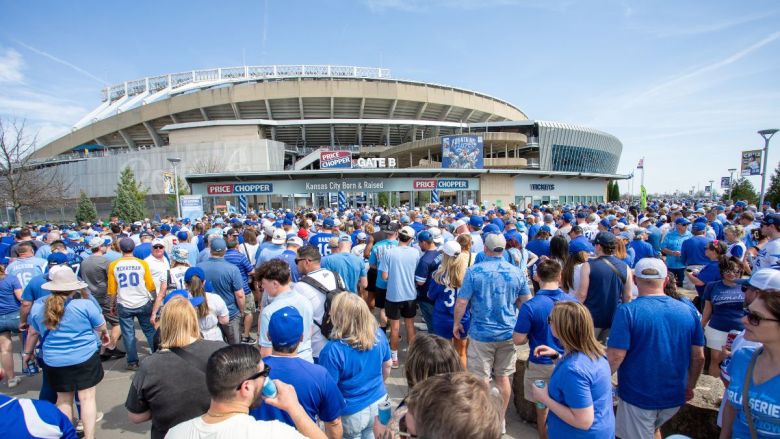
The City Council voted on Oct. 8 to use some of that public safety sales tax revenue to gamble on a new Royals ballpark in Crown Center. Only two councilmembers voted against the measure — Nathan Willett of the northernmost 1st District and Johnathan Duncan of the southwestern 6th District.
“Our shared goal is to create a transformative project that brings both the Royals and Major League Baseball to the heart of Kansas City, lifting our community for generations to come,” team spokesperson Sam Mellinger said in a statement.
If it pays off, the stadium will goose economic activity downtown, leading to a bump in sales tax revenues in Kansas City, including the public safety sales tax needed for those projects.
But if the stadium underperforms — or if it ends up cannibalizing existing economic activity, as many mainstream economists suggest — the city’s public safety dollars could be stretched even thinner.
The stadium finance plan
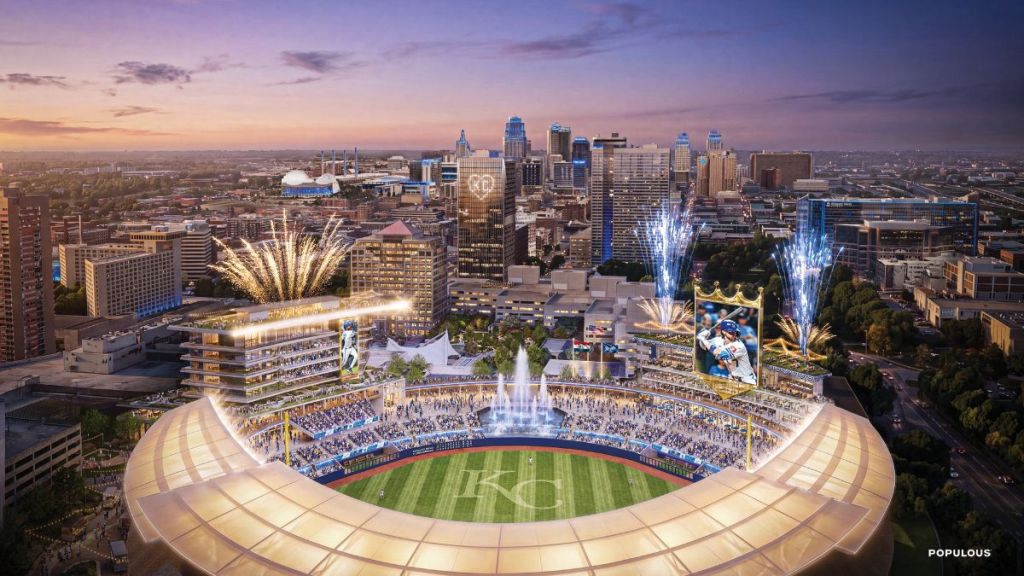
The new ballpark, which will be constructed in Crown Center, will be funded by Kansas City tax dollars as well as money from the state of Missouri.
Kansas City will contribute $600 million to stadium construction, which will add up to a total of $1.4 billion by 2060 including roughly $800 million in interest payments.
The money for those debt payments — averaging between $40 million and $50 million per year — will come from increases in certain tax revenues within what’s called a “stadium impact area.”
Essentially, the city is expecting spending to increase at the bars, restaurants and shops in the neighborhoods surrounding Crown Center, spanning parts of the West Bottoms, the Westside, the Crossroads and parts of midtown. When people spend more money there, that will generate more tax revenue, relative to what the city made in 2025.
Some of the increase in sales tax revenues will be labeled “stadium impact” and will pay for those $45 million annual debt payments.
(For a better understanding of what that means in real-world terms, we found 12 examples of things that the city will consider “stadium impact” over the next 30 years.)
What that means for the public safety sales tax
Kansas City’s tax redirection — which is what the City Council approved on Oct. 8 — includes eight revenue sources.
Among those is the 1/4-cent public safety sales tax that voters renewed in April 2025.
Last fiscal year, between May 1, 2024, and April 30, 2025, that sales tax generated $24 million that the city spent on police, emergency services and public safety improvements.
Out of that $24 million, The Beacon estimates that roughly $1.4 million, or nearly 6%, was generated within the stadium impact area.
How we got there:
According to a city-commissioned analysis of the stadium’s anticipated impact on Kansas City’s economy, the stadium impact area generated roughly $572 million in sales during the 2025 baseline year.
Applying a .25% sales tax rate to that $572 million in sales, the stadium impact area generated $1.4 million in specifically public safety sales tax revenues.
To be clear, that $1.4 million is not going anywhere. For the next 20 years until the tax is on the ballot again, that money is guaranteed to be spent on public safety.
But if the city generates any new public safety sales tax revenue within the stadium impact area, anything above that baseline amount will pay for the stadium instead.
That includes any increase in tax revenue because of inflation, as well as any increase because more people are shopping downtown.
Mayor Quinton Lucas said the city chose to redirect part of the public safety sales tax to the stadium because the new ballpark raises several public safety needs.
“I think there is a very real nexus to public safety needs long-term in this district,” he said. “You will see greater residential activity. I think you will see a greater need for policing services. The fire department has been talking about a new fire station needed in the area because of long-term residential population growth.”
But Duncan, who voted against the stadium funding measure, believes that the city could be making it more difficult to meet public safety needs by redirecting public safety tax dollars to pay for stadium debt.
“Addressing our public safety issues is a core function of any city,” Duncan said. “And for us to divert those revenues to pay for a for-profit business … is a concern. And I wish it were more of a concern to the mayor and my colleagues.”
Would the stadium cut into public safety funding?
Three factors could lead to the Royals stadium actually taking money away from the city’s public safety projects.
The first would be if the Crown Center ballpark and surrounding area don’t generate enough revenue for the city to make its debt payments.
That would force the city to dip into parts of its budget meant for other things, possibly including public safety, similar to the way it’s been pulling from the general fund to help pay back the debt for the Power & Light District. Officials say they’ve been conservative in their planning to make sure that wouldn’t happen with the Royals.
The second would be if the city doesn’t recoup the tax revenue it will lose when the Royals move out of Kauffman Stadium.
There are no precise figures easily available for how much that is, but the Jackson County Sports Complex Authority reported in its annual audit that Kauffman and Arrowhead stadiums combined generated a total of $13.1 million in sales tax revenue alone in 2024.
While those stadiums are still operating, that’s money going into city coffers for services like public safety and street improvements.
But once the Royals move to Crown Center, much of the sales tax revenue previously generated at Kauffman will go instead to the impact area, so the city would need to make that up from other sources outside the stadium impact area.
The third factor is if the money people spend in the stadium impact area is just money they otherwise would have spent in another part of the city.
Say, for example, that you go out for dinner at Friends Sushi on West 39th Street in Volker. The sales taxes you pay on your dinner, including that 1/4-cent public safety sales tax, will end up paying for city services.
But if you decide to go to the Crown Center ballpark for a game, and you get sushi at Kata Nori in the Crossroads instead of in Volker, the sales taxes from your dinner would go toward paying back the stadium debt.
The sales taxes you would have paid on 39th Street are no longer going toward city services.
Since that same economic activity — you going out for sushi — just moved to another part of the city, the public safety sales tax fund would lose out on money as a result of the stadium.
The road ahead for those three public safety projects
The Kansas City Council will need to make a decision on several public safety projects long before it ever knows whether the Royals ballpark gamble paid off.
It’s eyeing four major projects.
First and biggest is the $201 million permanent municipal detention facility, which will cost the city roughly $17 million per year financed over the next 19 years.
Second is the $94 million Central Patrol Division to replace the Kansas City Police Department’s station at Linwood Boulevard and Forest Street. Financed, it will cost $8 million per year for 17 years.
Third, the $89 million community resource center that would provide wraparound services, crisis support and reentry programs. It would cost $8 million per year over 19 years.
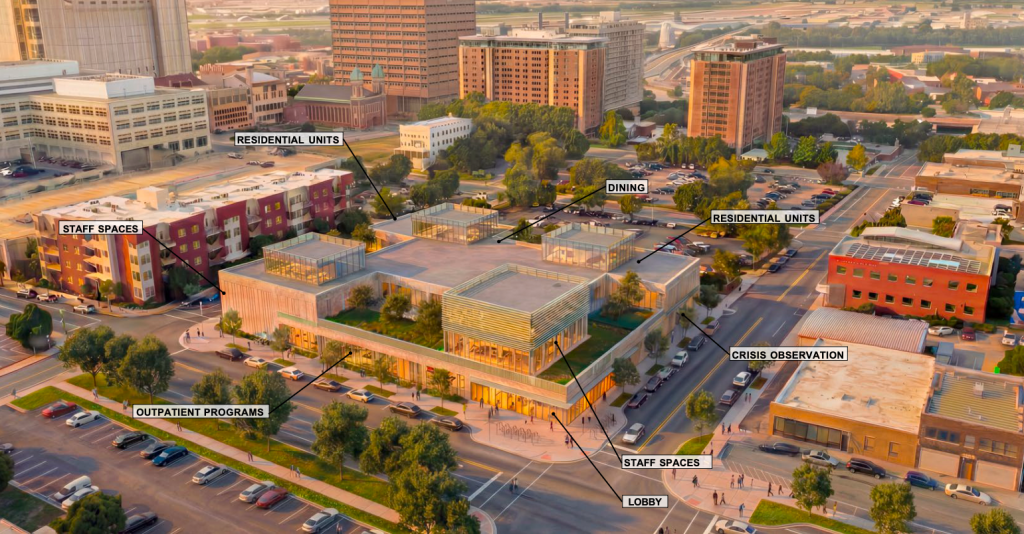
And finally, an $18 million tow lot relocation that is necessary because the newly constructed temporary detention center displaced the city’s existing tow lot. It would cost the city $1.5 million per year over 19 years. That’s on top of the one-time $25 million bill for the temporary jail, which has yet to open.
That totals more than $34 million per year, which is far more money than the public safety sales tax currently generates. Add on the other public safety needs that the tax will need to cover, including police body cameras and existing debt service, and the problem is clear.
While it’s still not clear how much a Crown Center stadium would cut into that funding, costs are only expected to increase.
In the meantime, city leaders like Lucas and City Councilmember Melissa Patterson Hazley have urged staff to “value engineer” the projects to make sure the city’s public safety sales tax can stretch farther.
That includes potentially downsizing plans for large parking structures or expensive design choices.

