



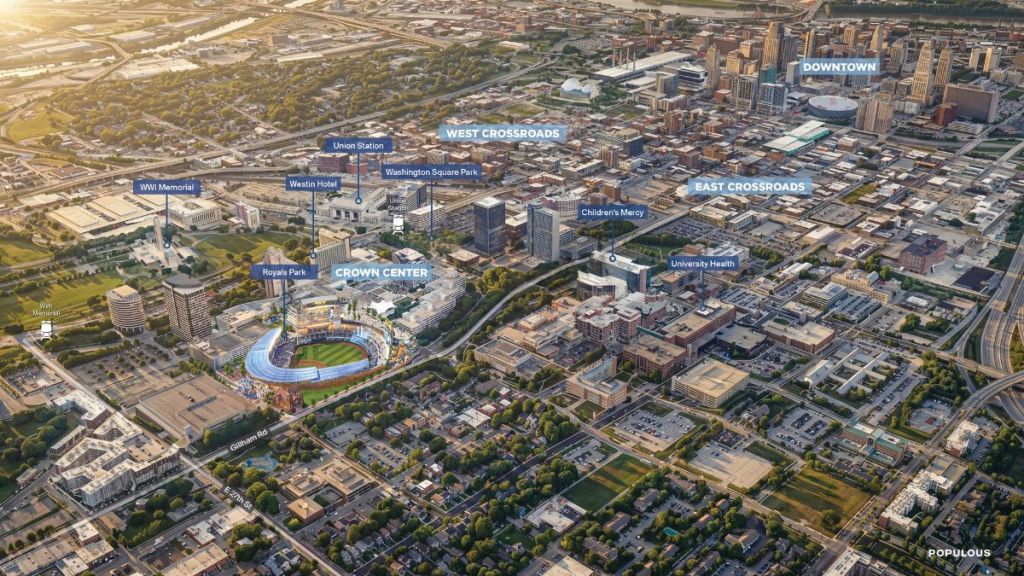
The Kansas City Royals announced on Wednesday that the team intends to stay in Kansas City, Missouri, accepting the city’s offer to help finance a downtown ballpark at Crown Center.
Takeaways
- The Kansas City Royals announced on April 22 that they will stay in Missouri, at a new downtown ballpark located at Crown Center.
- The proposed stadium would be among the most expensive ever constructed for a major league baseball team.
- Missouri officials have not said how much money state taxpayers will contribute to the project, but the number could be in the hundreds of millions.
That announcement comes after a two-year courtship between the Royals and Kansas City, following the overwhelming rejection by Jackson County voters of a sales-tax-funded stadium in 2024.
John Sherman, chairman and CEO of the Royals, said the Crown Center location will include a $1.9 billion ballpark as well as an entertainment district, bringing the total project cost up to $3 billion. He said about $2 billion of the project would be privately financed.
That puts the proposed stadium project as among the most expensive in Major League Baseball history — outranked only by Yankee Stadium in New York and a proposed ballpark for the Tampa Bay Rays in Florida.
“We’re bringing a second crown downtown,” Sherman said. “We will rethink, reimagine, redefine and redevelop Crown Center in an 85-acre-plus setting here that will instantly become the largest sports-anchored downtown development of its kind.”
A previous Beacon story examined the local contribution that Kansas City taxpayers will be making over the next 30 years to pay for the stadium’s construction.
That deal, which is still being negotiated, will require the city to take out $600 million in bonds that will be paid back using tax revenue generated by the stadium and a surrounding development district. That as-yet-undefined district will include Crown Center but is expected to stretch farther.
But that’s not the only part of the deal that will require taxpayer support.
Missouri passed a law last summer that outlines a similar contribution from state taxpayers.
When speaking to reporters after the announcement on Wednesday, Missouri Gov. Mike Kehoe would not give an exact dollar amount, but it will likely total hundreds of millions of dollars.
“This has got to be a good return on investment for taxpayers,” Kehoe said. “If the Royals left, we’d get nothing.”
Missouri’s contribution
The state’s contribution to the downtown ballpark will likely come primarily through the so-called Show-Me Sports Investment Act, championed by Kehoe when he called a special session of the Missouri General Assembly last summer.
That law authorizes the state to provide the Royals with hundreds of millions of dollars over the next 30 years to help pay for construction of the ballpark.
Unlike the city’s deal, which is a tax-increment financing plan, the state’s contribution will be a direct subsidy based on the amount of taxes that are currently generated by Kauffman Stadium.
The Kansas City Council ordinance passed on April 16 directs City Manager Mario Vasquez to submit an application to the Missouri Department of Economic Development to unlock the state funding.
Notably, that department will not formally pledge any money until after it reviews the city manager’s application.
At that point, the state will set a baseline number based on however much money the Royals paid in taxes to Missouri.
In essence, that means that tax revenue the state receives from the Royals ballpark could be redirected back to the team to help pay for the stadium.
However, if the downtown ballpark generates more tax revenue than the current location at Kauffman Stadium, the state will be able to keep the excess. That includes any tax revenue generated from the surrounding entertainment district.
The exact dollar amount is unclear, and Kehoe declined to provide that number when talking to reporters after the announcement.
But in 2024, the entire Truman Sports Complex generated about $40 million, including sales, income, use and entertainers taxes at both Arrowhead Stadium and Kauffman Stadium.
In previous years, that number hovered between $25 million and $35 million, but 2024 was an unusually high year.
Despite the Royals playing more games per year, the Chiefs tend to pay more in taxes than the Royals — in part because Arrowhead Stadium has a higher capacity, and in part because of concerts like Taylor Swift, Beyonce and Morgan Wallen.
Kehoe estimated that the Royals generate between $15 million and $17 million in tax revenue for the state every year.
Importantly, that only includes the state’s taxes. Any taxes that the Royals pay to the city or the county are not included in the baseline number, under last year’s stadium financing law.
That baseline number — somewhere around $15 million or $17 million — is the maximum amount of money per year that state taxpayers will pitch in for the downtown ballpark. The state’s law caps the incentive at 30 years, which is expected to be the length of the Royals’ stadium lease.
Over 30 years, that adds up to somewhere between $450 million and $510 million in state tax revenue.
That number is a far cry from the $900 million that Missouri House Speaker Jonathan Patterson of Lee’s Summit told Fox 4 KC the state could contribute.
“I think if you look at the numbers,” Patterson told Fox 4 KC, “and there was an audit in 2023, the teams generate almost $60 million, and so if you take half of that, then it would be $30 million, then times 30 years, it could be that number. I think those are good estimates that you’re working with.”
It’s unclear what audit he’s referring to in that interview. Official documents from the Jackson County Sports Complex Authority only show the teams generating $35 million for the state in 2023 — not $60 million.
How much are the Royals putting in?
The total cost of the new Royals ballpark is expected to be about $1.9 billion.
Kansas City plans to take out $600 million in bonds to contribute to the project. That number does not include interest. Assuming a 4.5% interest rate, the city will end up spending an additional $517 million on interest payments, for a total of $1.117 billion.
As for Missouri, the state has not confirmed an exact number yet. But if we assume that the baseline tax revenue currently generated by Kauffman Stadium is about $17 million, the state would contribute a maximum of $510 million over 30 years.
But unlike Kansas City’s contribution, Missouri’s number includes interest.
Assuming a 4.5% interest rate, the state’s annual appropriation could theoretically support about $274 million of project costs.
So with Kansas City contributing $600 million and the state contributing $274 million, that leaves about another $1 billion unpaid.
That’s the gap that the Royals will need to close, either by contributing $1 billion themselves or by finding other public subsidies from the state or Jackson County.
At the Wednesday announcement, Sherman estimated that out of the total $3 billion project cost (including the stadium and the entertainment district), two-thirds will be privately funded by the team and other private investors.
“Destiny appears to have its eyes on us,” Sherman said Wednesday. “It’s not how we drew it up, but this is exactly where we wanted to land in our search for a generational home for the Kansas City Royals. … I can’t wait to get to work on this.”

