



Casie Murff has had the entrepreneurial bug for as long as he can remember.
He tried his hand in insurance, in real estate and with an online storefront. Murff worked jobs that paid the bills but didn’t find them fulfilling. So, after some planning, he returned full-time to one of the first side hustles from his youth — cutting hair.
Takeaways
- Business creation has climbed back to pre-pandemic levels, and the rebound is powered disproportionately by Black, Latino and immigrant founders.
- Roughly 6.6 million Americans started a business last year, with immigrants launching at twice the rate of native-born people and Latinos starting at the highest rate of any ethnic group.
- Kansas City now starts businesses at a rate 12% below the national average — a reversal from 2017, when the region outperformed the country.
“I was in IT and in corporate America for 20 years, but I’ve always been an entrepreneur,” Murff told The Beacon. “I always felt like there was something more.”
He opened The BeVel Barber Lounge near 43th Street and Troost Avenue one year ago. This location is a new and expanded version of the shop he previously operated on 39th and Main Street that opened in 2021.
In doing so, he created jobs for himself and his handful of employees. But his aspirations are bigger.
“My mindset is to build an asset,” Murff said. “I don’t necessarily want to create a job for myself. I know at the beginning stages it will be a job, but the whole purpose is to create generational wealth for my family and to help others do the same.”
Murff’s business is one data point in a much larger story.
In May, the Kansas City-based Ewing Marion Kauffman Foundation released a nationwide 30-year report on entrepreneurship. The good news is that business creation in 2025 had climbed back to where it was before the COVID-19 pandemic. That rebound has been powered disproportionately by Black, Latino and immigrant founders starting businesses at a higher rate.
But a closer look at the data shows some concerning trends. Those same immigrant and minority-owned businesses were increasingly started out of necessity rather than out of opportunity — meaning a higher rate of people were starting businesses because they needed income as opposed to merely acting on a good idea or an opening in the market.
Businesses started out of necessity face a steeper climb to success and have higher failure rates, and startup survival rates dropped overall. So while the boom in minority-owned startups is real, so are the headwinds they face.
Economic engine
Joshua Akers, director of research for the Kauffman Foundation, told The Beacon that new business startups are one way to measure economic mobility because they impact both the entrepreneurs themselves and the people who stand to benefit from the jobs they create.
“We know that entrepreneurship is one of the fastest pathways to building wealth,” Akers said. “… The greatest producer, on an annual basis, of jobs in the U.S. economy comes from entrepreneurial startups.”
According to the Kauffman study, roughly 6.6 million Americans started a business last year. Immigrants did so at twice the rate of native-born people. Latinos started at the highest rate of any ethnic group, while Black founders posted the biggest one-year jump in entrepreneurship in 2025.
Carlos Gomez, president and CEO of the Hispanic Chamber of Commerce of Greater Kansas City, says that he sees the trends found in the national study show up locally. Many of the would-be founders his office assists are immigrants from Mexico, Central and South America and the Caribbean.
“Any immigrant coming to the United States — no matter where they come from — tends to be more entrepreneurial,” Gomez said. “… Look at the contributions of immigrants to this country, like Anheuser Busch. Bank of America was founded by a (son of an) Italian immigrant and is the second largest bank in the country.”
He says that anyone willing to leave behind everything familiar and move to a new place is an industrious person, and that helps explain why the group starts businesses at a higher clip than the native-born population.
Gomez says he saw a large uptick in Latino and immigrant entrepreneurship starting with COVID lockdown. He said those represented necessity starts because many Latino workers were among the first laid off from hotel, restaurant and service jobs that shut down. He says many took what they knew and started businesses. A cook started catering. A housekeeper started a cleaning company.
“Since we were the most laid off,” Gomez said. “The only way to make a living and provide was to start a business.”
Akers pointed to another potential accelerant. He said the access to cheap digital tools like online storefronts and payment apps have helped break down some old barriers.
“They open up an entire global economy to people that have an idea and have a product that they can sell,” Akers said. “We see that it’s been particularly beneficial for Black and brown communities, in terms of (business) starts.”
Opportunity start versus necessity start
While minority-owned businesses were started at a higher rate in 2025, the increase in necessity starts means a tougher path.
“If you start a business out of necessity, it’s generally less likely to grow as much, last as long or hire as many people,” Akers said.
Akers stressed hiring as one of the best signs that a business is healthy and doing more than keeping its founder afloat. He said that necessity founders have a harder time getting there. They are often scrambling to catch up and build after being pushed out on their own, with little to fall back on.
The data bears that out. Fewer than four in five new businesses nationwide survived their first year in 2025, down from the year before. At the same time, a greater share of founders started a business out of need rather than by choice in each minority racial and ethnic group the study tracks.
For the Kauffman study, the difference between starting by opportunity and starting by necessity was defined by the founder’s employment status. People who were working, in school or otherwise not unemployed count as opportunity starts; those who were unemployed are counted as necessity starts.
By these definitions, Murff’s business is an opportunity startup. He left a job to start a business after becoming a licensed barber and using a combination of savings, grants, loans and “sweat equity” to get started.
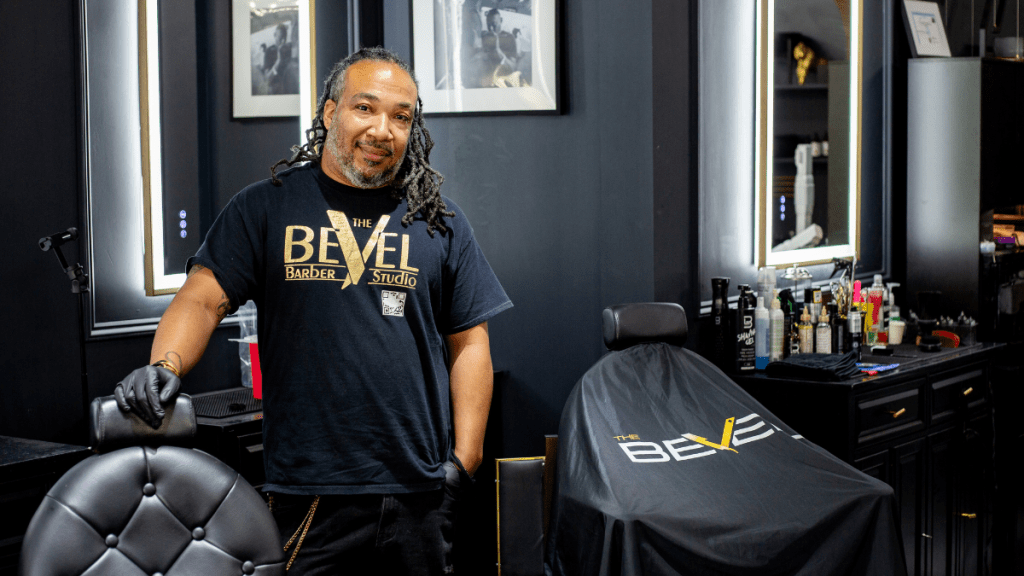
Most barber shops or salons rent out their chairs and barbers drift in when it’s busy and out when it’s slow. Murff put his people — currently a staff of three barbers and a nail technician — on payroll as W-2 employees so he can train, mentor, schedule and build a culture.
Gomez said that while starting a business out of necessity — as the Kauffman study showed Latinos doing at the highest rates — can mean additional challenges, it doesn’t automatically mean failure.
He said that locally the types of businesses the Latino and immigrant populations start have a tendency to be better suited to lasting through the three- and five-year benchmarks.
“The services that the Latino community are offering tend to be things that people need every day,” Gomez said about the businesses broadly. “People need their house painted, they need siding or a roof, they need someone to cook or clean… The businesses we’re starting up are everyday practical services that people need and hire all the time.”
Local headwinds
In the state-by-state data, neither Missouri nor Kansas is a standout. Missourians start businesses at a faster rate than Kansans but lose more of them in the first year. By comparison, Kansans start fewer but keep more alive longer.
The Kansas City area, meanwhile, lags in the rate of people starting new businesses when measured against the country as a whole in 2025.
“Now we know that the gap is 12%,” Akers said. “But we also know that in 2017 we were punching above the national average.”
Akers said that this trend has been building for the past decade, and he and his colleagues are studying it. They are looking into why that gap has developed and how to remedy it.
“Businesses in the Kansas City region fail more often at every stage,” Akers said. “Not only are we starting fewer businesses, it’s harder … and they are failing more often than what you would see at the national average.”
Where a business starts, even within the Kansas City area, can shape outcomes.
In affluent and suburban Johnson County, Kansas, new businesses have stronger compensation and employment outcomes than in Jackson County, Missouri, which includes the urban core.
Still, the biggest hurdles are somewhat universal. Access to capital tops the list and is historically tough for Black, Latino and immigrant communities. Akers says general economic uncertainty is the biggest obstacle across the board for all businesses.
“Uncertainty is the biggest thing. There’s just no certainty in this economy,” Akers said. “There’s no certainty in policy and it’s hard to predict tomorrow, which makes it hard to plan any kind of future.”
Gomez said that current immigration policy is disruptive to the community his organization serves. He said its chilling effect has rippled through the businesses he works with — leaving some short of workers and communities spending less.
“This aggressive immigration policy of deportation is going to negatively impact our businesses and the entire economy,” Gomez said.
Building momentum
Despite headwinds, the Black, Latino and immigrant communities seem primed to continue to start businesses at a high rate.
Help is there for founders who seek it. Murff pointed to mentorship and a network of organizations that aided him along the way — counting groups like Kansas City G.I.F.T., the Prospect Business Association, Porter House KC and the Heartland Black Chamber of Commerce among them.
“Being around the right circle … organizations and people that have the same mindset, it’s really iron sharpens iron,” Murff said. “They may or may not be doing the same thing that I’m doing, but they are going down the same path and following their dreams.”
Gomez doesn’t expect the wave to crest anytime soon. He says entrepreneurship is cultural and generational in the community he serves. He pointed to a poll of graduating seniors that found Hispanic high schoolers were twice as likely to say they are going to own a business someday.
“It’s kind of in the culture to be an entrepreneur,” Gomez said.
Akers said the rising failure rate of new businesses, while sobering, also highlights a strength in the U.S. economy — the ability to try, fail and try again without being written off.
“You can go for it, and you can try, and you can fail, but that doesn’t mean you are marked forever as a failure,” said Akers, who previously worked in Detroit. “One thing I’ll always tell people is how many car companies Henry Ford had before he had Ford … It wasn’t right out of the gate, he failed multiple times.”
For Murff, the road ahead is about growth and scale. He wants to turn the Troost shop into a template he can repeat — with possible new locations, a beauty supply store or maybe even a barber school in the future — leaving room for up-and-coming barbers who could one day run shops of their own.
“There’s no company that’s loyal to their employees anymore,” Murff said. “I just want to create something that nobody can take away.”
Disclosure: This story is based in part on research produced by the Ewing Marion Kauffman Foundation, which is a financial supporter of The Beacon. The Beacon maintains editorial independence. Funders do not dictate what we cover or how we report news.

