


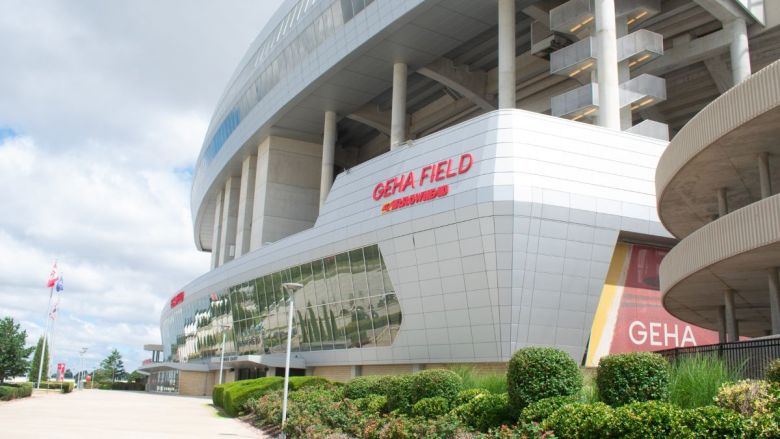
When they voted in February to approve hundreds of millions of dollars in public subsidies for the Kansas City Chiefs, Wyandotte County officials wanted to make sure they would not be left out of oversight for the new Chiefs stadium.
Now, four months later, at least one state official is saying the county has not yet earned a spot at the table.
Rep. Sean Tarwater, a Republican from Stilwell in Johnson County, said that although Wyandotte County approved its $450 million subsidy for the Chiefs, a provision in that ordinance bars the county from having representation on the newly created Kansas Sports Facilities Authority, which will own the stadium.
That sports authority, created by HB2466 in April, will own the property for the new Chiefs stadium, oversee its administration and decide how to spend the $7 million per year that the team will pay in stadium rent to the state.
But several elected leaders at the Unified Government of Wyandotte County and Kansas City, Kansas, disputed Tarwater’s claim and believe the county’s contribution makes it legally entitled to a seat on the sports authority board.
“We’re in a good place with the state,” said Christal Watson, the mayor and CEO of the Unified Government. “And when I say state, we’ve been working directly with the governor, lieutenant governor’s office. … I understand (Tarwater’s) concerns, but I’m sure they understand ours.”
Three different STAR bond districts
The biggest portion of the Kansas subsidy for the new $3 billion Chiefs stadium complex will come in the form of sales tax and revenue bonds, or STAR bonds.
That’s a tax incentive specific to Kansas wherein the government uses new sales taxes generated by an attraction like a Chiefs stadium to pay for its construction.
First, the government draws a STAR bond district around the planned development where sales taxes will be collected.
It then calculates the baseline level of taxes generated by the area before development begins.
Then the government will sell bonds to investors — in other words, taking out a loan — and use any increase in sales tax revenue above the baseline to pay off the debt.
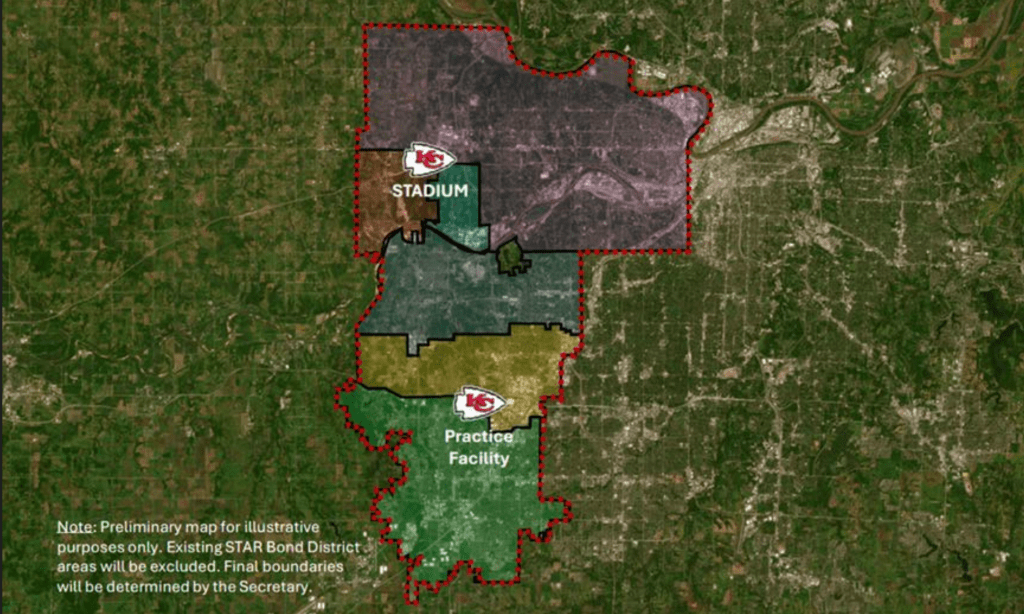
A key detail here is that there will be three different STAR bond districts involved in the Chiefs stadium deal:
- Kansas will create a STAR bond district that will redirect money that would otherwise go to the state’s budget. That district will be drawn broadly enough to support $1.8 billion in bonds for the Chiefs.
- Olathe approved a STAR bond district that will redirect money that would otherwise go to Olathe City Hall. That district will fund $400 million for the Chiefs headquarters complex.
- The Unified Government approved a STAR bond district including about 236 acres on the northeast corner of State Avenue and 126th Street that will redirect money that would otherwise go to the combined government of Wyandotte County and Kansas City, Kansas. That district will fund $450 million for the stadium.
At the time, Unified Government commissioners were concerned that if they didn’t voluntarily sign on to a local STAR bond contribution, the state would impose one on them.
And even if they did create a local STAR bond district, the commissioners were concerned that the state would go back and revise the district boundaries, effectively giving away more of the county’s tax dollars without the Unified Government’s permission.
“If you include the whole county in our local increment,” said District 5 Commissioner Carlos Pacheco, “then all of a sudden we’re talking about way more than what we thought we were getting into. That’s a whole different story.”
So the commissioners added a provision saying that if the state decides to redraw the Unified Government’s STAR bond district — for example, to include portions of downtown KCK or areas around the Legends shopping center — the commission will automatically withdraw its offer.
But the Unified Government’s protective measures have ruffled some feathers in Topeka.
Disagreement over Wyandotte County’s contribution
At its core, the dispute between the Unified Government and lawmakers like Tarwater focuses on a specific provision of the state law creating the sports authority, a new governing body to oversee the stadium.
The sports authority will have an 11-member board, including one person appointed by Watson and one appointed by Olathe Mayor John Bacon.
Olathe and the Unified Government only get their representatives if they sign on with their own local STAR bond deals. Both did in February.
But the law also says that they cannot make their STAR bond contributions conditional in a way that would limit the state’s ability to draw the boundaries of its own, larger district. (The state has not yet established the boundaries for its STAR bond district.)
Tarwater believes that the Unified Government has done that.
“When I had my conversation with the mayor recently,” he told Fox4, “she was really unaware that it was not done correctly, and so I think it’s an easy change.”
Reached by The Beacon, Tarwater had a slightly sharper tone.
“They knew unconditionally what they were doing going into it. They didn’t make the change,” he said. “Not only did they not change it, but they said they wanted eight new bridges too, and they made a pretty big production out of it.”
But several members of the Unified Government commission believe that Tarwater is wrong.
As Tarwater said, the commission was concerned about a state STAR bond district that covered large swaths of the county because they believed it would make it harder for the Unified Government to get other STAR bond projects further down the line.
Importantly, that concern did not make it into the final ordinance. Pacheco said they ultimately decided not to press the issue.
“Knowing that if we were to perhaps limit the state portion of things,” Pacheco said, “they were probably going to balk at it, and then we were going to have difficulty with further negotiations. So I thought, you know, if anything, we protect our (local sales taxes). That’s the thing that matters the most.”
Pacheco told The Beacon that nothing in the ordinance attempts to restrict the state’s STAR bond district. The ordinance only restricts the state’s ability to revise the Unified Government’s STAR bond contribution.
UG Commissioner Andrew Davis, who represents District 8, agreed that the ordinance the commission approved does not include any restrictions on the state STAR bond district boundaries.
(Davis voted against the ordinance because he felt the rushed timeline didn’t allow Wyandotte County to have any real negotiations with the team. Pacheco voted yes.)
Why the seat on the board matters
The sports authority is the government body that will own the stadium and oversee its construction and operations.
It was created at the request of the Chiefs because if a public body administers the stadium, the team can avoid income taxes on its bonds.
That tax break could be worth $1 billion for the team, in addition to nearly $2.7 billion that the team will receive in sales tax subsidies from Kansas, the Unified Government and Olathe.
But one important role that the sports authority board will play is determining how to spend hundreds of millions of dollars in rent over the 30-year term of the Chiefs stadium lease.
As part of the deal, the Chiefs will pay $7 million in annual rent to the sports authority. That money will be paid into a “repairs, maintenance, management and operations” fund that will be overseen by the “government owner” — meaning the sports authority.
While the details remain to be seen, the sports authority board will likely take votes on how to spend that money in the stadium.
The Chiefs will have a representative on that board — in essence, helping decide how their landlord will spend their own rent.
In addition to the Chiefs representative and the mayor appointees from Olathe and Wyandotte County, the following state officials will also appoint members to the board:
- The governor
- The president of the state Senate
- The Senate majority leader
- The Senate minority leader
- The speaker of the House
- The House majority leader
- The House minority leader
- The state secretary of commerce.

