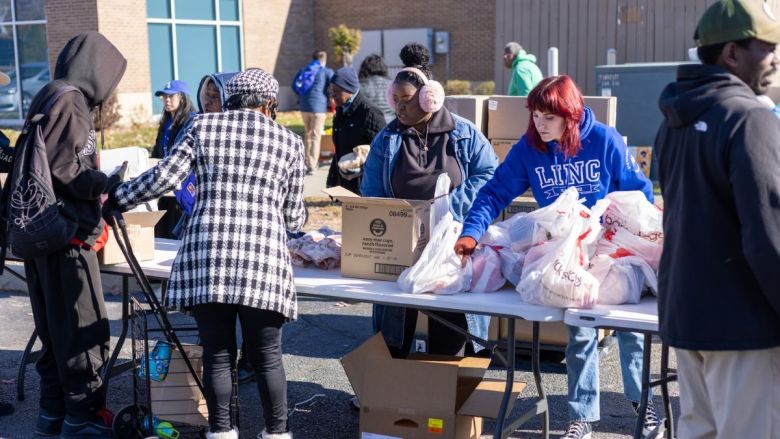
The groceries people want the most from the Texas County Food Pantry in Missouri are often the hardest for it to get: high-priced items like meat, eggs and milk.
The pantry serves about 400 households a month in rural southern Missouri, relying on donations and a small thrift store to help keep food on the shelves for the county of about 25,000.
“The most expensive things are the things that they would like the most,” Director Laura Crowley told The Beacon, “which are the things we get the least of.”
As Missouri pantries prepare for the holidays, they are helping households cover grocery costs even as fewer people receive federal food assistance under the Supplemental Nutrition Assistance Program, or SNAP.
Starting Oct. 1, the state’s Family Support Division, which runs the program, expanded verification requirements for SNAP recipients in Missouri. Applicants and beneficiaries are now asked to provide documented proof for certain household expenses. This comes after the expanded work requirements for adults aged 18-64 on SNAP, which happened in November 2025.
Advocates of ending hunger say Missouri’s new mandated paperwork and the program’s tighter requirements are making SNAP more difficult to access, leaving more Missourians without enough to eat and requiring charitable organizations to help fill the gaps.
The changes signal a shift in the wrong direction, the advocates say, following recent years when Missouri made inroads on its food insecurity rates across the state.
In 2019, approximately 865,000 Missourians were considered food insecure, according to the Missouri Hunger Atlas. By 2023, that figure had dropped to approximately 715,000.
But by the end of 2025, it jumped even higher than 2019’s figure at 951,330.
What pantries can put on the table
Crowley’s pantry is the largest in Texas County and one of few in the state that are open four days a week. Combined with another smaller pantry which serves about 90 households, they manage the bulk of food assistance across the county.
It’s also unique because families can visit the pantry and shop the shelves, as opposed to getting a premade package of grocery items, Crowley said.
“They’re able to take a cart and go around… they’re able to take what they want, as opposed to we box it up and it includes some things that they can’t eat or don’t like that go to waste,” Crowley said.
The pantry gets donations through Ozarks Food Harvest and collects donations from Walmart three days a week. Those donations are mostly produce, with some dry goods and bakery items.
Meat, eggs and dairy, though, are especially difficult to get. For example, they place orders for meat to Ozarks Food Harvest, but don’t always receive it.
“We don’t always get what we order because they have a hard time getting it as well,” Crowley said.
Overall, Crowley said she hasn’t seen a major uptick in new faces since new changes to the SNAP program took effect in Missouri at the beginning of October.
“I have not really noticed a change,” Crowley said. “We do our numbers each month, and everything has been pretty steady for the year.”
Up north in Mexico, Missouri, The Help Center is starting to see some changes. The pantry serves 550 to 600 households monthly while holding distribution twice a week.
Kim Archer, who runs the program, said that over the past few years she’s seen more older adults coming, recently including some first-time visitors and people who haven’t been into the pantry for several months.
It’s a typical pattern she’s observed over the years: an uptick toward the holidays, with additional upswings in the summer months while kids are out of school. She also notices older adults using the pantry more in the winter.
“We’ve had a few people that have lost their SNAP benefits altogether,” Archer said. “Like I said, they haven’t been here for several months, and now they’re coming in monthly because of it.”
To prepare for the holidays, local food drives bring in popular ingredients like mashed potatoes, vegetables, stuffing and gravy. In Mexico, a local company donated 30 turkeys to be distributed to pantry recipients through drawings for the holidays.
More SNAP applications, fewer approvals
SNAP enrollment has dropped in Missouri since provisions from H.R. 1, or the Trump administration’s One Big Beautiful Bill Act, took effect.
About 52,700 fewer Missourians received SNAP in October than a year earlier, an 8% decline, according to state data.
Enrollment in the program in Missouri has dropped from nearly 660,000 people in October 2025 to just over 607,000 in October 2026. But applications for assistance increased.
Missouri received nearly 46,000 applications in October, about 6% more than a year earlier. It approved about 24,000 of them, a drop of about 20%.
The state also rejected fewer applications and processed about 9,300 fewer overall.
For Christine Woody, the food policy manager at anti-poverty organization Empower Missouri, the increase in applications challenges the idea that declining enrollment means the need is less across Missouri.
“Just looking at the numbers, you can see that something’s not working right,” Woody said.
She said Missourians are running into problems receiving notices, reaching the department and documenting their work.
“They’re not able to come up with the paperwork that they need to prove that they’re a gig worker,” Woody said. “And they’re trying to figure out how to show proof that they’re doing it.”
Missouri says its additional verification requirements are intended to reduce payment errors ahead of new federal costs, the Missouri Independent reported. The state chose to require the extra documentation for household costs, but federal law does not require verification of all of those expenses and resources.
Under H.R. 1, states’ share of SNAP administrative costs increased from 50% to 75% starting in October 2026. Separately, starting in October 2027, states with payment error rates of 6% or higher generally will be required to cover between 5% and 15% of SNAP benefit costs.
More paperwork for SNAP enrollees and applicants also means paperwork for agencies like the Family Support Division, said Gina Plata-Nino, the director of SNAP policy and advocacy at the Food Research & Action Center.
“That creates a barrier where you’re not necessarily changing eligibility, but you’re making it more difficult to access the program,” Plata-Nino said.
A tightening budget
Higher costs for running programs including SNAP and Medicaid affect all Missourians, not just beneficiaries of the program, Plata-Nino said.
That’s because they’ll need to pull more resources from the state budget, which is already facing a massive shortfall. Last week, reports surfaced that Missouri faces a nearly $3 billion gap between state spending requests and available revenue for fiscal year 2028.
“Even for non-SNAP recipients, when these funds are taken up in other spaces, many other priorities from the state will suffer,” Plata-Nino said.
For now, Missouri is eking by with a preliminary error rate that falls just below the 6% error rate threshold for needing to pay more into the program, the Missouri Independent reported last month.
Still, Woody is concerned about what the budget constraints mean for the state of Missouri.
“That’s their bottom line — is to not have to pay this extra money. And to do that, if you cut people off, they’re either not on the program, and not counted in the error rate,” Woody said. “They’re getting rid of those cases that could cause, potentially, an error, and they can’t be dinged for it.”
Woody said the data tells the story: Applications are up while approvals are down.
“The data shows you that it’s not like the economy is doing better and no one needs this program,” Woody said. “It’s something else, and I think that something that has changed is the increase in paperwork, the increase in verification.”
“Those are the things that changed,” she said. “It’s not the lack of need.”