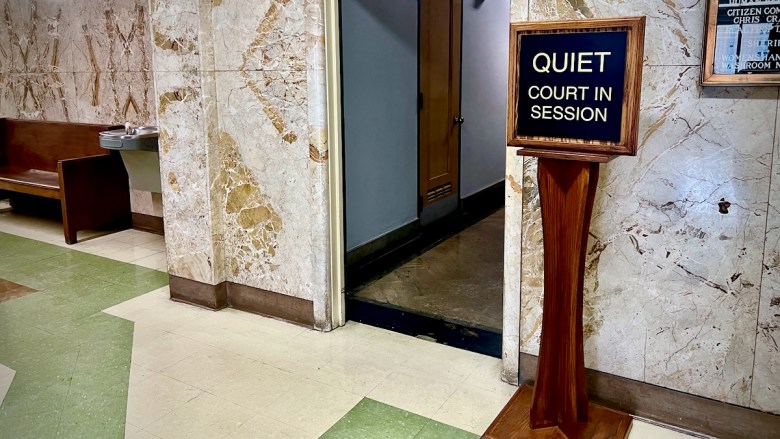
On Tuesdays at 9 a.m., Jackson County Circuit Judge R. Travis Willingham’s downtown courtroom fills up with defendants who are often guilty.
They are guilty of missing credit card payments, falling behind on small loans or failing to pay down something bought on credit.
Occasionally, though, the people who end up on Willingham’s high-volume collections docket are guilty of getting sick and not paying the bill that came later from a hospital or doctor.
Patient advocates said that kind of guilt is showing up more often in jurisdictions across Missouri and Kansas as medical costs rise and the share falling on patients — even patients who have insurance — increases.
Recent national reporting about Kansas’ junior Republican U.S. Sen. Roger Marshall has raised broader questions about the ethics and methods of collecting such debt.
The New York Times reported that, as a private obstetrician-gynecologist a decade ago, Marshall charged his Barton County patients 18% interest on unpaid bills, took them to court and sought bench warrants when they didn’t show up. The newspaper counted 81 times when Marshall’s patients were arrested.
Defense lawyers in the Kansas City area said bench warrants in debt collection cases aren’t common here. But they do see people being sued over unpaid medical bills on a regular basis.
Often, if a patient fails to show up to a court hearing for any number of reasons, the court issues a default judgment, which can lead to the creditor garnishing the patient’s paycheck or placing a lien against their property.
“Sometimes,” said Katy Kettler, the attorney who oversees the Consumer Protection Unit at Legal Aid of Western Missouri, the patients “don’t know about this until their check gets garnished or their bank account gets garnished.”
That seemed to be a likely outcome for a Platte City resident contacted by The Beacon last week. Told that she had been sued by NKC Health, formerly North Kansas City Hospital, over a $2,800 debt and summoned to an Oct. 15 hearing in Platte County Circuit Court, the woman sounded stunned.
“What?!” she said, before trailing into silence.
Getting sent to collections can cause cascading financial and medical harms to people just trying to stay afloat, say patient advocates who are calling on policymakers to put guardrails around collection practices for medical debt, something people often can’t avoid or plan for.
“We’ve been conditioned … to believe that every instance of medical debt is an instance of financial mismanagement by a patient,” said Mary Shannon, a co-founder of Care Over Collections, a nonprofit working to help shine a light on medical debt in Missouri. “It is treated like discretionary spending, like this person overspent on a handbag they couldn’t afford, or a Carnival cruise for the family. And not that they were seeking healthcare.”
Kansas City-area hospitals have sued hundreds of patients over medical debt this year alone, according to an informal review of court records, with some more litigious than others.
And while any hospital with nonprofit status is obligated to determine whether patients are eligible for financial assistance before taking them to court, several lawyers told The Beacon that’s not always happening locally, on both sides of the state line.

The scope of the problem
Medical debt is ubiquitous. Well over one-third of U.S. households have it, including past-due bills, payment plans with a provider, health bills charged on a credit card or a loan to cover doctor bills. In 2024, KFF, a national leader in health policy, estimated that across the country 20.4 million adults, including many with health insurance, collectively owed at least $220 billion.
Care Over Collections, which is cataloging medical debt court cases in Missouri, has counted 3,378 lawsuits filed since 2023 in seven judicial jurisdictions. The organization plans to continue working its way through all of the state’s 46 circuit courts.
Cases cataloged so far involved $4.7 million in medical debt judgments against defendants who were most often not represented by an attorney, according to the nonprofit. Since such cases are handled in civil, not criminal court, defendants are not entitled to legal representation.
Roughly 64% of the time, the cases the group tracked ended in default judgments, meaning the defendant did not appear in court. And over 70% led to wage garnishments.
It’s clear, Shannon said, that these cases are just a taste. Some counties have so many, courts have set up regular medical debt dockets to handle them.
“In Madison County (in southeast Missouri), on the third Wednesday of the month they’ll hear 100 cases,” Shannon said. “And they’ll do 100 cases next month and 100 the following month.”
The same pattern can be seen in Kansas.
“Hospitals are suing people every day in every court in the state today,” said Matt Keenan, executive director of Kansas Legal Services Inc. “I’m talking about nonprofit hospitals suing working Kansans every day of the week all over the state.”
Only some hospitals sue
The approach hospitals take to debt collection varies widely because, for the most part, every medical practice or hospital can establish their own policies. There is no legislated standard.
In the Kansas City area, NKC Health and the University of Kansas Health System, which owns the University of Kansas Hospital, Liberty Hospital and Olathe Medical Center, sue patients over unpaid bills. But St. Luke’s Health System, AdventHealth and the city’s five HCA-owned for-profit hospitals do not.
NKC Health, the area’s only independent hospital, has filed 92 debt collection lawsuits in Missouri courts so far in 2026, according to a cursory count of cases in the state’s court database. A search for the University of Kansas Hospital turns up around 218 medical debt cases filed this year in Missouri, including 124 in Jackson County. In Kansas, 114 cases show up in that state’s court database. Those counts are, at best, rough estimates.
In a written response to questions, NKC Health Chief Financial Officer Austin Jones explained that the hospital’s use of “extraordinary collection activities,” such as garnishing wages or placing liens against patients’ assets, is “rare,” but did not provide specific numbers.
Following up on questions from The Beacon, the hospital’s Senior Director of Marketing Amy Schemenauer said in an email, “We don’t have any reports we can run to provide that answer. But anecdotally, it is likely less than 0.01%.”
Jones wrote that the hospital would only take those steps following “an extensive process” trying to qualify patients for free or discounted care, set up interest-free payment plans and search for alternate sources of coverage.
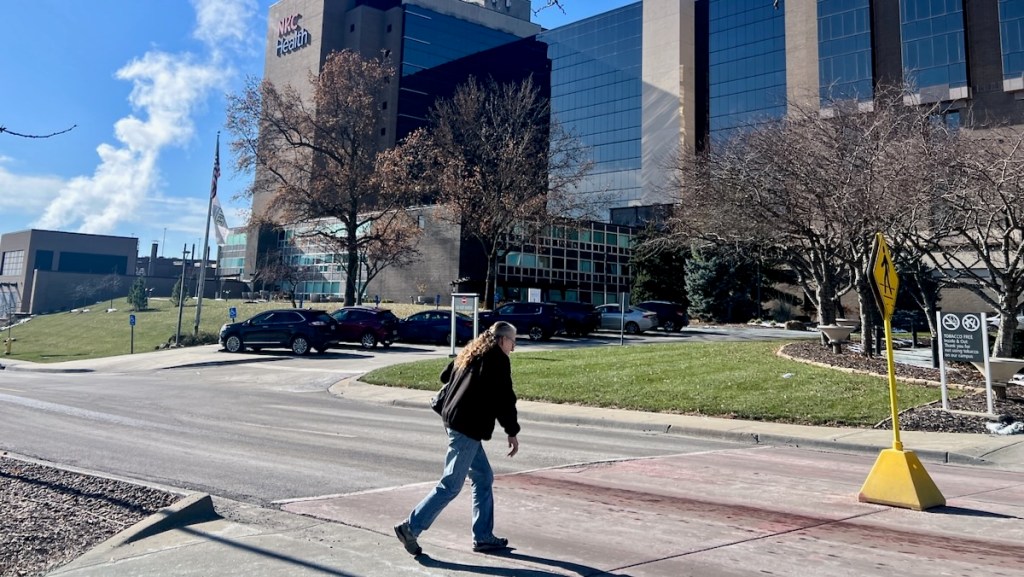
Colette Lasack, KU Health System’s vice president of revenue cycle, said going to court is the last resort. The health system’s policy is to send four billing statements over a 120-day period. It also looks for available insurance options, investigates if the patient qualifies for free care or other discounts by checking credit agency data and other available information and offers interest-free payment plans for up to five years to any patient who needs more time to pay off a bill. Only if those efforts fail will a bill be sent to collections and possibly end up in court.
“If there’s anything we can glean from our data that tells us this patient might qualify for charity,” she said, “we want to act on that.”
It’s clear some patients can be overwhelmed financially, Lasack said. They may have bills from other hospitals that KU Health System doesn’t know about, or face other extenuating circumstances making payment difficult.
“Sometimes patients are scared,” she said. “Sometimes they’re like, ‘Oh my gosh, I should be able to handle this.’”
But she wants patients to know that reaching out to the hospital is always a better approach than ignoring bills, messages and phone calls.
“The message for patients is, pick up the phone and call us,” Lasack said. “Let us know what’s going on because we’re here to help.”
It’s only when the health system determines that patients can afford to pay but don’t that bills are sent to collections and may end up in court.
“We have a responsibility to collect from patients who are able to pay,” Lasack said. “Just like any business, at the end of the day, we’re here to provide great care, but we can’t provide that great care if we don’t cover expenses. And part of covering expenses is collecting.”
Some legal requirements
In exchange for their tax-free status, nonprofit hospitals are required by federal law to offer charity care and financial assistance to patients who need it. How much free care they provide and how it is quantified is largely left up to the hospitals. Only a handful of states have laws with more specific requirements. Kansas and Missouri aren’t among them.
But evidence suggests that many hospitals aren’t doing enough for patients who need help.
The Lown Institute, an organization that studies and rates hospitals, found that more than three-quarters of the 1,773 hospitals it evaluated spent less on charity care and community investments in 2020 than the estimated value of their tax breaks.
That deficit, which amounted to $14.2 billion, could have wiped out medical debt for 18 million Americans, the organization found.
When it comes to financial aid and free care, nonprofit hospitals are obligated to comply with some specific guidelines.
Under the law, they must have a financial assistance policy that applies to emergency and “medically necessary” care. The law also specifies what must be included in the policy, such as any “extraordinary collection actions” used, and says that policies must be “widely publicized.” The law requires hospitals to determine whether a patient qualifies for assistance before suing.
But Casey Johnson, director of advocacy and litigation with Kansas Legal Services, said hospitals often fail to live up to that obligation. Providers have told his agency’s medical debt clients that the patient should have taken the initiative to apply for charity care.
“But that’s not what the law says,” Johnson said. “The law says (hospitals) have to try to make a determination if people qualify — before they sue them.”
Many people struggling with medical debt simply don’t know they have an option for getting help, he said. Or they don’t learn about their debt until after they’ve already missed a court date.
A worsening problem
Nancy Davidson, an attorney with Kansas Legal Services, said she regularly sees clients who end up with a default judgment and watch 25% of their paycheck vanish after their wages are garnished. Problems spiral from there.
“You start getting garnished, and then you start falling behind on everything else, and then you may end up in this docket on an eviction,” Davidson said.
A 2022 KFF survey found that about half of adults, including 30% who already have medical debt, were at risk of seeing their finances upended by a new medical bill, even one as small as $500.
According to the survey, one-third of people with medical debt expect to pay it off within a year, a quarter said they would pay it off in one to two years, but nearly 20% doubted their ability to ever pay it off.
“There’s a misalignment between what people have and what they’re asked to pay … and that’s growing,” said Allison Sesso, president and CEO of Undue Medical Debt, a nonprofit that buys discounted medical debt and pays it off for patients. “It’s a frivolous act to try to collect from people who don’t have it.”
But the problem is likely to get worse.
As new Medicaid requirements take effect next year and private health plans — including those sold on the Affordable Care Act marketplace — become less affordable, thousands of people in Missouri and Kansas are expected to lose coverage. Some estimates predict that 14 million Americans will become uninsured by 2034.
Area hospitals already see the pattern: Patients come in without insurance or can’t afford high deductibles and copays and end up with unpaid bills.
And it’s clear that worries about medical expenses are no longer relegated to people with little or no financial cushion. Dr. Vikas Saini, president of the Lown Institute, expects to see more people across the income spectrum facing medical debt burdens.
“Either the prices have to moderate and come down, or insurance has to cover more,” Saini said.
The real fix, he said, involves addressing a wider problem.
“We need to reorganize health insurance so that everybody’s covered and the question of how doctors and hospitals and everybody else gets paid doesn’t land on the lap of working people who are struggling,” Saini said.

Medical debts are different
In Willingham’s courtroom on the seventh floor of the Jackson County Courthouse, medical debt cases mix with other consumer debt as if they are the same. On Sept. 22, of the 90 cases heard, two were brought by the University of Kansas Hospital, the only obvious healthcare plaintiff. But Willingham said every week he sees a few on the docket.
Medical debt also hides in small loans or credit card debt. And sometimes it shows up directly as a medical credit card, promoted to patients by a medical practice or hospital. The payment option lowers risk to providers by shuffling all of the patient’s responsibility onto a credit card. That increases debt for patients by sometimes adding daunting interest payments to an already unaffordable bill.
Prime Healthcare-owned Providence Medical Center in Kansas City, Kan., and St. Joseph and St. Mary’s medical centers in Missouri, promote a healthcare credit card on their websites, illustrating just how entwined medical and consumer debt have become.
But medical debt, patient advocates warn, is fundamentally different than a credit card balance run up with restaurant tabs and online shopping. And it shouldn’t be treated the same, they said.
For one thing, healthcare is not a choice. It’s a necessity that can’t be avoided. And its price can be unpredictable, confusing and amorphous, a difficult cost to place neatly in a household budget — especially one built on thin paycheck-to-paycheck margins.
Among consumer and healthcare advocates, calls are growing for reforms to make clear the distinction and protect people from adverse outcomes that can follow medical debt. Reforms will likely need to come at the state level, but little has been done so far.
The Medical Debt Policy Scorecard, published by Innovation for Justice, recommends policies to reduce how often people incur medical debt, to help them resolve debt out of court and to improve outcomes when someone ends up in court without a lawyer.
The group also wants reforms that would put an end to wage garnishment, liens on primary residences, seizures of bank accounts and arrests.
But progress is clearly slow.
Only seven states earned more than 50 points on the organization’s 100-point scorecard scale. Missouri, with a score of 45.75, and Kansas, with a score of 43.75, both fell in the “weak” category, along with most other states.
Ryan Pferdehirt, a medical ethicist with Kansas City’s Center for Practical Bioethics, believes that the commoditization of healthcare — treating it as any other business transaction — is at the heart of what needs reform.
“When the patients are customers and the providers are providing a service, it’s just a contract,” Pferdehirt said. “It’s just a business relationship.”
But doctors aren’t just providing a service. They’ve taken an oath to take care of their customers and to “do no harm.” It is worth asking, Pferdehirt said, if taking a patient to court for failing to pay a bill meets that obligation.
“Would a good, virtuous person send someone to collections for $100, $500 or $1,000?”