


Some people simply can’t stomach dining solo or sitting in a movie theater all alone.
Takeaways
- Kansas City let just 16 establishments serve alcohol until 5 a.m. as a temporary World Cup experiment, and The Quaff is one of them.
- A reporter spent nearly 10 hours observing the room to see whether the World Cup extended bar hours pay off for workers and whether it’s safe for visitors and locals alike.
- Most travelers said they were in for a single match and gone quickly, suggesting busy one-off nights rather than a six-week windfall.
I can.
Last week, I spent nearly 10 hours by myself at a storied dive bar downtown. On a Tuesday night. Until 5 a.m. Wednesday.
But hold your judgment or applause — it was all for journalism.
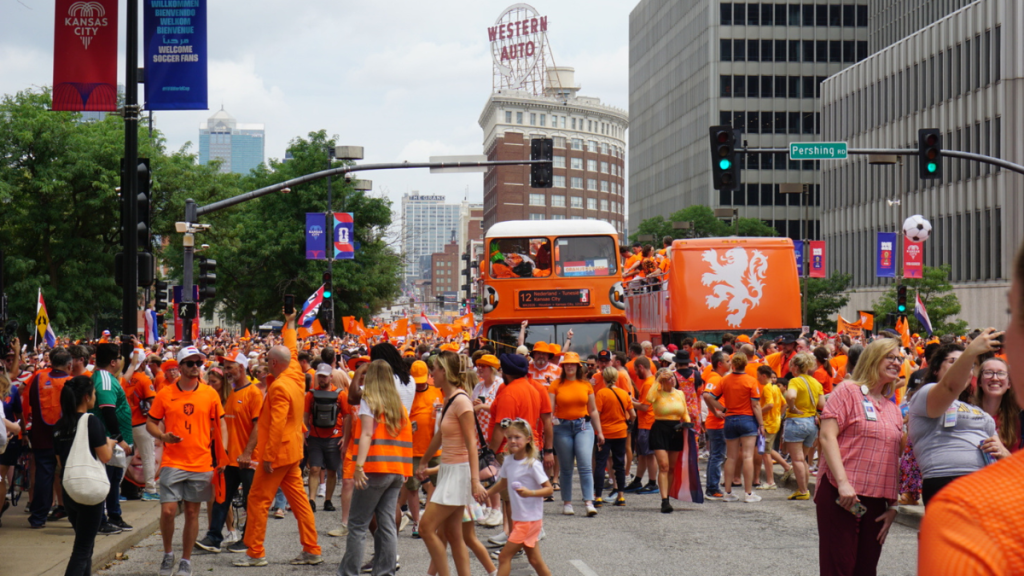
Kansas City has talked in circles about the impact of hosting the World Cup. Depending on whom you ask, the tournament is either the best thing to happen since the advent of burnt ends or an expensive 40-day distraction wearing a party hat and a scarf.
Opinions run the gamut. It’s a boom. It’s a bust. It will be chaos. It will be a passing blip.
A question that nags at me is how this all will affect working people. The hospitality industry — the third largest employer in the city — is the most obvious candidate to feel the impact for good or bad. The Beacon has written about it extensively, from concerns over staffing shortages and places that closed before the opportunity to debate about auto gratuity on checks and the civic back and forth over extended bar hours.
With all the noise out there — doom and gloom debating happy talk and civic boosterism — it’s tough to get a read on what’s actually happening on the ground.
So I threw on my press badge and went to see for myself.
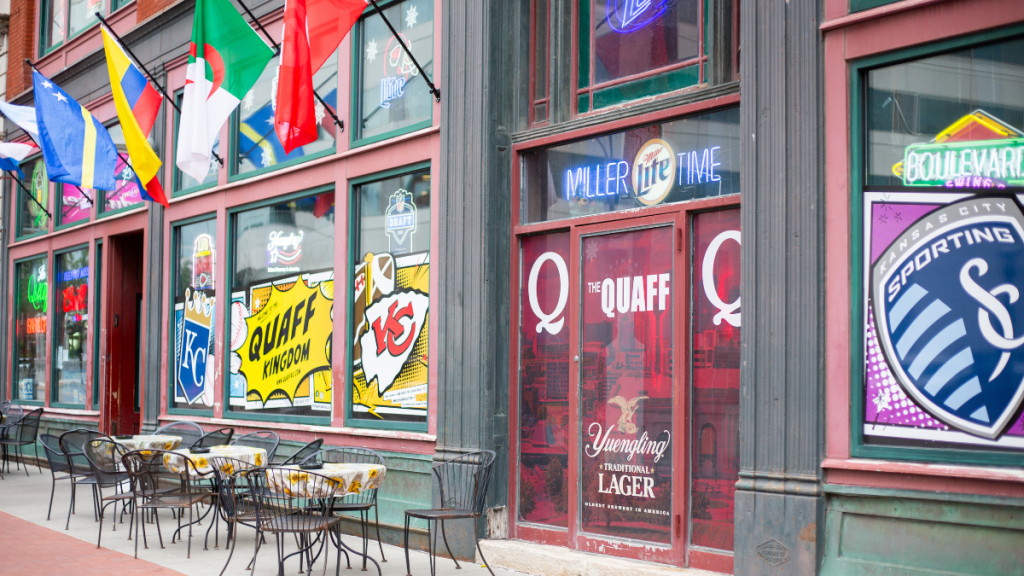
With a notepad and laptop, I posted up at The Quaff for the first match in town, Argentina vs. Algeria. The locally owned bar near 10th Street and Broadway was my choice for two primary reasons. The owners have courted World Cup crowds, and it is one of just 16 Kansas City establishments allowed to serve until 5 a.m., which is a temporary experiment in extended bar hours.
The hope was to gauge whether the juice is worth the World Cup squeeze and what alcohol service that late into the night actually looks like. The following is a little different than the standard fare served up by The Beacon, but it’s befitting the unique time in Kansas City, and is a firsthand account of the impact seen at one place, on one night.
7:30 p.m. — Arrival
My ride downtown arrives as a Tesla Cybertruck, whose driver is trying to avoid the match day traffic.
I can’t figure out how to open the handleless door. For a moment I ponder whether I may have to scan a QR code or sign into X (formerly Twitter) to access the cabin. The driver is a retired IT worker who hopes to use the World Cup as an opportunity to help launch his own driving service and mobile app. But this evening he’s decided that the smartest play is to avoid Arrowhead and the stadium traffic entirely.
The Quaff, when I get there, is ready.
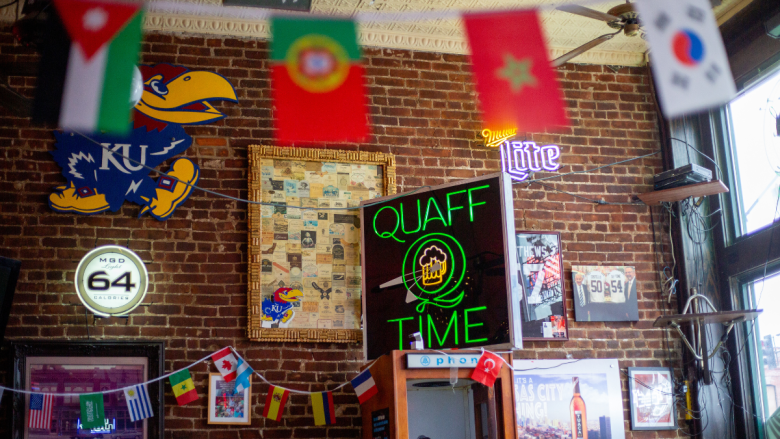
Scarves, flags and banners decorate the space. The staff are wearing soccer jerseys. Every screen is tuned to the same green rectangle.
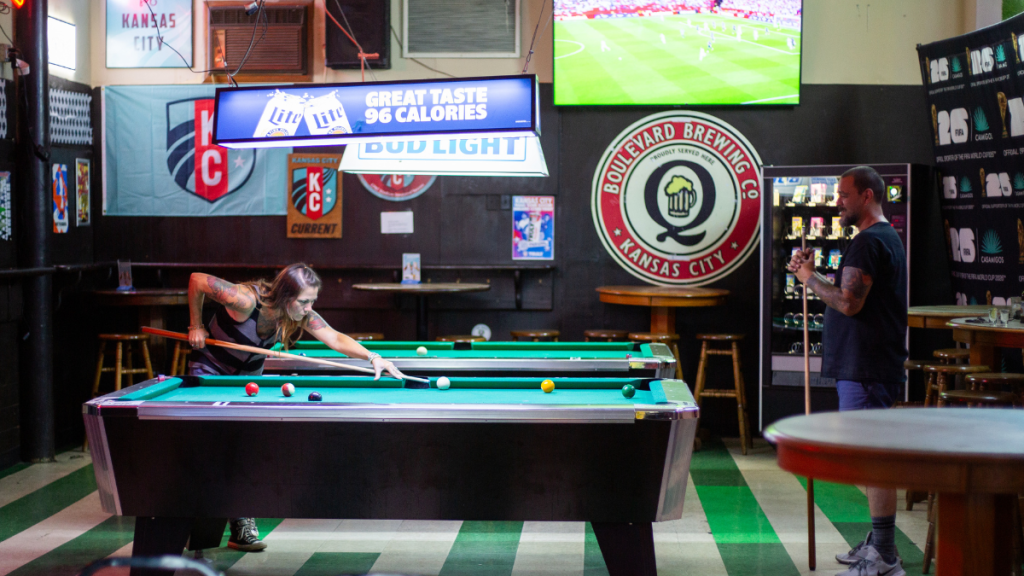
The Quaff has three long rooms and a sidewalk patio. A narrow bar greets guests, and to the right is a middle room with two pool tables. As you move to the third space there’s the kitchen window, two pop-a-shot games, two dartboards and a stack of board games. Televisions and projector screens abound around tables and chairs all primed for World Cup crowds.
I claim a corner table. It’s the best fly-on-the-wall seat in the house, with sight lines to all three rooms and the door just behind me. The sign on the bar puts occupancy at 150. At the moment, there are maybe 20 of us.
The place has the unmistakable hush of a typical Tuesday. My server tells me she’ll be here all night. I tell her so will I.
8 p.m. — Kickoff
Every eye in the room swings to the screens.
The broadcast cuts to overhead shots of “Kansas City Stadium,” and Arrowhead looks strange in its remade FIFA visage. It’s akin to running into an old friend who’s shaved off the mustache they’ve worn for years.
Down at field level it’s all Lionel Messi all the time — and not just on the pitch. The coverage might convince viewers he’s the only man playing. Between whistles he turns up in commercial after commercial selling me batteries, hardware and seemingly the general concept of perseverance. A few minutes in, he scores, and a server lifts a vuvuzela and lets it wail across the bar.
By halftime the number of patrons had grown, though not quite doubled. Four friends have claimed a pool table, and with a pitcher of beer they are running the felt with the ease of regulars who would be here World Cup or not.
But here’s something a decade behind a bar in a previous career taught me that has rarely failed. In the summer, business doesn’t pick up until dark. For whatever sociological reason, people don’t tend to be hungry or thirsty en masse until the sun goes down.
Half a match in, I catch myself pondering whether the World Cup won’t swallow the city whole after all. Images on TV show a sold-out stadium, a packed Fan Fest and the Power & Light District full to the brim. But while those crowds roar across town, here in the corner of a legacy downtown bar and grill it looks like a mellow Tuesday that’s just beginning to warm.
9 p.m. — Out front
I step out for air and find some of the night’s best entertainment seated around a sidewalk table.
Three older men are smoking and throwing back oat sodas while talking the most magnificent trash to one another — the kind sharpened by years of camaraderie. They come apart laughing at well-worn lines and jovial barbs.
A doorman stands by — relaxed, watchful, running math on every face coming up the block. He says the bar has already had a few international visitors and they are expecting more tonight. He notes that the Argentines in particular are easy to spot since he checks every ID and theirs is a national ID that doubles as a passport.
Inside someone blows an air horn to celebrate Messi’s hat trick. A server passes word that the streetcar is packed.
10 p.m. — The lull
The whistle blows and the game sound from the TVs is traded for Aerosmith and then the Foo Fighters.
Out front, the staff start hauling lawn games onto the sidewalk to catch the spillover they anticipate — oversized Jenga, a light-up and dry version of beer pong, a couple of cornhole boards and beanbags are in place.
In the dead air after the match, doubt seeps in.
There’s a genuine lull now, the room half-emptied of its reason for gathering, and I actually write the word: bust.
Around 10:45 p.m., I wander out to see if I can chat someone up while playing a yard game. The waitress working the far room has time to kill, because her section is the last of the three to wake up. She clocks my too-confident eyes on the beanbags and kindly offers to play a game of cornhole.
And while she thoroughly beats me, we make conversation. She’s worked this room for 25 years. She tells me that the place has been owned by one family since before the Korean War and three generations of that family will be working the floor tonight. They would be spotted running pints and plates while greeting regulars by name.
“A diamond in the rough,” she calls The Quaff, sinking another bag.
The streets are stirring, but only time will tell if these workers will see the benefit of what’s been billed as the biggest event Kansas City has ever hosted. People trickle in as I reread my last note: “maybe it’s a bust.”

11 p.m. — The build
It’s not a bust.
I shouldn’t have been surprised. The business came in the way bar crowds usually come — in waves. Almost no spot is busy wire to wire.
Strangers slap hands at the bar. “Viva, viva Argentina” gets the response “Go, Messi,” before a return quip of “You’re messy,” and the whole thing collapses into laughter that doesn’t need the joke to be good. Someone dances. Someone sings along to the jukebox, then a couple more.
And here I have to stop and defend the whole institution.
There’s a particular magic in a room of strangers when some decide to sing or dance in public. All that careful self-consciousness drops away as a few people who may never meet again agree for a moment to live inside a musical. It speaks to the revelry found in pub culture and nightlife.
It isn’t for everyone — plenty of happy people would find this loud, raucous and a bit much. They’d prefer to be home by 10, and that’s allowed. A late bar isn’t a public good like a library. It’s a particular pleasure for particular people. And the room is filling with exactly those people.
Midnight — The turn
The soccer jerseys in the room have multiplied like gremlins given water after midnight.
The Argentines prove every bit the late-night diners their reputation promised. As confirmed by the man working the door, suddenly a sizable share of the room is literally from Argentina.
The table beside me fills with gentlemen sporting the most pleasant accents. Maybe it’s the setting, but I can’t shake the notion that they sound like the soccer-playing “Ted Lasso” character Jamie Tartt. One politely asks where the restroom is, we exchange pleasantries and I learn they are here from Liverpool.
The temperature in the room is climbing — not from the weather, but from the bodies.
By half past midnight the joint is packed. Every chair is taken, the bar rail has people standing two deep in pockets, extra patio seats are brought out and filled. Throw in the people standing around outside and the place is bursting at the seams. It will stay that way, every seat full, for some time.
1 a.m. — Saturation
The room has become a small United Nations of the delighted.
The Liverpool lads, it turns out, are driving an RV clear across North America. A group of them started in Mexico City, then traveled to Houston, Dallas and Oklahoma City before arriving in Kansas City. One tells me that they went this route instead of splurging for hotels given the prices. He says it’s a once in a lifetime opportunity to see the continent.
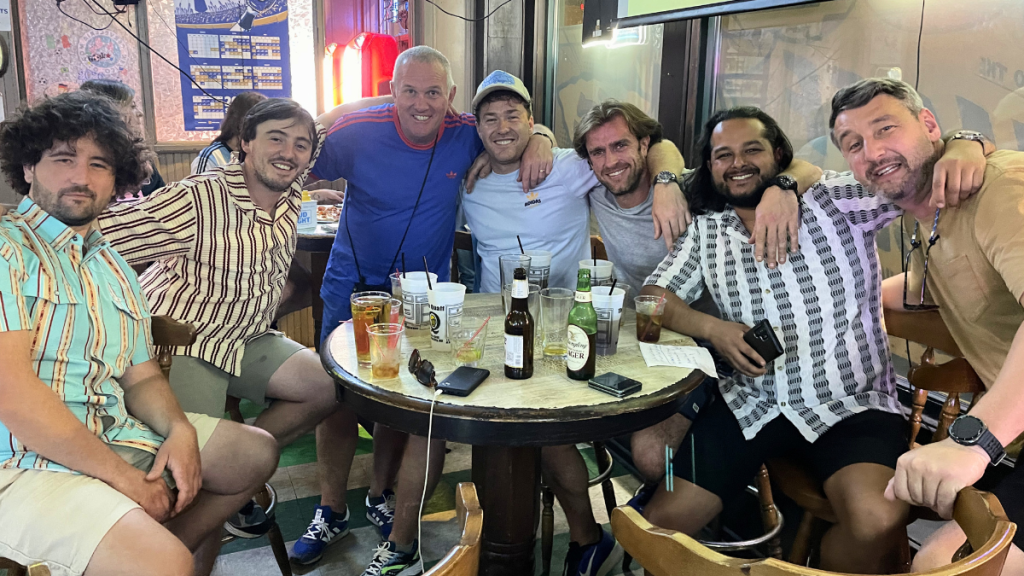
They tell me that they’ve settled in at a RV park near the stadium and have taken rideshares across the city. One does his best mangled Southern drawl and lights up describing the reception they’ve received. They’re enjoying being strangers in a strange land and they’re already plotting their next stops. The next night is their last in Kansas City, and he asks for a recommendation for “someplace lively.”
A few people arrive hauling actual suitcases, as if the bar was a gate at the airport.
Inside is a sea of Messi jerseys and worldly accents. Outside there’s a growing stack of souvenir cups — that weren’t allowed in the bar — brought by Argentine fans and guarded by the man working the door.
A 26-year old from Denver tells me he’s thoroughly charmed by Kansas City. He says the part of the city he’s staying in is surprisingly walkable. He shared that he struggled with hourslong delays for transportation after the match and finally split a ride with a couple of Argentines who found Kansas City to be pleasantly affordable.
Near the bar, two fans stand shoulder to shoulder, an Algerian flag and an Argentine flag knotted around their respective necks like capes. Opponents at the whistle. Allies by 1 a.m.
2 a.m. — Visiting themes
Things mellow just a bit, and as the crowd slightly turns over everyone seems a touch friendlier. Every glance around the room brings back a smile.
I met a man from Houston who won a ticket lottery to the game earlier. He flew in that very morning, hit up Fan Fest, ate barbeque, watched the match, took a walk by Power & Light and is now finishing a drink before hopping in a rideshare to his hotel. He says he’s having a great time, but he’ll be home by the next afternoon.
He had a speed run of the experience I heard repeated from several visitors. The theme among them was that they traveled in for a match, but will be gone within a few days, if not hours.
The 40-day windfall that some hoped for or imagined — visitors lingering, spending, filling hotels for six weeks — is not what I’m hearing. What seems to be materializing instead is a string of busy single nights with relative quiet stitched in between. Which, if you’re a place like The Quaff, isn’t everything you dreamed about, but is still likely welcome, especially on a weeknight
3:01 a.m. — Uncharted territory
This is the hour of bar service I was most curious about — the one that, any other Tuesday night, doesn’t exist in Kansas City. The Quaff is used to late hours, but by 3 a.m. normally their doors are shut, chairs are being put up, and everyone is sent on their way.
Instead, the space is roughly 80% full, and the call-the-fire-marshal crush has eased into something gentler, a busy bar at an unusually late hour.
The jerseys haven’t vanished — soccer fans are still nearly half the room — but a new group of night owls are settling in with them.
The social lubricants dispensed by The Quaff are working their magic, because past 3 a.m. people who may have been strangers earlier are mingling freely — some finding me in my corner.
The only friction of the night arrives at 3:10 a.m. — a flash of attitude between two men, a stepped-on shoe or a spilled drink perhaps — and the doorman gets whistled over. Inside of one minute the kerfuffle is over. After a brief mediation they are shaking hands. A few more fist bumps and shoulders patted, then it’s all done.
For all the hand-wringing and worries about what these extra hours would unleash, that is the sum total of the danger I witnessed all night.
4 a.m. — The overflow
There’s a new layer of people filtering in and overlapping with the remaining soccer fans.
It’s the bar’s native late-night population — the people who normally turn up after most of the other places close.
Service industry workers shuffle in, unmistakable across a dark room even if they are out of their full work uniforms. The tell is their nonskid shoes, typically ugly black things with the anti-grease tread peeking up around the soles. Those shoes are the secret sign of someone who’s just spent a shift making other people’s nights, and now they want one of their own.
The characters get more colorful by the minute. An old pool hustler talks my ear clean off about the movie “Tombstone,” its finer points and enduring importance. I let him, because where else is he going to do this at 4 in the morning?
This group undoubtedly sports more eccentric types than the earlier crowd, but I don’t sense a menace in the bunch. The scene is reminiscent of the standard late-night establishments that hum at an hour most of the city never sees or hears about. The difference seems to be merely the later time.
4:30 a.m. — Last call
Someone brings the house lights all the way up and blares an instrumental arrangement of “The Star-Spangled Banner.” Last call at The Quaff is anything but subtle.
As the staff shouts instructions for everyone to finish their drinks and pay their tabs, a new song comes on. The loudspeaker belts the western-themed “Rawhide,” and the message is again hard to miss — it’s time to get things rolling.
“Bar’s closed,” someone hollers into the warm room.
5 a.m. — The sidewalk
Out front, Argentines, line cooks and night owls stand under streetlights waiting for their rides.
Standing there, I do the mental math this whole assignment is about. Was this all worth it?
The sample size is quite small, and a month from now boosters and skeptics alike will pore over the numbers.
I can’t answer for everyone in the greater Kansas City area. But I can tell you what I saw in this one room, on this one night. A Tuesday that played out like a Friday or Saturday is no small thing. It’s a windfall for the workers and the family that owns the place.
As far as the later hours, that paid dividends both for the Argentines looking for a late-night scene and as a respite for service industry people looking to blow off steam. It may not be the case every night, everywhere, but crucially the evening came and went safely.
That’s not the whole answer to the question locals keep asking. But it’s an honest snapshot of it. This is what late night looked like on a match day in Kansas City: slow to start, then full to the rafters, then — somewhere past 3 — just a bar that stayed open a little longer than usual, full of people glad it did.

