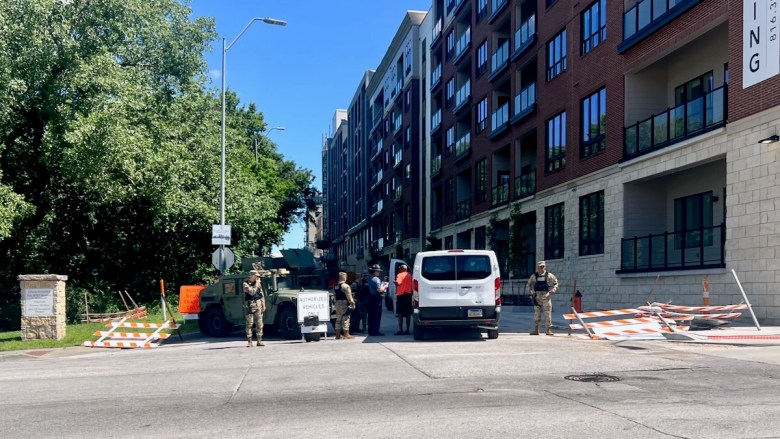
Since Kansas City stepped onto the World Cup stage this month, gun violence has repeatedly threatened to steal the spotlight.
On June 6, before matches even began, a shooting that injured nine people made international headlines because it took place about five miles from Swope Soccer Village, where England’s team has its base camp.
Takeaways
- During the World Cup, part of Kansas City’s role as a host city has been to tamp down worries about high-profile shootings.
- Kansas City’s gun violence death rates dwarf those in the home countries of the teams based here for the tournament.
- Health providers treat the physical injuries and the mental toll that come from violence. They also see working to prevent violence as part of their treatment plan.
On June 16, only hours before the city’s first World Cup match, one person was killed and four were injured when a gunman shot into cars that were driving along Truman Road and Interstates 670 and 70. One of the injured victims was an Uber driver taking Argentina fans to the stadium.
And on June 19, the night before the second local World Cup match, one person was killed and five were injured in a shooting near the city’s historic 18th and Vine Jazz District.
That’s far from a complete tally of violence that has struck Kansas City in recent days. And the tally is also far from unusual.
Although local officials downplayed the high-profile shootings as completely unrelated to the World Cup and emphasized measures taken to keep visitors safe, the reality is hard to sweep under the rug.
As of June 24, the Kansas City Police Department counted 66 homicides for the year, a decline from the same point in 2025 when there had been 84 homicides. Handguns were used this year in 56 attacks, rifles in eight and an unknown firearm in one. And that’s just Kansas City, Missouri. Shootings have also scarred nearby towns and suburbs. In 2024, more than 1,800 people died of gun violence in Missouri and Kansas combined.
Health providers who treat people affected by gun violence and organizations that work to help victims and their families said they hope hosting the World Cup — and getting a glimpse of ourselves through an outside lens — might help make something clear to people who live here.
Gun violence is an epidemic that ripples through the community every day, they said, harming not only those who are directly connected, but even those who take in a regular stream of violent news.
“It affects the community, whether you live one block from the homicides or whether you live two suburbs away,” said John Ham, executive director of Mothers in Charge, a Kansas City nonprofit that helps people touched by violent crime. “We’re all impacted one way or another.”
A fraction of the violence
Kansas City’s 2024 gun homicide rate of 24.6 per 100,000 people ranked among the worst rates in U.S. cities. That stands in sharp contrast to the countries with teams based in the area for the tournament. England, Argentina, the Netherlands and Algeria all see a fraction of the gun violence we do.
The disparity likely explains why a shooting in the middle of the night on Troost Avenue on June 6, which happened to take place a 10-minute car ride from the English team’s training spot, garnered headlines across the ocean. Meanwhile, the news coverage in Kansas City focused largely on the negative publicity the shooting had caused the World Cup’s smallest U.S. host city just days before the tournament was to begin.
“People are numb,” said Judy Sherry, a founder of Grandparents for Gun Safety. “I think some people might be embarrassed to think that all of the world can see, front and center, what’s going on in Kansas City.”
But she’s not optimistic the embarrassment will overcome the numbness or propel meaningful change. Lawmakers on both sides of the state line have only loosened gun restrictions in recent years, while state law prohibits Kansas City from enacting any restrictions of its own.
Meanwhile, for many people, gun violence is just a normal part of life, Ham said.
“We know it exists,” he said, “and we just move through life believing there’s an acceptable level to violence.”
The constant drumbeat of gunshots and homicides may make many people avoid thinking about the real lives lost and families torn apart. Even victims can seem to get used to the pattern, said Patty Davis, program manager for trauma informed care at Children’s Mercy.
One of her colleagues recounted an interaction with a patient who came to the emergency department for something unrelated to gun violence. But while there, he asked doctors to look at an existing wound.
“He said, ‘Oh yeah, and can you guys look at my leg? I got shot like three months ago and I’m just wondering if it’s healing OK,’” Davis said. “He’d never been to the doctor. He just moved on with life because it wasn’t a priority.”
Prevention as treatment
Davis said the incident illustrates just how common gun violence is in some communities. She estimated that five to seven times a week a child shows up at Children’s Mercy with a gunshot wound.
St. Luke’s Hospital in Kansas City, one of the area’s Level 1 trauma centers, saw a 52% increase in adults treated for gunshot wounds from 2019 to 2024. That spike prompted the hospital to begin a program to give away gun locks at primary care offices and urgent care locations. Since last fall when the program began, it has distributed more than 17,000 gun locks.
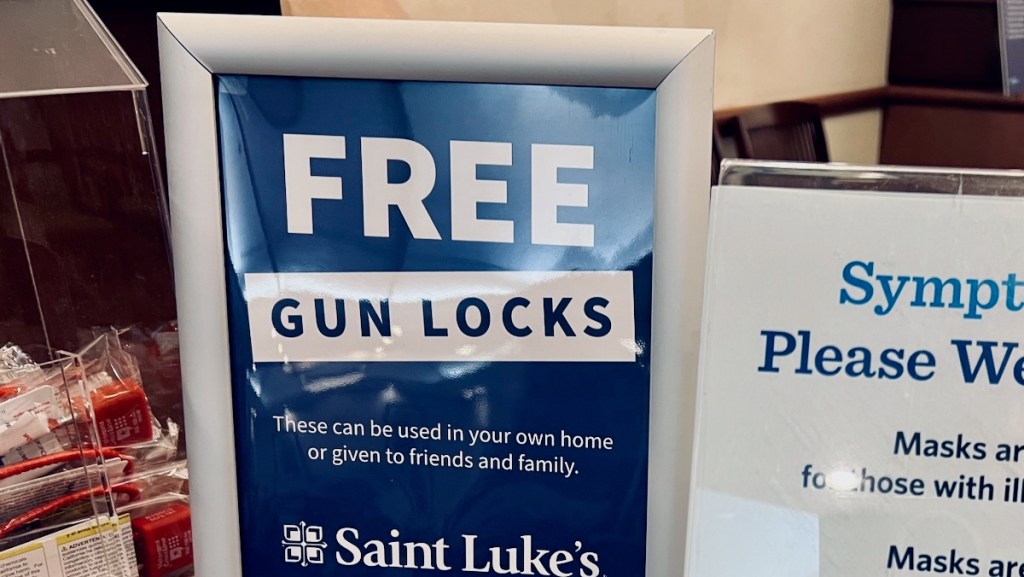
Other hospitals also give away gun locks. Children’s Mercy has a program that works to educate parents about gun safety and gives them access to free gun locks and safes.
The programs reflect a broader health care approach. Hospitals and doctor’s offices are increasingly seeking to prevent shootings from happening in the first place. That includes emphasizing the importance of treating trauma and educating patients about gun safety.
Dr. Leo Andrew Benedict, St. Luke’s trauma medical director, sees both as important parts of his role as a doctor who regularly cares for shooting victims.
“I am trying to come up with interventions to help prevent something like this in the future,” he said. “Whether it’s small, whether it’s big, providing direct education to patients, providing direct education to family members — it is something that’s a part of my treatment plan.”
Across the country, gun homicides have gone down, leading to a decline in gun deaths overall.
In 2024, the U.S. recorded 44,447 gun deaths, fewer than in each of the previous four years, but that number still puts 2024 among the five worst years. And it still makes the problem in the U.S. far worse than in other high-income countries.
Gun homicides dropped to 15,364 in 2024, down from 20,958 in 2021, the height of the pandemic. But gun suicides continue to climb, a trend that started more than 20 years ago. In 2024, gun suicides reached 27,593 — 62% of gun deaths overall — compared to 16,907 in 2002.
That truth, Davis said, shows why education about gun safety is so important. Children’s Mercy is trying to approach that work in a way that will not seem patronizing or preachy to parents. She knows from personal experience how that feels.
“I’m so annoyed when I go in to talk to my pediatrician, and they say, ‘Do you have any guns in the home?’” Davis said. “And then they just start with this lecture, and I feel like I’m being judged, because the truth is, my husband does have guns, they are in a safe, they’re locked up, but … I just feel shamed.”
The reality is, hospitals have to walk a tightrope when discussing guns. According to Pew Research, about 40% of Americans live in a household with a gun. The organization’s 2024 survey found the country is evenly split between those who believe laws should protect gun rights and those who believe laws should limit gun ownership.
That’s why Children’s Mercy has tried to take an approach based on education, not lecturing. Part of that is giving a platform to families who have been affected by gun violence to tell their stories and explain why a gun lock or a safe might have prevented their tragedy.
But being heard above the political rhetoric remains challenging, Davis said. And it’s proving to be even more difficult than the campaigns to curb secondhand cigarette smoke or enforce seat belt laws, which also met resistance.
“Unfortunately, this topic has been hijacked by manufacturers to spin a narrative that if we’re talking about gun safety, we’re trying to change the Second Amendment,” Davis said. “Our goal is not to remove guns from family homes. That’s their right. Our goal is to make it safe.”
Scars that don’t show
In 2015, firearms surpassed motor vehicle accidents to become the leading cause of death for young adults, 18 to 25 years old. Guns became the leading cause of death among younger children in 2020, and that’s still the case.
Healthcare providers are working to treat the problem while also recognizing that the physical scars aren’t the only ones that need to be cared for. Gun violence results in post-traumatic stress disorder, depression, anxiety and any number of other illnesses that happen when people can’t sleep or are afraid to leave the house and make social connections.
Michael Duncan Jr., who leads Seton CARES, a youth mental health program that the nonprofit Seton Center launched in early 2025, sees the suffering regularly. He has received more than one referral for a child whose parent has been a shooting victim. But a person’s proximity to violence doesn’t need to be that direct for them to feel the effects, Duncan said.
People’s mental health can suffer just by having violence in the neighborhood, seeing a lot of police activity or hearing about homicides.
“That can impact the quality of your mental health,” Duncan said. “It puts the brain in survival mode, and that can make you hypervigilant or cause emotional dysregulation, difficulty concentrating, sleep problems, anxiety and depression. … The more you witness it, the more you are involved in it over time, it can become toxic stress.”
That chronic stress leads to health consequences, lower academic performance and behavioral problems.

The good news, said Davis of Children’s Mercy, is that a specific type of therapy known as trauma-focused cognitive behavioral therapy will help treat the problem. The talk-based approach helps people go through the storyline of what happened to them and tell it in their own way.
“The more that we can have them review that storyline, the less power that situation has over them,” Davis said. “So then, every time they have a reminder of it, it will be less intense than the last time they had a reminder because they’ve been talking through it.”
But that type of therapy can be hard to find. Davis said Children’s Mercy has an eight-month waiting list for trauma-focused cognitive behavioral therapy. Although the hospital has helped train 50 therapists around the community in the approach, it’s still not enough to truly meet the needs.
And people are often limited by the insurance they have or their ability to pay for the treatment because many private-sector therapists don’t take insurance.
“Even if we doubled all the providers — or tripled them,” Davis said, “the fact is there’s more kids that could be using (the therapy) that don’t even know they need it.”
Groups like Mothers in Charge are trying to help by spreading the message that gun violence can ripple through entire families and communities. The group, founded by Rosilyn Temple, whose son was murdered in 2011, works with the Kansas City Police Department to be on the scene after someone is killed.
“Our organization focuses right there on the trauma that’s left behind and reducing that trauma and giving people the tools they need and the support they need to minimize that trauma,” Ham said. “It’s not going to go away. We provide tools to family members that help them process what’s happened.”
Temple often is the person on the scene. But Mothers in Charge has other volunteers who have lost children to violence. It can help to connect with someone who has been in the same position.
Ham said his group’s role is only one part of the solution. Healthcare providers, public health agencies, law enforcement and community nonprofits all have a part to play in helping address and treat the effects of trauma.
“It is clear to most people that we are not arresting our way out of violent crime,” he said. “The community has to take responsibility. Families have to take responsibility. And they have to hold each other accountable.”