


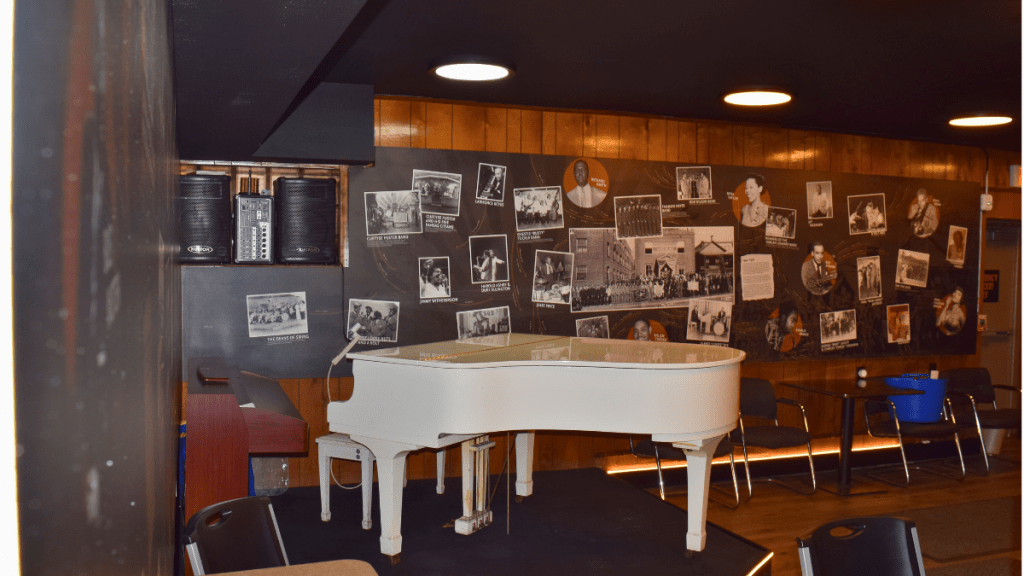
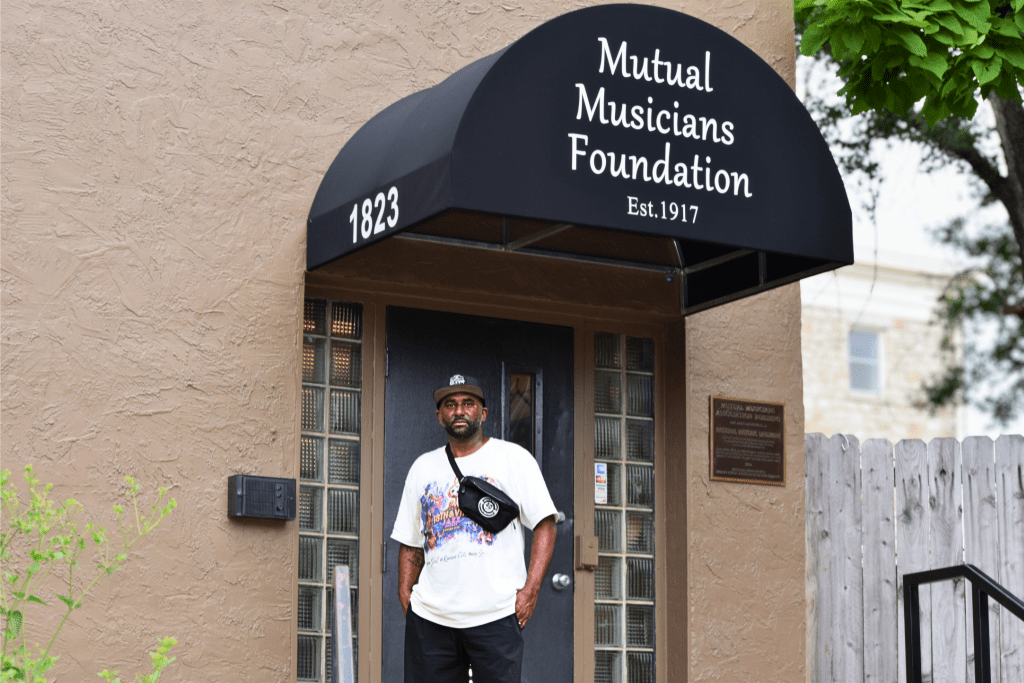
If you want to settle a bar tab as the sun rises in Kansas City, for decades there has been exactly one spot to do so — the Mutual Musicians Foundation in the 18th and Vine Jazz District.
The National Historic Landmark opened in 1917 as a union hall for Black musicians and has a century-old tradition of filling the air with jazz and glasses with libations into the early morning hours.
Takeaways
- During the 2026 World Cup, Kansas City approved 16 establishments to serve alcohol until 5 a.m. in designated entertainment districts.
- Less than a month before the tournament the city added restrictions to loosened state liquor laws, prompting a hurried application process.
- Bars and restaurants citywide can stay open until 3 a.m., but only establishments in entertainment districts could apply to serve until 5 a.m.
- In the interest of public safety, 5 a.m. bars had to submit security plans.
James McGee, secretary of Mutual Musicians Foundation, said the Friday and Saturday night revelry started organically. In the golden age of Kansas City jazz, local musicians would gather with colleagues and close friends for informal after-hours jam sessions — after their formal gigs across the city.
McGee said that over time the mixing of cultures and hanging out with musicians became a late-night draw for a city that infamously bucked prohibition.
“When the lights go down and everything else calms down, the night becomes alive,” said McGee.
For years the late-night jazz sessions — and the imbibing that came with them — were membership-based and off the books. To preserve the cultural legacy, the foundation went legit in 2007. Missouri revised its laws to allow the Mutual Musicians Foundation to operate and serve alcohol until 6 a.m.
As a result they were the only licensed place in Kansas City allowed to serve alcohol past 3 a.m.
Now the FIFA World Cup has come to town, and the Mutual Musicians Foundation has late-night competition.
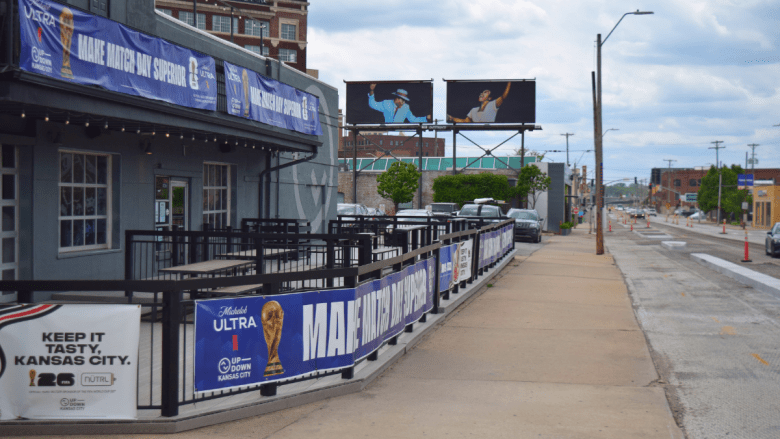
Kansas City, Missouri, has approved 16 establishments to serve alcohol until 5 a.m. in specific districts for the length of the tournament, June 11 through July 19.
“This is a rare opportunity to showcase our hospitality industry, our businesses and our city on an international stage,” said Buddy Lahl, CEO of the Missouri Restaurant Association.
But getting there was a see-saw: States loosened their liquor laws, then Kansas City Mayor Quinton Lucas moved to rein them back in the name of public safety, then a compromise was reached following pushback from bar and restaurant owners.
The city ultimately decided to let all establishments licensed to sell liquor by the drink have the option to stay open to 3 a.m. Some were eligible to serve alcohol through 5 a.m. in an expedited process that received input from Lace Cline, the assistant city manager for public safety, the Kansas City Police Department and the city’s regulated industries division.
To earn the extra hours, bars that fell within designated entertainment districts — such as Downtown, Westport, West Bottoms, Crossroads, Country Club Plaza and Zona Rosa — had to be in good standing, apply for a special license and present a security plan within days.
For bar owners and workers within the city, it’s an opportunity for extra revenue in a notoriously fickle industry as well as a way to compete with establishments in the suburbs that can stay open late.
But in practice many are likely to use their temporary extended hours license as an option for extra hours. The 5 a.m. last call is expected to be limited to match days and weekends, depending on demand.
Debate over last call
Missouri passed a law last year allowing 23-hour alcohol service — 6 a.m. to 5 a.m. the following day — to all licensed establishments during the World Cup. Kansas passed a similar law several months later.
The key difference is that in Missouri, if a municipality objected it had to opt out. No action meant that all licensed establishments could operate 23 hours a day. In Kansas, municipalities had to opt in to the extended hours.
In Missouri, cities including North Kansas City and Independence opted out. Meanwhile, Kansas cities including Olathe and Merriam opted into the extended hours.
Lucas introduced an ordinance May 7 to scale back to standard hours — 1:30 a.m. for most, 3 a.m. for others — citing public safety.
“I respect fun. I respect freedom. But, Kansas City doesn’t need bars operating 23 hours,” Lucas wrote on social media.
Lucas wasn’t alone in his reservations.
At a May 12 committee meeting, Councilman Johnathan Duncan invoked the folksy wisdom of nothing good happens after midnight, so certainly 5 a.m. should be a concern.
Council members also wanted to ensure that added public safety costs wouldn’t be borne by the city but would rest with operators. A resident testified by citing studies that tie longer bar hours to increases in ambulance calls and crime.
Chuck Barges, owner of the Thirsty Bull at Zona Rosa, said his bar is typically open until 3 a.m. But he had made plans and preparations to stay open until 5 a.m. after Missouri passed their law expanding hours.
He said a reversal would put him at a competitive disadvantage — neighboring establishments in suburban cities would be able to stay open later, undercutting his typical late-night business. He was one of several restaurant and bar owners who reached out to the city to advocate for extended hours and particularly pushed for Zona Rosa to be included in the final revision of the ordinance that ultimately passed.
“I was never crazy about 23-hour alcohol sales,” Councilman Wes Rogers told The Beacon. “But when we’ve been telling people for a year they can stay open … and then at the last minute we pull the rug out from under them, that was pretty frankly, discouraging to me.”
The compromise they reached — option to serve until 3 a.m. for all establishments, and up to 5 a.m. for applicants with a security plan in entertainment districts — tried to balance tourism and hospitality industry concerns with public safety. It passed with a unanimous vote in the City Council.
The Kansas City Police Department did not take a position on the ordinance. Jackson County Prosecutor Melesa Johnson said the World Cup is an incredible opportunity for the business community and that her office would collaborate to “ensure Kansas Citians and visitors are safe and anyone who causes harm is held accountable.”
“The hours between bar close and sunrise are when our office sees an uptick in criminal activity,” Johnson said in an emailed statement to The Beacon. “But I’m confident business owners who complete the safety plan will be better prepared to handle issues that may occur.”
Safety plans and the ticking clock
The compromise ordinance may have settled some concerns, but it also started the clock on a fast-by-necessity process.
The ordinance passed May 14, less than one month out from the World Cup’s opening match. The applications for establishments wanting to stay open in the entertainment districts until 5 a.m. opened June 1 and closed June 8. Successful applicants were notified of their status just two days before the opening World Cup match.
Markus Smith, a division manager with regulated industries who reviewed the applications, said the process was fast because it had to be.
“We had to put a deadline, because the World Cup was just getting ready to happen,” Smith said.
Before June 1, Smith described a process where regulated industries, the assistant city manager for public safety and KCPD collaborated in creating the application and the questions operators needed to answer.
The verbiage of official city communications left the impression that KCPD had direct involvement in approving or denying temporary extended hours licenses.
Ordinance language said that establishments seeking to serve until 5 a.m. required “…submittal of a security plan to the City and Kansas City Police Department…” The city’s public notice said applicants must “submit a security plan for review and approval by both the City of Kansas City and the Kansas City Police Department.”
Smith and a spokesperson with KCPD clarified that the police did not make direct approval decisions.
The police review “was basically that they helped with the process of questions that were going to be asked (on the application), and that’s kind of their part that they participated in,” Smith said.
Smith said that after applications were submitted, they reviewed and confirmed that each establishment had a current liquor-by-the-drink license, had a completed security plan and fell within the city-approved districts. He says they also checked for any trouble with the police or city in the last six months.
“We were trying to find out what these businesses were going to actually put in place to try to protect our citizens, still give everybody a great experience, and utilize the best way of trying to keep crowd control and those types of things in this situation,” Smith said.
Barges of the Thirsty Bull said the application asked him to explain details of his process and approach during the World Cup. He told them what kind of certifications his staff has, what kind of security they use, how they staff the establishment, if they have cameras and so on.
“There was quite a bit of detail that went into it,” Barges said. “It’s not something that you could have just winged and got through.”
Lahl of the restaurant association said that the short window to apply, and not a lack of interest, could be a reason for the short list of establishments that applied for and received the temporary extended hours license.
“For one, you only had days to submit the application,” Lahl said. “We went a whole year thinking we could be open 24 hours a day or 23 hours for alcohol service. … And then three weeks before it starts the city decides that they want to put in restrictions. I think Kansas City kind of fumbled that.”
Only 17 establishments applied for the extended hours, according to a city spokesman. Twin City Tavern was the one rejected application, because it fell outside the geographic boundaries for the city’s temporary extended hours license.
Extended hours in practice
Despite many references to 23-hour alcohol service, few if any are expected to serve starting at 6 a.m.
“I don’t anticipate anybody open at 6 o’clock in the morning, but they sure could,” Lahl said.
The approved bars are also unlikely to run to 5 a.m. every night of the tournament’s roughly 40-day stretch either. The extension was designed for sports bars and World Cup watch parties, Lahl said, not for every bar and tavern in the city to stay open all night through the summer. He says he expects most to be somewhat selective with when they will stay open late.
Barges said the Thirsty Bull will stay open until 5 a.m. on match nights and weekends but will play the rest of the time by ear. He said if it’s a weeknight and the room is sparse with no game going on, it’ll be the manager on duty’s call on whether they will stay open past their regular hours. Barges said before the games even began in Kansas City he had groups of international travelers visiting his bar coming from nearby hotels asking if he’d be open until 5 a.m.
Even then, Lahl expects the late hours to pad a bar’s revenue, not remake it.
“I don’t think anybody ever thought this was going to be a silver bullet revenue generator for 40 straight days,” Lahl said. “It was going to generate some revenue, but was also really just to show people a good time, to be hospitable in Kansas City to the folks from other countries and the folks visiting.”
Some of the payoff is for the people who work in the industry itself. In addition to increased earning potential, the citywide bump to 3 a.m., paired with the district 5 a.m. licenses, gives late-shift workers somewhere to unwind when their own night ends.
“It’s also great for the hospitality industry, for the folks that get off at midnight or 1 in the morning,” Lahl said. “Now they have a place to go that’s open and some entertainment for them before they go home.”
Barges says the late-night crowd is often less rowdy than some assume.
“I know it sounds scary, but these people are adults and they work at night,” Barges said. “It’s no different than a person getting off at 4 or 5 in the afternoon.”
Last call
Back at the Mutual Musicians Foundation, McGee watched as he got 16 new peers in the late-night alcohol business.
He wasn’t surprised to see a limited number of establishments go for the extended hours — including no one else in the 18th and Vine district. McGee said that staffing rather than the law can be the trickier part of staying open until morning.
“From an operator standpoint, the way you have to staff, the way you have to manage that, it’s different,” McGee said. “Once we hit midnight, then 3 and 4 o’clock. … Everybody doesn’t want to work that.”
While Barges said he has a staff eager to stay up to earn, Lahl did concede that staffing is a persistent issue in the hospitality industry and could have contributed to a lower than expected number of applicants.
What sets the foundation apart, McGee said, is that it doesn’t treat late night as just another shift.
“We’re probably more strict in our operations than most regular night clubs, because we’re thinking about the culture, the heritage and the legacy aspect of it,” McGee said. “We’re not just taking care of a bar — it’s not a bar — we’re taking care of a historic landmark.”
His guidance for the newcomers serving past 3 a.m. is to lean into judgment before muscle and to train staff to read the room before trouble starts. McGee said that many who come to the late-night sessions have come from another bar, so monitoring for overintoxication is key.
“Make sure their people are just really paying attention and using their discernment in reading what people are doing,” said McGee.
He said one trick of the trade at his location is that there is a set of concrete stairs leading to the entrance. If a patron struggles with the steps, it’s an immediate red flag for the security staff.
But the main lesson he offered is the one the foundation has been teaching for a century.
“The best advice they can get is to come hang out at the foundation one night,” McGee said. “See what we do. Feel free to take it with you.”

