


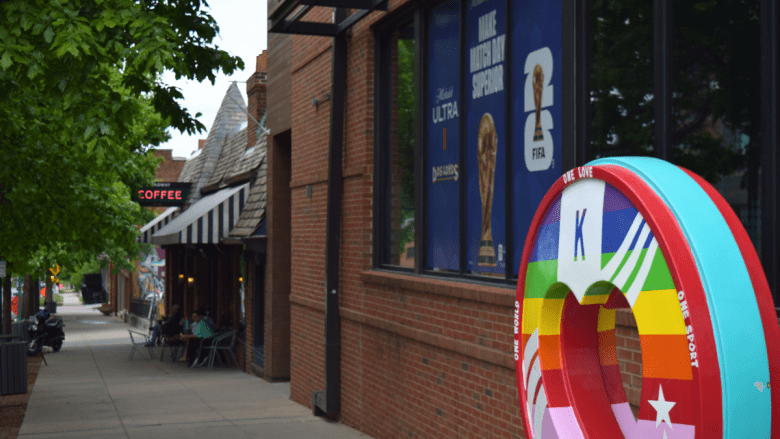
The countdown is on as Kansas City is set to host six World Cup matches starting June 16. Four national soccer teams — Argentina, England, the Netherlands and Algeria — will soon also set up base camps in the area where the teams will practice and stay between matches.
Takeaways
- The Missouri Restaurant Association has recommended auto-gratuity during the World Cup, but adoption is voluntary and far from universal in the Kansas City area.
- Visiting countries like the Netherlands and England customarily tip 5% to 10%, while tipping at all is unusual for many other countries.
- Tips average 19.7% in the Kansas City area and the discrepancy between customs and pay structures threatens to have tipped employees “working twice as hard for half as much.”
The Kansas City area is expected to be swarmed with fans of the teams, and the local hospitality industry could see a boon. Mike Burris, executive director of the Missouri Restaurant Association, said that local restaurants and bars are expected to book $60 million to $90 million in business from the World Cup, according to estimates shared with him from KC 2026.
Just how much of that money ends up in the pockets of restaurant servers remains to be seen.
Countries that Kansas City is hosting for matches and base camps share proud traditions and passion for their soccer teams. They also have a less commonly recognized trait: cultural norms where restaurant servers are tipped at a much lower rate than in the United States, if at all.
“Of all the countries coming here, some of them will know about (tipping), and some of them don’t know anything about it,” Burris told The Beacon. “If I was a server, I wouldn’t be too happy if I took care of somebody for 90 minutes and they didn’t tip just because they didn’t know any better.”
For tipped employees, part of more than 116,000 leisure and hospitality workers in the area, that cultural difference in tipping custom and pay structure is cause for concern. It could mean a stretch of 40 days where they are as busy as ever while simultaneously making less than usual. For some that would mean exhaustion while having to choose which bill not to pay.
“That’s the fear,” said Charles Peach, managing partner of The Combine and The Skyline Rooftop Bar. “We’ll roll out the red carpet for all of these people coming into Kansas City and show them a great time, and at the same time, we’ll be working twice as hard for half as much.”
To counteract this scenario, the Missouri Restaurant Association recommended that restaurants add a 20% automatic gratuity to checks temporarily during the World Cup. Some restaurants have announced they will do so, including Peach’s establishments. He says it’s necessary to protect staff’s take-home pay.
“It really doesn’t affect the business overall, outside of the fact that you want to keep your people happy,” Peach said. “One of the responsibilities of an employer is to make sure their staff feels listened to, feels taken care of, and they know that you’re not just looking out for your bottom line, but you’re looking out for their bottom line as well.”
Burris says most restaurants and bars in the area have at least considered the idea. Several tipped restaurant employees who wished to remain anonymous told The Beacon they supported adding gratuity to checks. Almost universally they cited the difference in customs — including one tipped employee who lived abroad and spoke from experience.
While a patchwork of restaurants and bars in the area have said they will adopt the policy, others are hesitant to add auto-gratuity to checks. Many locations in hot spots like the Power & Light District and Westport haven’t made a final decision yet. Neither have other tourist draws like some legacy barbecue restaurants or steakhouses.
“We’ve had conversations,” said Nicholas Boden, general manager of The Majestic Steakhouse. “But we have not decided on anything so far.”
Auto-gratuity is a “tricky subject,” and some locations have said they don’t plan on adding it to checks. Jasper Mirable said Jasper’s Restaurant won’t adopt auto-gratuity, and many national chains are also unlikely to do so. Several restaurateurs said they are unsure on what to expect, since the city has no precedent for something like this.
The result is, only a few weeks out, there’s not a unified approach if the tips don’t come during the World Cup, and the area’s restaurant workers are bound to feel it.
Tipping math
Katie Gorman is finishing a master’s program, and while she’s looking for full-time work, she has two part-time jobs in Brookside area restaurants.
Gorman says that with tips she takes home roughly $18 an hour at one spot and averages about $25 an hour at the other. She plans to work as many hours as she can during the World Cup but assumes an average of 33 hours a week between the two restaurants.
She shared her personal summer budget with The Beacon to illustrate the impact that losing tips could have.
Gorman lives with two roommates and has a modest budget with student loans as her largest expense.
In the most extreme example, if she received no tips she’d go from an estimated blended total take-home wage of $23.30 an hour to the state’s minimum wage of $15 an hour.
If she didn’t receive tips above the $15 minimum wage threshold she’d lose out on more than $1,500 in take-home pay over the 40-day course of the World Cup. Even if she cut all personal spending she’d still have to choose which bills not to pay for at least one month.
“One of the reasons why servers and bartenders are so against ending tipping is because (tipping) gets us closer to what our wage would be if minimum wage had kept up with inflation,” Gorman said. “It gets us closer to a wage that matches the buying power of what our parents and grandparents had when they were our age.”
Many tipped restaurant employees have an employer-paid wage that’s half of the state’s minimum wage, but they almost always exceed it in take-home pay when tips are included.
“One myth is that servers get less than minimum wage automatically, but that’s because they’re the highest paid employees,” Burris said. “The truth is, even if they didn’t reach the threshold of $15 an hour, that restaurant would have to make up that difference.”
Tipping customs
No server is likely to go without any tips during the World Cup. For a more realistic scenario, it’s worth looking at who’s expected to come here and what their tipping customs are.
According to the Western Union global tipping guide, the likely visitors are culturally much lighter tippers. The U.S. and Canada are largely outliers in their pay structures for tipped employees compared to the rest of the world, and 15% to 20% is recommended for restaurant service.
In contrast, most other countries have a higher base pay for tipped employees or build in a service fee that goes to staff wages. People in the Netherlands and England can tip 5% to 10% for truly exceptional service, while many countries expect that tipping is included in checks and may only round to the nearest dollar for an additional tip.
A Deloitte report for Airbnb projecting the economic impact of the World Cup in 2026 assumes that 40% of visitors staying in a host city will be from a foreign country. They also expect one international visitor per each domestic visitor in the U.S. during the World Cup.
According to data from Toast — a restaurant payment processing system — Kansas and Missouri both average 19.7% in tips.
If 40% of Gorman’s patrons tip 5% instead of the average for the area, she would still likely make above minimum wage. But she would teeter between just making it and falling behind her budget. Her break-even wage is $19.37 an hour, and whether she’d hit that mark depends on the effect the World Cup has on sales, which specific restaurant roles she worked and sales-based tip-share policies.
“You cannot support yourself, let alone a family, on (minimum wage). So they really depend upon those tips,” Peach said, noting that based on location and expertise servers can make upward of $20 to $50 an hour. “To take them down (when they are accustomed to making more), that’s just not fair to our staff.”
Restaurant workers in Kansas are more vulnerable to swings in take-home pay from lowered tips because their safety net is lower. A server in Missouri can make no less than $15 an hour while one in Kansas could make less than that before bottoming out at $7.25 an hour.
The MIT Living Wage calculator says a single person with no children needs to make $22.97 to live comfortably in Kansas City.
In a standard sit-down restaurant servers and bartenders rely on tips, but they often share tips with support staff like hosts, bussers and food runners. Some restaurants like Fox and Pearl near Union Station have a tip pool for every employee, so to owner Kristine Hull the decision to add a 20% auto-gratuity was a no-brainer.
“We aren’t really sure what to expect,” Hull told The Beacon. “But in the event that we get a lot of people from other countries (where) maybe tips aren’t a normal thing … our entire restaurant is a tip pool — front of house and back of house. Tips are very important to their paychecks. So we just decided for the World Cup we will have an automatic gratuity on every check.”
She says it’s just to be safe and that it will be clearly indicated to guests at the restaurant that the tip is already factored in. Hull said that auto-gratuity is already included for larger groups and private room rentals, so it isn’t a totally new practice.
Managing expectations
The World Cup has been billed as the largest event Kansas City has ever hosted. FIFA and Visit KC say 650,000 will visit the area, while the Deloitte report for Airbnb estimates 158,000 visitors who will need accommodations in the Kansas City area during June and July.
There’s been spirited local debate over projections of the exact number of visitors and economic impact the World Cup will have, but the assumption has been that it will certainly be a draw.

Boden at The Majestic said he’s leery of making special arrangements for the restaurant until he sees higher reservations, for a combination of reasons. He noted flight data reporting that suggests not a particularly large number of additional visitors, plus people perhaps avoiding downtown because of the assumption of it being a circus.
Boden said that while his restaurant considers adding auto-gratuity, it is a historic location with longtime patrons who would likely bristle at the idea.
“It’s one of those things, like, yes, I want to do it… But also I feel like it’s a dangerous standard,” Boden said. “You run the risk of putting a bad taste in the mouths of the people that support you on a regular basis … all to capture theoretical money from out-of-town people that are only here for six weeks.”
He pointed to the NFL Draft that the city hosted in 2023 as an example of being burned by inflated expectations. The Missouri Restaurant Association said it was severely disappointed by how the draft played out for area restaurants. The Majestic is downtown and Boden said he expected a packed house but then had slower than usual business.
“You know, all these people were downtown, but did they really go to any of the restaurants and spend money, or did they just come downtown and then leave?” Boden said. “That’s what happened to us during the draft.”
He and others have also pointed out that travelers to the World Cup will likely be wealthier and by virtue of that more privy to tipping customs in the U.S. Boden says his restaurant will keep weighing the pros and cons, but are likely to wait to see what happens as visitors arrive.
“If we all don’t make any money, I might have to (change policy). I have no problem reprinting menus, and putting it on the website,” Boden said. “But right now, I think it’s kind of like Jerry Maguire, you know, ‘Show me the money!’”
Burris told The Beacon that the automatic gratuity — with clear communication — is a recommendation and not a mandate as individual restaurants are free to do as they please. He also said that any restaurant guest could ask to have the automatic gratuity removed and most would accommodate the request.
“Some of these places will wait and see and that’s fine,” Burris said. “But after that first match any server or tipped employee will let them know.”

