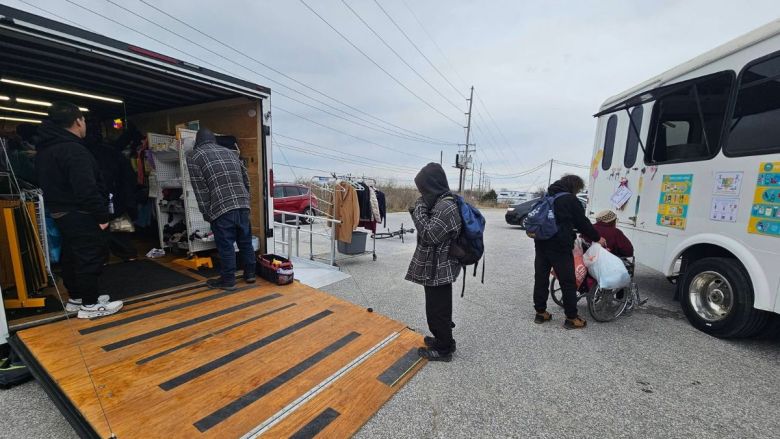
When outreach workers with CoMo Mobile Aid surveyed people experiencing homelessness in Columbia, Missouri, earlier this year, one finding stood out — many were older Missourians experiencing homelessness for the first time.
The survey, conducted by CoMo Mobile Aid and a research team at the University of Missouri, found that 59% of those surveyed were experiencing homelessness for the first time, and more than 40% of those surveyed were 50 or older.
Many people experiencing first-time homelessness reported dealing with illnesses or disabilities and difficulties earning enough income to make rent payments. Others reported they traveled to Columbia for medical care or addiction treatment and were unable to find a way back home.
For Steph Yoakum, the operations manager at CoMo Mobile Aid, the survey results weren’t surprising, but the numbers were discouraging.
“It confirmed what we keep seeing,” Yoakum said. “It confirmed, ‘Oh hey, we keep seeing new faces.’”
Takeaways
- Nearly 60% of people surveyed said they were experiencing homelessness for the first time, mirroring national trends.
- Health crises, disabilities and rising rents are pushing people into first-time homelessness.
- Columbia increasingly serves as a regional hub for people seeking medical care, housing assistance and mental health services.
The survey of more than 140 people found that most respondents live in local shelters or hotels, while others live on the streets, stay with friends or family or live in tents.
Nearly half reported inconsistent access to food, and only half of those eligible for the Supplemental Nutrition Assistance Program actually access those benefits.
Yoakum said many people living on the streets do not struggle with mental illness or substance use, they are simply low-income and fell on hard times.
“It is folks over 50 who are renting, and yes, it’s people whose rent got too high,” Yoakum said.
The findings mirror national trends when it comes to first-time homelessness, aging and limited amounts of affordable and accessible housing around the country.
Missouri follows national trends
Although Yoakum still feels there is much more to learn about Columbia’s homeless community — the survey only included a small cohort of the faces CoMo Mobile Aid sees on a frequent basis — the data documents some of the things they see anecdotally on the streets.
Still, researchers say the survey’s results reflect broader trends happening nationwide.
“The people who are homeless for a short period of time, or it’s their first time being homeless, have very low rates of mental health and substance abuse issues,” said Dennis Culhane, a professor at the University of Pennsylvania and a homelessness researcher.
“They are more likely to be employed, and about 45% of them have a job at the time they become homeless, and they tend to get out of homelessness very quickly.”
In some ways, the numbers seem to be improving.
Data from the U.S. Department of Housing and Urban Development’s 2025 point-in-time count, a local count of the number of people experiencing homelessness on a single night, found a 3.4% decrease in homelessness from 2024 to 2025 — the first decrease in the figure since 2016.
But the improvement was largely driven by a decrease in the rate of family homelessness. The number of people in families (at least one adult and one child) decreased by 11% from 2024 to 2025, to just over 230,350 people.
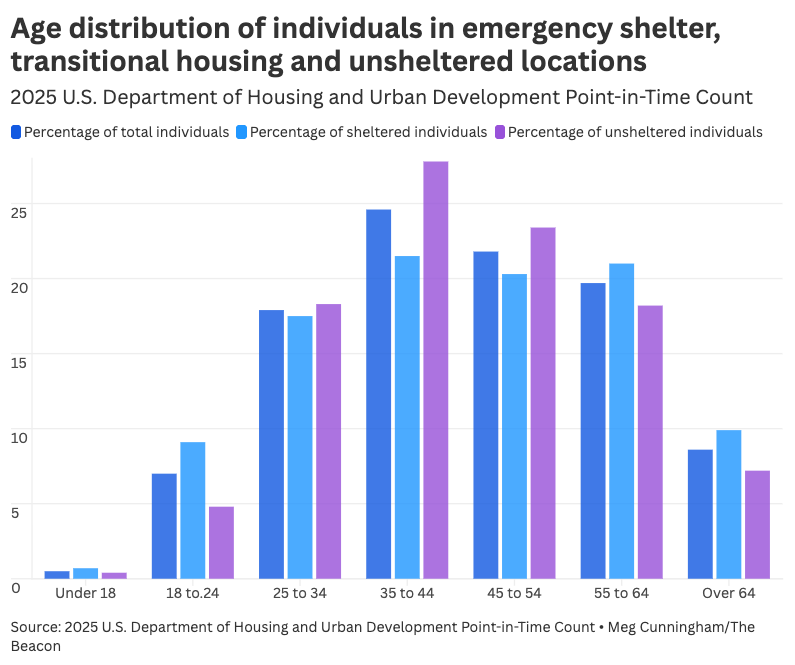
At the same time, individual homelessness hit the highest figure on record in 2025.
People experiencing homelessness predominantly live in urban areas, but people in rural areas made up 20% of the count in 2025.
In Missouri, approximately 6,000 people were homeless, according to the 2025 point-in-time count, a 14.1% increase from 2024.
Baby boomers make up a large part of the nation’s homeless population, Culhane said, because of the size of their generation.
People born between 1955 and 1965 “have been the largest segment of the homeless population since the mid-‘80s,” Culhane said. “If you look today from people aged 25 up to age 55, it’s pretty much the same size population for every age group, but the over-55 group is much higher.”
For older Americans, health issues and physical disabilities are driving factors.
A 2024 report from researchers at the University of California, San Francisco found that 68% of older homeless adults said they had been diagnosed with at least one chronic illness, and more than 40% reported having at least one limitation on performing day-to-day activities.
Lack of affordable housing is the main driver of homelessness
Despite health issues or mental illness, a lack of affordable housing is the main driver of homelessness nationally, Culhane said.
“The fact of the matter is, whatever their situation, if they had adequate income and rents were cheap, they would be staying somewhere,” Culhane said.
“It’s a mismatch between the incomes and the rents,” Culhane said. “And the rents are largely driven by housing supply. There’s been a shrinking supply of affordable housing as rents have increased.”
In Boone County, home to Columbia, the local data matches national trends.
A 2024 affordable housing study found that the county was short more than 2,100 rental units overall. Many of the shortages were for more expensive rental units, driving renters who could afford to pay more for housing into lower-cost units, taking them off the market for those who needed them, the study said.
The lack of affordable housing is something advocates have taken note of across the region.
At Services for Independent Living in Columbia, which is part of a federal and statewide network helping seniors remain independent, the lack of affordable and accessible housing is raising concerns.
Many of their customers are part of a long waiting list for housing assistance vouchers. Even when they get a voucher, finding a landlord who accepts them can be difficult.
“We do the best we can to help people find housing, but if there’s not stuff available, that becomes a barrier for people,” said Karen Sicheneder, the organization’s communications and development specialist. “We certainly don’t want to see anybody become homeless just because of the lack of housing.”
And even for those who do use housing vouchers or get help with living expenses from benefits programs, landlords can see an opportunity.
“Unfortunately, some landlords kind of take advantage of whatever Social Security stipend or increase might happen that year,” said Patty Wickham, the director of advocacy and network development at Aging Best, central Missouri’s area agency on aging that serves 19 counties.
“We’re seeing people that are gradually having their rent increase faster than what they’re able to have their income keep up with,” Wickham said. “They’re limited in their ability to work, because if they work too much, they’re not able to draw (tax-free) their Social Security anymore. So it kind of keeps them locked into a box, if you will.”
As rural services shutter, Columbia grows as a regional hub
Most of central Missouri, including Boone County, is designated as a low-income mental health professional shortage area, meaning that there aren’t enough providers offering services to low-income Missourians for mental health issues.
As a result, many people have to travel to Columbia to get the care they need. But transportation is also a major issue.
For many older adults, finding adequate housing is only part of the challenge. Accessing health care, social services and transportation can be just as difficult, especially in rural communities.
“The transportation piece is probably one of the biggest barriers that we are seeing,” Sicheneder said. “Even if we were to build affordable housing, we still need the transportation services in order to be able to support getting people from the affordable housing to wherever they need to be able to go. That’s one of the bigger challenges when we get outside the city limits.”
Yoakum said many of the people CoMo Mobile Aid interacts with aren’t from Columbia.
“It’s from these small counties, they are coming here for medical services, then being discharged from that medical service, and they have no physical way of getting back home,” Yoakum said. “Or their family doesn’t want them, doesn’t have a way to provide the services that they need somewhere like Edina.”
Wickham pointed to a client who was hospitalized due to elder abuse and couldn’t return to her home as a result. Her insurance covered a short stay at a rehab facility, but once the insurance coverage ran out, she was forced to start living at Columbia’s local shelter.
“She was walking around with a couple of broken hips,” Wickham said. “That’s horrific, especially for her age and her never being unhoused before.”
Services like OATS Transit or other transportation programs have gradually gotten more expensive and less accessible to those who need them, Wickham said.
“It’s a very easy population to prey on,” she said.
Wickham said many of the older adults she encounters aren’t experiencing homelessness because of a single mistake or financial decision.
Instead, housing instability often follows a major life event like an illness, injury, hospitalization or death of a spouse that can create a cascade of challenges.
By that point, she said, many older adults are already struggling to navigate rising housing costs, limited transportation options and complex health needs.
“Usually it’s some kind of massive life event,” Wickham said. “Something eventually causes things to start slowing unraveling. Then they quickly unravel. And usually in that quickly unraveling phase is when people start reaching out for help.”