


After a meager year in 2025, Kansas City’s regional economy did better than expected in 2026, at least when it comes to adding new jobs. Growth is projected to continue in 2027 — just a bit slower.
That’s the top-line takeaway from the Mid-America Regional Council’s annual economic forecast, presented this month by Frank Lenk, director of MARC’s office of economic research.
The economic forecast isn’t a crystal ball. Lenk and his team use the latest jobs, population and other data to analyze recent trends and try to get a sense of what’s to come for Kansas City.
“The (local) economy is doing well, but workers aren’t necessarily feeling it,” Lenk said. “Demographics are really driving a lot of the changes, and they are actually creating more of a low-growth environment.”
The region added an estimated 12,800 jobs in 2026, which is nearly three times as many as in 2025. But Kansas City’s labor force — everyone working or looking for work — shrank by about 12,300 people between August 2025 and August 2026.
Here’s what else to know about the state of Kansas City’s job market.
Click the link to jump to sections:
- What are the biggest industries in KC?
- What industries have added the most jobs recently?
- How many jobs is KC expected to add next year?
- Is KC adding jobs faster than the rest of the country?
- Where is KC not keeping up with the rest of the country?
- What is changing in the local workforce?
- What is happening with unemployment?
- If employment is growing, why might workers still feel squeezed?
What are the biggest industries in KC?
Healthcare is Kansas City’s biggest employer, with about 165,800 jobs as of August 2026. Government — which includes public school teachers and staff — comes in second at about 148,800 jobs, followed by retail at about 112,400 jobs. Rounding out the top six are restaurants and hotels, professional and technical services like engineering and accounting, and manufacturing.
Economists break down industries in a number of ways, but first into two categories: goods producing or service producing. Kansas City workers are six times more likely to work in an industry that provides a service rather than one that makes a physical thing.
About 1 million local jobs are in service industries, compared to about 161,500 in industries that produce goods. The two largest goods-producing industries locally are manufacturing, with about 91,300 jobs, and construction, at 69,200 jobs.
What industries have added the most jobs recently?
The healthcare and construction industries had the biggest job gains in recent years.
Healthcare added 21,600 jobs to the region between August 2022 and August 2026, while construction added about 10,600 during that same timeframe. Together, those industries represent more than half of the region’s job gains since 2022.
However, other industries also grew over that time including state and local government, manufacturing, accommodation and food services, as well as finance and insurance.
“When we look at 2026, this is the kind of distribution of growth you want to see,” Lenk said before citing growth in several industries, “It’s pretty broad, and that’s what you want.”
He noted that the region is healthier with broad growth because if one industry suffers, another can step in.
How many jobs is KC expected to add next year?
Next year is forecasted to be a year of less growth for the region. The forecast is for the Kansas City area to add 10,700 jobs in 2027. That’s down from the 12,800 added in 2026.
While that growth is slower, it is a marked improvement from 2025. Early figures estimated that the local economy lost jobs in 2025, but were revised to show modest growth of 4,400 jobs.
MARC’s forecast expects that healthcare and construction will again lead the job gains. Healthcare is expected to add about 5,700 jobs, while construction is expected to add about 3,900.
Analysts expect that next year’s job growth will be almost entirely in construction and healthcare, compared to 2026’s growth that happened across sectors. The two industries account for roughly nine out of 10 forecast new jobs in 2027.
“It’s mainly healthcare and construction, and that makes me nervous because construction could be a bubble, for example, and so it could go away,” Lenk said. “And so then we’d just have healthcare. Well, that’s not enough to really build an economy that we want.”
The 2027 regional economic forecast does expect smaller job gains in transportation and warehousing, hotels and restaurants, private schools and colleges, and manufacturing. However industries like wholesale trade, information jobs like publishing and telecom, real estate and administrative support are expected to shrink.
Is KC adding jobs faster than the rest of the country?
Overall, the Kansas City economy is adding more jobs than the rest of the country. From August 2022 to August 2026 Kansas City’s employment grew 5.1% compared to 3.7% nationally according to the Bureau of Labor Statistics.
The edge comes mostly from industries that make things, despite those jobs taking up a smaller portion of the local job market as a whole. Comparing growth rates, KC’s goods-producing jobs grew 9.4 percentage points faster than the same jobs nationally, while service sector jobs grew at about the same pace as the rest of the country.
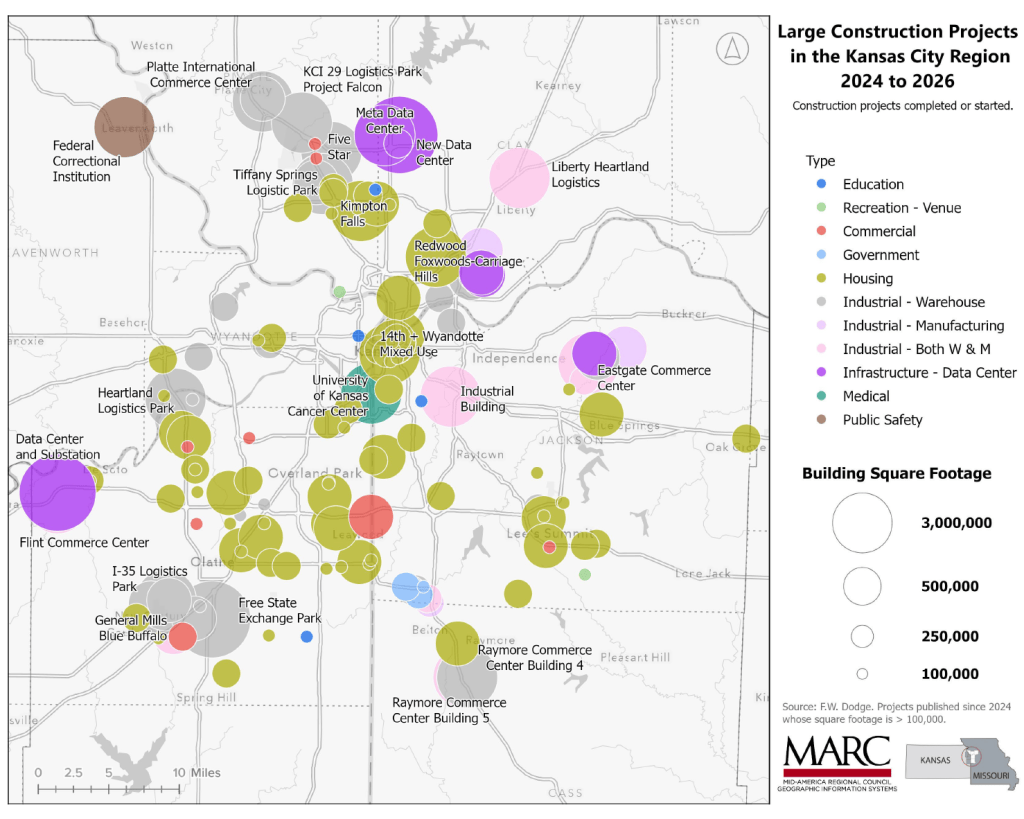
Construction beat the national job growth rate by 11.3 percentage points locally, driven by large projects such as data centers, warehouses and multifamily housing. Manufacturing also did 7.8 points better than the national average, with computer and electronics makers growing and the local auto makers holding steady while the industry shrank nationally.
Healthcare, the biggest regional grower of jobs, slightly lags behind the national job growth with the exception of hospitals’ job growth rate, which is 7.1 percentage points higher than the rest of the country. Lenk said that Kansas City has strong hospital systems that draw patients from across the region.
Other professional services — including engineering, architecture and scientific research firms — are also outpacing the nation in terms of regional job growth, as well as hotels and the insurance sector.
Where is KC not keeping up with the rest of the country?
Some industries like white-collar business services and entertainment did not see job growth at the same rate locally as seen in the rest of the country.
How far some local industries trailed national job growth between August 2022 and August 2026
- Computer systems design: 13.4 percentage points
- Administrative and support services: 6.5 percentage points
- Arts, entertainment and recreation: 5.8 points
- Wholesale trade: 5.8 points
- Legal services: 5.4 points
- Real estate, rental and leasing: 1.3 points
- Federal government: 0.6 points
Lenk noted that much of the computer systems job lag locally can be partially attributed to Cerner being purchased by Oracle, which then downsized its local workforce. Federal government workforce cuts had a particularly large impact on Kansas City, MARC estimates that the region lost about 2,900 federal civilian jobs in 2025 alone.
If the KC region is to continue to outperform the country in job growth, Lenk said, the area needs to focus policy and investments in supporting sectors that send their goods and services outside of the Kansas City area.
“That’s what brings the dollars in. That’s how regions grow,” Lenk said. “They don’t grow by serving themselves. They grow by serving a larger economy.”
What is changing in the local workforce?
The Kansas City region lost 12,300 workers between August 2025 and August 2026.
That is chiefly due to an aging population, according to Lenk. Baby boomers are retiring, and not enough young workers are coming up behind them. According to MARC, in 2001 about 26% of the region’s working-age (16 or older) residents were 55 and older. By 2050, they project that about 43% of the area’s working-age population will be 55 or older.
“It’s hard to build a growing economy without a growing workforce,” Lenk said. “You can grow the output, but you can’t grow jobs.”
Fewer people are being born or moving here to replace the retiring workers. The U.S. fertility rate has fallen to 1.6 births per woman, below the 2.1 needed to keep the population steady. Immigration has historically helped fill the gap, but Lenk said deportations and stricter immigration policy could mean the country loses more immigrants than it gains in the near term.
But other factors like the high cost of child care can lead a parent to exit the workforce after crunching the numbers. Caring for aging loved ones could also be a contributing factor to the declining workforce, as well as a lack of transportation access or frustration with the job market.
This decline in the number of workers is expected to contribute to slower job growth in the economy both locally and nationally unless it is addressed. Lenk suggested that without a change in fertility rates or immigration, the region and the country could possibly expect see the “end of growth” in the next 10 to 15 years and that communities would need to search for new ways to measure economic success.
“It’s a really hard economic question to have a prosperous society when the number of people and the number of jobs are declining,” Lenk said.
What is happening with unemployment?
Unemployment in the region is still low.
In the post-pandemic recovery, the unemployment rate in the Kansas City region dropped as low as 2.2% but has crept up since and hovered around 3% and 4%. The unemployment rate was most recently reported at 3.4% for Kansas City in September 2026. Economists generally view an unemployment rate under 5% as “full employment.”
Like last year, the Kansas City economy is in what economists call a “low hire, low fire” job market. Few employers are laying workers off, but few are hiring. That keeps the local economy stable on paper but makes for tough sledding for anyone looking for work.
If employment is growing, why might workers still feel squeezed?
Just because the economy is growing doesn’t mean paychecks are.
Put plainly, workers may still feel squeezed because things are more expensive, and wages haven’t kept up.
After accounting for inflation, workers have seen almost no real raise in 15 to 20 years, Lenk said. The people who are doing well are the ones who own something like a home or stocks, and that gives them a cushion is something goes wrong.
In the Kansas City region, Lenk estimated that about 400,000 workers earn less than $45,000 a year.
Young adults are feeling it most, Lenk said, citing Urban Institute data showing more food insecurity, trouble paying rent and utility shutoffs for that group. Homes feel out of reach, and inflation eats into whatever raises they get.
“Real incomes are stagnant, so it’s just harder for them to see that American dream,” Lenk said before voicing what young workers may be thinking. “Am I going to be able to be comfortable, not rich, just comfortable at some point in my life?”
Basic costs like housing, food, healthcare and childcare have risen substantially in recent years — outpacing wages in some cases — so the gains from a growing economy are landing unevenly.
“The economy is doing relatively well right now,” Lenk said. “But not everyone is doing well, and many workers are not feeling like the economy is doing well for them.”
Tell us about your experience in the local economy.
We at The Beacon are curious about what your experience has been navigating a changing local economy. If you have thoughts or lived experience you’re willing to share, please fill out the survey below.

