


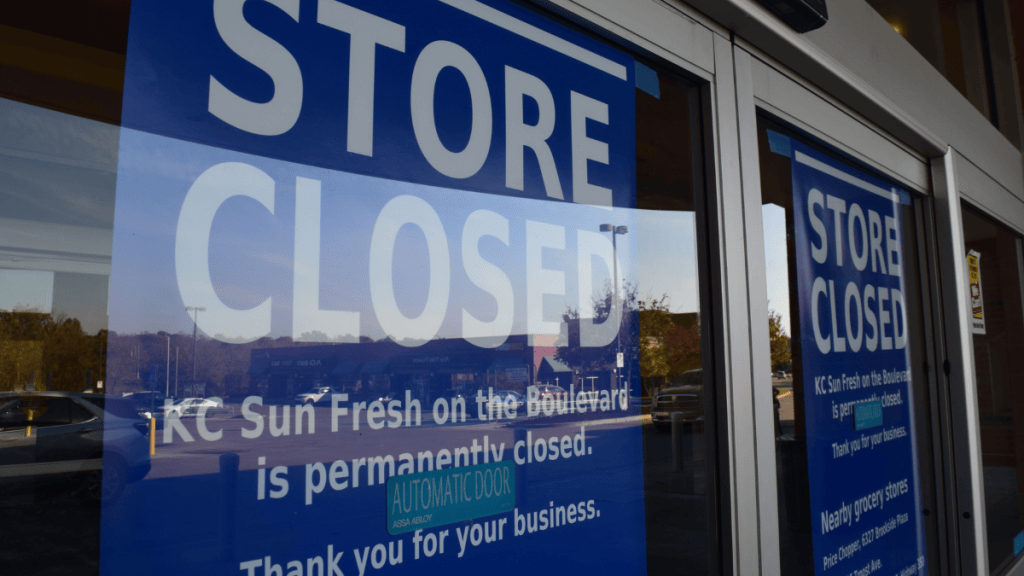
Deborah Phillips walked up to the automatic sliding glass doors of the Sun Fresh in the Blue Parkway Shops on Oct. 26, only to be disappointed.
The grocery store had closed for good the night before, citing “declining sales and rising operating costs.”
Phillips works down the street and would often come by the store on her lunch break. She said the store shelves were sparsely stocked for months leading up to the sudden closure.
“It’s a hard blow to the neighborhood,” said Phillips. “People don’t have anyplace else to go.”
She said she’ll likely lean on the area’s fast-food options for her lunches now but was saddened to see the closure, particularly for those who live nearby or don’t have a car.
“It’s a hard thing for a lot of people, particularly with Thanksgiving coming up,” Phillips said.
The store had a bus stop nearby, “And you could come here, get your groceries, then get on the bus.”
The Sun Fresh in the Blue Parkway Shops is just the most recent of several grocery store closures around Kansas City.
Last year the Sun Fresh at Linwood Boulevard and Prospect Avenue and the Merc Co-op in downtown Kansas City, Kansas, shuttered their doors. Last month, the Midtown Costco closed operations before its conversion into a business center, while in September, the North Kansas City Save-a-lot closed for good.
Like many on this list, the Linwood and Prospect grocery store closure turned the surrounding area into a food desert — but just temporarily.
That grocery store has since seen a revival.
In May, new proprietor Anthony Estrada opened United Market KC in the former Linwood Sun Fresh space. Estrada says the full-service grocery store is averaging 1,000 transactions a day. Its transformation and early success could offer lessons to other area grocery stores and local officials who want to see access to fresh food in every neighborhood in the city.
The Beacon previously reported on the challenges of two grocery store locations — downtown KCK and at Linwood and Prospect — given a number of factors including historic disinvestment in the surrounding neighborhoods.
Estrada has taken on the challenge anyhow.
In an interview with The Beacon, Estrada said the store is paying all of its bills and sales are trending in the right direction. The Kansas City Star recently suggested in a column that he’s a “grocery store whisperer.” After his first United Market opening, he is planning to open a second location in downtown KCK in the coming months.
United Market’s “secret sauce” appears to be a combination of strong community involvement, a different pricing strategy and the experience of Estrada and his team — all paired with the will and support of local governments to see success at locations that have struggled to sustain a grocery store.
Then and now
The city of Kansas City purchased the Linwood Shopping Center — where United Market KC operates today — in 2016. It then spent $17 million redeveloping it and putting in a grocery store as an anchor tenant after a previous grocer left the area in 2007.
Lipari Brothers first ran the Sun Fresh when it opened in 2018 before approaching local nonprofit developer Community Builders of Kansas City — who also operated the recently closed Sun Fresh in the Blue Parkway Shops — to take over operations following the COVID pandemic.
After initial profitability, sales fell and stock on shelves dwindled over time until the Linwood Sun Fresh’s closure in August 2025. Community Builders at the time cited a spike in persistent crime and nuisance activity around the store as major contributors to reduced store traffic and subsequent financial losses that led to the closure.
Community Builders is currently a part of an active lawsuit against the city, alleging that as the property’s landlord the city breached their lease contract by not maintaining the shopping center “in a first class manner,” leading to $5 million in losses for the nonprofit. The city is disputing the claims in Jackson County Court.
In the final days of the Linwood Sun Fresh, safety concerns — including an incident where a machete was brought into the store — and a “persistent sewer smell” contributed to a downward trend of reduced foot traffic and declining sales.
Walking into the United Market today, you may be surprised to hear this recent history if you didn’t already know.
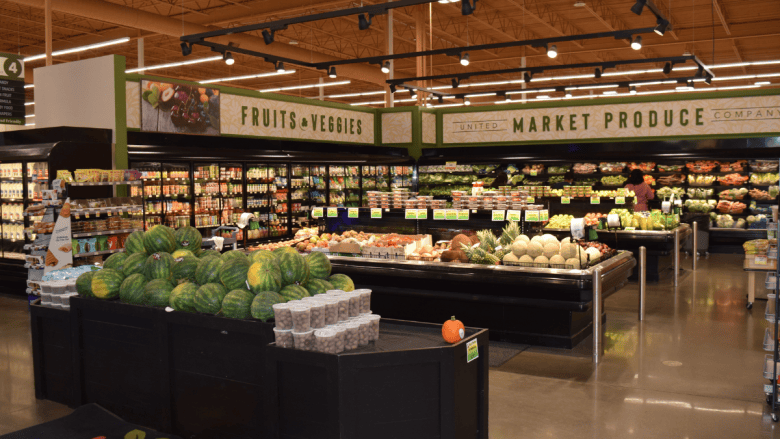
United Market is an aesthetically pleasing, 36,000 square-foot full-service grocery store with features like a custom-cut meat counter, a fresh deli, and a hot food and salad bar. Once past the security guard posted at the entrance — who can view any of the dozens of security cameras — customers are greeted by a large selection of colorful produce.
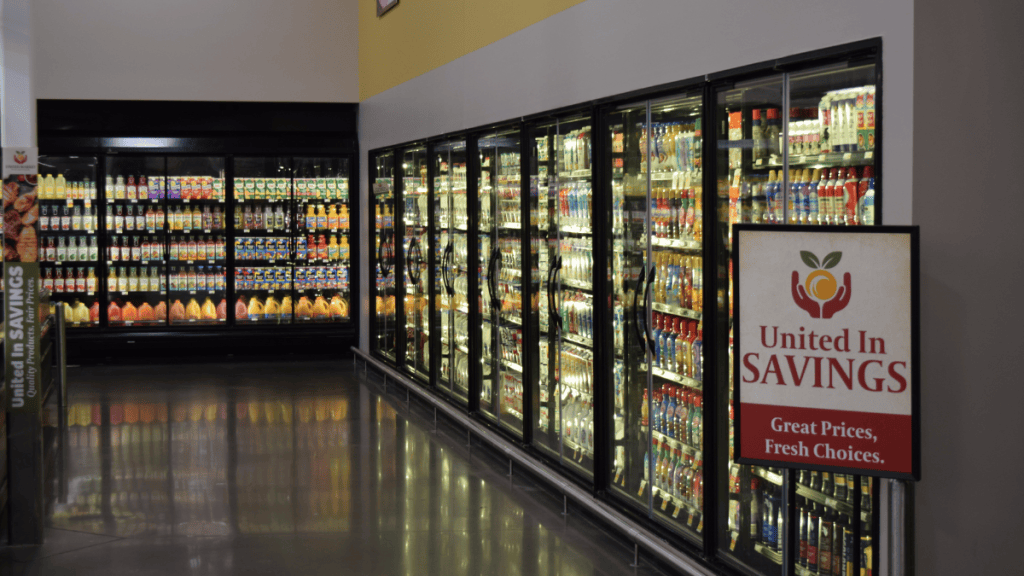
“We do our part on the inside of the store,” Estrada said. “We keep it clean and organized. The floors are shiny. The shelves are full, stocked and faced.”
Estrada, who grew up in and lives in the Kansas City area, told The Beacon that he sees operating the store as providing a community service.
“A grocery store does not solve the problem (of food insecurity) if families cannot afford what’s on the shelf,” Estrada said.
Pricing strategy
Communities need access to fresh food, but groceries are a tough business. The national average net profit margin for a supermarket is 2.1%, which leaves little room for error.
Estrada said that wholesale costs of core grocery items are somewhat uniform and come from the same warehouses in the area. However, he said when it comes to fresh items like meat and produce, his team will shop around for the best deals to try and keep prices down.
“We deal with multiple suppliers, so that we can get the best cost,” Estrada said. “Then we pass that cost (savings) on to the consumer.”
While food prices are generally rising due in part to continued inflation and the increased cost of diesel, prices can differ from store to store depending on that business’ pricing strategy.
“That’s kind of an operator’s choice,” Estrada said. “We get to pick the daily shelf price, based on what percentage we feel that the store can operate and pay its bills.”
During a January committee meeting discussing plans for the proposed store, City Councilman Darrell Curls asked directly what Estrada would do differently given the previous challenges the store faced.
Pricing strategy was the first thing he mentioned.
“My pricing strategy is to go in at the right price,” Estrada told the committee. “Oftentimes, when you have a store in an urban community, the operators tend to overprice their items to compensate for theft, and I feel like that’s unfair.”
While theft is an issue in the grocery and retail business, some industry loss-prevention experts believe that its effect is overstated and inventory loss can be addressed with adequate staffing, store layout changes, technology and efficient operations.
Estrada elaborated when speaking with The Beacon, saying that a combination of new shared security and training has kept the store safe. Adding that while there are multiple pricing strategies available to operators, he chose one that would rely more on volume and keeping prices lower.
Community buy-in
Community participation and feedback are key to the store’s success, according to Estrada. He said that every kind of grocery store doesn’t work everywhere: Each store needs to be tailored to the surrounding community in order to have a sustainable business.
As part of that effort, United Market has a community advisory board for the Linwood location to hear direct feedback from shoppers and neighbors the store serves.
“They help me keep a pulse on the community and kind of understand what the needs continue to be,” Estrada said.
Pat Clarke — president of the nearby Oak Park Neighborhood Association — serves as the chair of the advisory board that meets monthly.
He sees the board as a hands-on, neighborhood-rooted group that monitors the store and its prices while providing feedback on a variety of issues, including items that should be offered.
“At the end of the day,” Clarke said. “That store is our (the neighborhood’s) store.”
On a recent visit, nearby resident Devonta Thomas called United Market “a beautiful addition,” and backed the idea that it was serving the area well.
“They are taking the time to actually dedicate a better shopping experience for all of us in the community,” Thomas said. “It’s a clean space, the shelves are always stocked and the people are friendly.”

Thomas also noted that he liked the store’s free membership card, similar to other loyalty cards that earn points based on what the customer purchases.
“I think that’s a benefit to the community because you get to save money while you spend money,” Thomas said.
Security and city support
The fact that the United Market at Linwood and Prospect is there at all is due in part to the city identifying the need for an anchor grocery store in the city-owned property and utilizing economic development tools to make it happen.
United Market received $1.5 million in startup assistance to stock the shelves, rebrand the store with new signage and help with early payroll before sales came in.
The store’s lease also allows for rent of $1 a year for a stabilization period of five years. However, United Market will pay rent of $15,833 a month if they have sales of over $1.12 million a month for three consecutive months during that time.
The city made another change as well.
The previous tenants dealt with persistent crime in the area that spilled into the store and made many would-be shoppers feel unsafe and therefore unlikely to return.
To combat this, the city expanded the Linwood Community Improvement District (CID) in June. Doing so has had a number of effects, but chiefly it allows for CID-funded security officers to patrol a larger area around the store. Security is shared among more businesses and presently funded through a combination of city support and a 1% sales tax for the CID — charged on purchases within the district.
Included in the expansion of the community improvement district is the Lucile H. Bluford branch of the Kansas City Public Library, across the street from United Market.
Abby Yellman, chief executive officer of the Kansas City Public Library, said that the expansion of the CID has led to some positive momentum in the area. She said that the increased collaboration has led to progress generally, but added that the library’s in-house security now has the ability to coordinate with the grocery store and CID security.
The previous smaller CID limited where security could operate.
“They can at least go and have conversations with individuals and address things a little more proactively,” Yellman said. “So then that way, some of those nuisance things we were seeing and some of the concerning things have declined because we’re proactively going out and having those conversations through the Metro Security and that expansion of the CID.”
Notably, according to Community Builders’ lawsuit, supports like these were sought by the previous tenant before Sun Fresh closed.
Estrada said that the security guard inside the front door has access to cameras and coordinates with another guard who patrols the parking lot and the larger area around the store. He said their level of training and customer service has helped deter nuisance activity, but also pointed to collaboration and having shared security across the entire shopping center as a boon to safety.
“I feel like all the businesses, including the library, have come together to keep everyone safe,” Estrada said.

Across the state line, the future second United Market at 501 Minnesota Ave. in Kansas City, Kansas, is similarly a government-owned property. The Unified Government also put together an incentive package after the Merc Co-op closed that includes $150,000 in startup support, and their occupancy fee is waived for a year before paying $5,000 rent a month that could rise at 3% a year thereafter.
Looking ahead
While the early returns at United Market at Linwood and Prospect are promising, it’s not the only grocery store opening in the face of recent closures.
The day after the Blue Parkway Sun Fresh closure, a new lower-cost grocery model from Price Chopper called “Chop More!” hosted a grand opening about 4 miles away on East 63rd Street.
According to reporting from Startland News, the concept is a “no-frills” store where products are transparently priced at cost plus 10% to cover overhead.
In the coming months, Estrada will also open the second United Market in downtown KCK. While the store is one-third the size of the location at Linwood and Prospect, he says it’ll have the same name and format, just in a smaller space.
“We’ve been doing great. We’re up and open for five months now, so I feel like the community has really embraced us,” Estrada said. “So we’d like to be able to help on (the other) side of the state line as well.”
Estrada’s choices and approach to both the Linwood United Market and the future location in downtown KCK are informed by decades of experience.
“I started out pushing carts,” Estrada said.
He worked his way up to becoming a store director for more than 16 years before moving into wholesale operations. He helped open 17 grocery stores and was the district manager for roughly 45 Associated Wholesale Grocers-affiliated stores in the Kansas City territory.
“I got to see what works and what doesn’t work for other operators,” Estrada said.
Time will tell if the United Markets will flourish and last, but so far so good according to Estrada.
“I truly believe if you put people first and community first, the store is going to be there,” Estrada said. “It’s going to be profitable.”

