


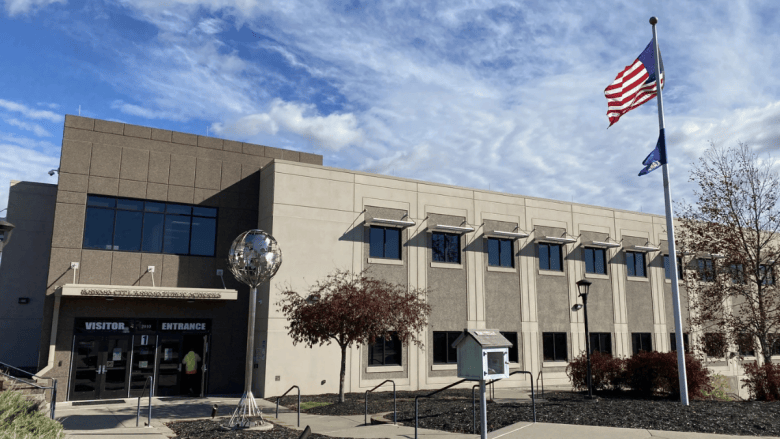
Kansas City, Kansas Public Schools: Board Listening & Learning Session (Oct. 19, 2026)
By Kenneth Heermann, Kansas City Documenter
See more about this meeting at Documenters.org
Summary
- The Kansas City Kansas Public Schools Board of Education held a 90-minute listening and learning session where district leaders walked attendees through the 2026-2031 strategic plan. The Beacon Documenter was part of one of the groups that rotated to five tables where district administrators briefed attendees on the five focus areas of the strategic plan.
- Topics brought up by attendees included special education, district communication with parents, graduation credits and student electronic devices.
- District staff said it is a struggle to find special education teachers and paraprofessionals.
- Parents voiced some frustration with the district’s ParentSquare communication system.
- Chief Operations Officer Miguel Martin said the district has crafted a memorandum of understanding with local law enforcement agencies for additional help at extracurricular events.
Notes
KCKPS Strategic Plan and Priorities
- Board President Randy Lopez welcomed attendees on behalf of the board:
- “All seven of us feel it is important to get as much community input, and to make sure that we make ourselves available and accessible to hear back from you, and to share priorities that the board has and that the district has moving forward,” he said. “So we really appreciate you. We know that taking time out of your evening is a lot to ask, but we’re so grateful that you are all here and that you’ll share information with us.”
- Superintendent Anna Stubblefield asked attendees for “candid and authentic feedback about what’s working,” including where the district may have “blind spots.”
- Stubblefield introduced Michelle Hubbard, who facilitated development of the plan. Hubbard is the former superintendent of the Shawnee Mission School District and is now a field specialist with the Kansas Association of School Boards.
- Hubbard said:
- The board began discussing a new five-year plan in December. In January, the district selected a steering committee of about 50 people through an online application. Members included students, parents, teachers, staff and community members.
- Hubbard said more than 1,000 respondents filled out a survey about what today’s kindergartners will need when they graduate.
- Action teams composed of community members worked from February through April, one for each focus area. Hubbard said team membership ranged from about 15 to as many as 35 people. Deputy Superintendent Kevin Hansford said that all applicants were placed on an action team.
- In May, Hubbard worked with the cabinet to add timelines and measures.
- The board approved the plan on June 23.
- The North Star goal remains: By 2031, 100% of students will graduate with a Diploma+ endorsement, with no disparities in race or gender subgroups, while meeting or exceeding the state’s average graduation rate.
- The vision statement is new: “A united community empowering every student to adapt, thrive, and succeed in an ever-changing world.” Hubbard called the vision “probably the hardest” part of the committee’s work.
- The five focus areas are:
- Student learning and pathways.
- People and talent, retention and growth.
- Supportive school climate and positive student experience.
- Family and community partnerships and communication.
- Safe, modern and effective learning environments.
- Representatives from the action teams organized around the five focus areas summarized their work and attendees rotated through the tables. They could fill out feedback cards.
Student Learning and Pathways
- Hansford said the district’s first priority is Action Plan 3, professional learning communities. He said progress will be visible on the district’s new website.
- Dezarae Allbritton, executive director of elementary schools, said:
- Teachers get 50 minutes of planning time daily, with two structured team days a week, usually Tuesdays and Thursdays. “We don’t like to call it a meeting; really, it’s a culture,” she said.
- Allbritton added: “You will see teachers making instructional decisions, informed decisions around data, and so we’re just getting a little bit tight on that process.”
- Administrators are now doing a book study on the professional learning communities framework.
- Within two to three weeks, principals will complete a survey to set baseline data for next steps.
- The third-quarter focus will be unit and lesson planning. One Wednesday a month is set aside for unit planning and another for building leadership teams to review data.
- She was asked how the plan serves students with disabilities and responded: Special education teachers get the same planning time plus eight additional days a year for progress monitoring, progress reports and goal alignment.
- Allbritton also told one group member that teachers have not protested the process as being an additional duty because it is built into their planning time.
People and Talent Retention and Growth
- Jarius Jones, associate superintendent of human resources, and Chalita Middleton, director of human resources, led the table.
- A participant who runs a transitional home for boys aging out of foster care said students needing special education can go unidentified. He described a student whose individualized education program (IEP) was outdated because a school had one evaluator for all of its IEPs.
- Jones said the district is trying to hire the right people for evaluation and support roles. “We’re struggling finding the special education teachers. We’re struggling finding the special education paraprofessionals,” he said.
- He also said teachers and parents work together to ensure that students are evaluated and receive resources, if needed.
- Middleton said the district is recruiting people already working in its classrooms through its Para-to-Teacher Program. She said principals refer promising candidates, and the district also recruits career changers.
- A participant who runs a transitional home for boys aging out of foster care said students needing special education can go unidentified. He described a student whose individualized education program (IEP) was outdated because a school had one evaluator for all of its IEPs.
Supportive School Climate and Positive Student Experience
- Jackie Rodriguez, executive director of multilingual education services, and Angela Grant, director of evaluation, research and assessment, led the table.
- Counselors were restructured to sit under academics, and school leadership teams are setting expectations.
- The district is bringing on a new data system from a company called Abre that combines student information, finance, human resources and curriculum data. It will feed a public dashboard of strategic plan indicators.
- Staff said ParentSquare, the district’s new family messaging platform, has high-quality translation, and staff can adjust text in the district’s top six languages.
- Conscious Discipline, a behavior and self-regulation approach used in early childhood for several years, “launched actually in the summer” in elementary schools, staff said. K-5 principals receive monthly virtual training, coaches are assigned to buildings and teachers attend longer training sessions.
Family and Community Partnerships and Communication
- The table leader said the plan’s three action areas are communication, advocacy and reporting; family awareness and access; and removing barriers to access. She said the communications department is implementing ParentSquare.
- Participants raised several concerns about ParentSquare:
- Families with children in multiple schools can’t always tell which student a notification is about.
- Families can’t tell who receives their replies.
- Swahili-speaking families in particular need help setting their language in the app.
- A participant said students skip classes and are still moved ahead, some reading at fifth- or sixth-grade levels in high school. The table leader said her team is building automatic attendance alerts for the student information system, so parents are notified when students skip individual classes.
Safe, Modern and Effective Learning Environments
- Martin said the district is drafting a five-year capital improvement plan covering HVAC, plumbing, paint, carpet and other upkeep. He also said:
- Projects funded by the $180 million bond voters approved in November 2024 include an addition at Sumner Academy, a new Woodland Hills Elementary combining Silver City and Noble Prentis elementary schools, and new Central and Argentine middle schools.
- Harmon, Woodland Hills and Argentine Middle will form the district’s first campus with all three schools within walking distance.
- Staff use an emergency operations plan app with emergency contacts, lockdown procedures and inclement-weather plans. It is one-way; communication with families goes through ParentSquare.
- K-12 buildings must hold two fire and tornado drills and at least one intruder drill a year.
- Wyandotte High School got a ramp by the auditorium and a new parking lot on the south side of the gym with additional ADA parking spaces. Martin said many buildings are historic, which limits changes.
- A memorandum of understanding with the Kansas City, Kansas, Police Department, the Wyandotte County Sheriff’s Office and the Kansas City, Kansas Community College police will provide help at extracurricular activities when the district is short-staffed. He said it was presented at the previous Tuesday’s board meeting and is up for final approval at the next one. Martin said the district has to work within its finances, noting community concern about local and state taxes.
Closing questions and answers
- Hubbard estimated that more than 200 people participated on some planning team. An administrator read questions submitted online before the meeting.
- Teacher contracts: Teachers and certified staff are working under the previously settled contract. The district has a tentative agreement and hopes to bring a settlement to the board soon.
- Unreturned calls: Lopez said the strategic plan outlines a 48-hour standard, which “doesn’t mean you have to be answering [in] 48 hours, but it does mean that you have at least acknowledged that you have received the message and that you’re working on it.” The published plan sets acknowledgment within 48 business hours (See Page 25, Action step 4.1.4).
- Graduation credits: The state minimum is 21 credits. Board policy offers two higher tiers, up to about 28 credits, and diplomas reflect the level earned.
- AP courses: AP courses are offered at all high schools, and the plan adds more. Sumner will add an AP pathway for scheduling flexibility alongside its International Baccalaureate program. “If you’re at Sumner, you have to take an AP course every semester or every year,” an administrator said. AP will be optional at the other high schools.
- Devices: K-8 students generally don’t take devices home unless requested, including by a parent. High school students take them home for assignments.
- Block schedule: The questioner asked to limit high school students to four courses instead of eight. The administrator said the district previously used a four-by-four block and that the current administration changed to the present schedule based on research.
- A parent asked about a survey on Wednesday scheduling sent near the end of last school year. Staff said Wednesdays would be left unchanged.
- Another participant said the district still struggles to get information out and questioned how meeting days are chosen.
Observations & Follow-Up Questions
- Communication with parents was a recurring issue among attendees.
- The roundtable format allowed closer, more direct conversation with district leaders.
- When will the public strategic plan dashboard launch and how will it be announced?
If you believe anything in these notes is inaccurate, please email us at documenters@thebeacon.media with “Correction Request” in the subject line. Learn more about Documenters on our website.
Documenters notes are free and publicly available under a Creative Commons Attribution 4.0 license (CC BY 4.0). They may be shared, remixed, or reused with appropriate credit to Documenters.org and the local partners. For full guidance, see: https://www.documenters.org/creative-commons/

