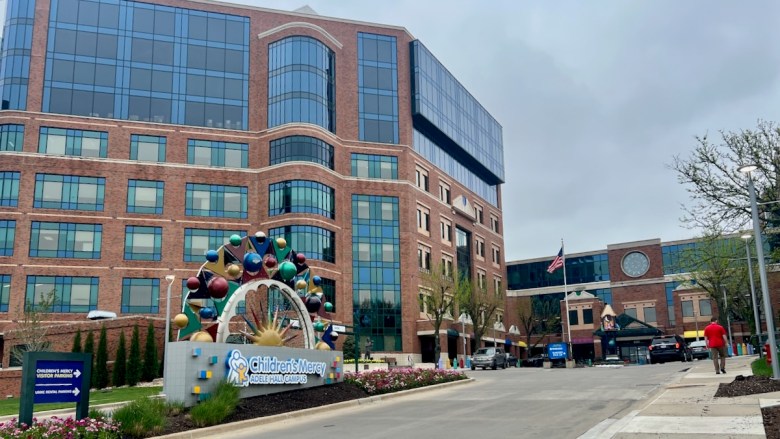
As Children’s Mercy launches a $1.7 billion overhaul of its Kansas City campus, the hospital has offered early retirement to an undisclosed number of employees.
Hospital leaders said in a written response to questions from The Beacon that the voluntary retirement offer is unrelated to its building expansion plans, which include a new hospital tower along with plans to renovate existing patient care spaces. The hospital is seeking to borrow $500 million to help finance the expansion but will pay more than $1 billion of the cost in cash.
Children’s Mercy leaders did not specify how many of its almost 9,000 employees are eligible for the early retirement offer or how much money the reduction in staff could trim from the hospital’s $1 billion payroll.
Takeaways
- Children’s Mercy has offered voluntary early retirement to an undisclosed number of workers, but declined to say how many employees are eligible.
- The hospital’s new tower project, including a clinical building, an inpatient tower and a utility plant, along with renovations to existing facilities may cost between $1.3 billion and $1.7 billion.
- The hospital said the project will be financed in part with $500 million in new debt.
Their statement called the retirement program “a thoughtful approach to managing our workforce.” And they said the hospital continues to hire “across the organization, including for roles that support care delivery, access and critical operations.”
Patrick Zagar, an analyst with S&P Global Ratings who follows Children’s Mercy, said he was not aware of the hospital’s early retirement offer to employees. But he said it falls in line with what is happening across the health care sector.
Hospitals continue to face pressure from high inflation, he said, and now they are staring down revenue losses stemming from President Donald Trump’s One Big Beautiful Bill Act and other policy changes.
Children’s Mercy told bond analysts they expect to see an annual net reduction of $40 million in government payments in coming years because of changes enacted through the legislation. In 2025, the hospital netted about $309 million from supplemental funding related to Medicaid.
“All providers across the country are focused on efficiency and productivity,” Zagar said. “Everyone is looking at their expense footprint, and a lot of times there is room to improve or to become more efficient on the nonclinical side.”
Crucial to growth
Children’s Mercy’s new acute care tower will expand overall patient capacity at the main hospital by 25% to 30%. The hospital’s president and chief executive officer, Dr. Alejandro Quiroga, has said the capital project is crucial to its business strategy to bring more pediatric patients to Kansas City for lucrative specialized care.
This includes the clinical areas of hematology/oncology, neurosciences, gene therapy, fetal health, precision medicine and transplant surgery. This fiscal year, after the hospital added two abdominal transplant surgeons, organ transplant volume has grown nearly 60% over the previous year, according to the hospital’s statement about its new bond offering.
Like other pediatric providers grappling with declining birthrates, Children’s Mercy has been aggressively pushing to expand its geographic reach in an effort to increase its patient pool. In the last year the hospital started work on a $152 million expansion of its Overland Park campus, began building an 18,000-square-foot clinic in Wichita and announced plans for a new pediatric outpatient facility in Springfield.
If Children’s Mercy doesn’t invest more than $1 billion in its main campus, leaders said, it will soon run out of room. Within five years they estimate the Hospital Hill facility would have capacity for only 67% of patients in need of beds and for only 40% of newborns needing a spot in the neonatal intensive care unit.
And that’s with an overall decline in patient numbers. Although patient volume has ticked up the last two years, with the exception of inpatient and outpatient surgeries, the volume remains below pre-pandemic levels, according to S&P Global. Its rating report noted that inpatient admission growth is “increasingly limited by capacity,” a problem it said expansion plans will address.
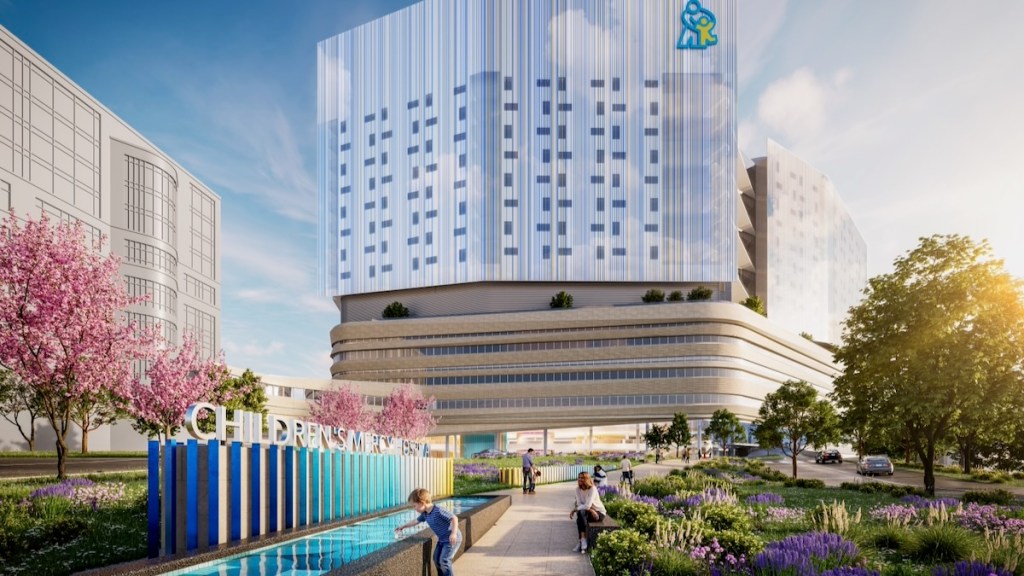
Children’s Mercy’s new hospital tower, expected to be completed in 2031, will add intensive care and surgical space, expand the emergency department and create an impressive new entrance to the hospital. Once the tower is complete, the hospital also plans to renovate existing space.
The total project, with an estimated cost of $1.3 billion to $1.72 billion, depending on inflation and other contingencies, includes:
- The tower project, estimated to cost $1.3 billion and to be built between 2026 and 2031. It will include a clinical building, an inpatient tower and a central utility plant.
- Renovating existing facilities on the campus, estimated to cost $379.7 million and to take place between 2031 and 2035. The hospital’s board of directors still must approve this phase, which could change in scope, size and timing, depending on future needs.
- A parking garage, estimated to cost $45 million. The hospital’s statement did not disclose a timeline.
Paying for the project
To foot the bill, Children’s Mercy told bond rating agencies it hopes to raise up to $500 million in new debt, while relying on operating cash flow and cash to cover $1.02 billion and tapping philanthropic gifts for $200 million.
The process of raising the debt is already underway.
Trading of bonds issued by the Missouri Health and Educational Facilities Authority on behalf of Children’s Mercy began in early June. Analysts estimate the funds raised through the sale of that series of bonds could bring in between $250 million and $350 million, depending on market conditions.
Future bond sales could extend the hospital’s new debt to $500 million, nearly three times its existing debt load.
But bond rating agencies are still bullish on the investment. In May, S&P Global raised the hospital’s bond rating on the new offering to AA from AA-, while Moody’s Ratings affirmed its current Aa2 rating of the hospital.
Both agencies assessed the stand-alone pediatric hospital as being in a strong financial position, with healthy earnings and financial reserves.
In 2025, Children’s Mercy reported more than $2 billion in net patient revenue, up from $1.9 billion in 2024. And operating income for the nonprofit hospital was $122 million in 2025, up from $104 million in 2024.
The hospital had unrestricted cash and investments, including funding from the hospital foundation, of $2.6 billion as of March 31. That represents 430.7 days of cash on hand on March 31.
The bond rating agencies also pointed to the hospital’s dominant market position as the only stand-alone pediatric hospital in Kansas and western Missouri. And they endorsed the hospital’s strategy to expand its reach into new markets and build more capacity on the main campus.
Moody’s Ratings’ report said it expected the hospital’s “superior market share and expanding regional draw” to support operating cash flow margins — meaning the cash generated by operations — in the range of 9% to 11%.
But there are still potential storm clouds.
About 40% of the hospital’s patient revenue is related to Medicaid, which means the hospital is reliant on related supplemental government income, which will decline in coming years. Like other hospitals, Children’s Mercy also expects to see an increase in the number of patients who lack health insurance thanks to new Trump administration policies. That could mean treating more patients who can’t pay.
In addition, the hospital is absorbing the ongoing costs of multiple capital projects, which the hospital described as the largest investment it’s ever made in direct patient care. In addition to building projects planned in Kansas City and underway throughout the region, the hospital is adding more express care and ambulatory specialty clinics to increase patient capacity.
Children’s Mercy just completed a $140 million investment in its electronic medical record system, switching from Oracle Health, formerly Kansas City-based Cerner, to Epic.
Analysts warned that the new debt and expense associated with the hospital’s main campus renovation could strain the rosy financial picture. Moody’s report concluded that “significant complications resulting from Children’s Mercy’s $1.7 billion capital plan” could lead to the hospital’s bond rating being lowered.