


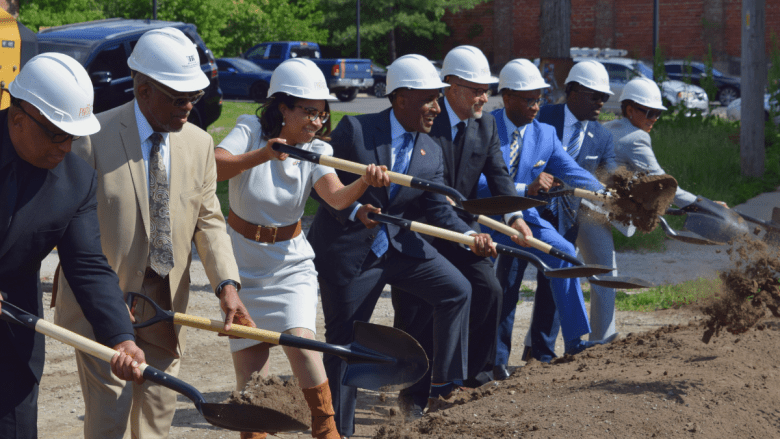
Kansas City voters will decide Aug. 4 whether to keep paying a sales tax that funds economic development within Kansas City’s urban core.
The renewal question for the Central City Economic Development (CCED) sales tax appears on the ballot as Kansas City Question 3.
Kansas City shoppers have paid the CCED sales tax — one-eighth-cent for every dollar spent — since voters first approved it in April 2017. The current voter authorization of the tax expires Sept. 30, 2027, so the question is back on the ballot. A “yes” vote continues the tax at the same rate for another 10 years. A “no” vote lets the tax expire next fall.
The tax is collected on all purchases subject to a sales tax citywide. The tax money is put into a dedicated fund that can only be spent on economic development inside a roughly nine-square-mile area. The CCED boundaries are Ninth Street to the north, Gregory Boulevard on the south, The Paseo on the west, and Indiana Avenue on the east.
Since 2017, the CCED tax has collected roughly $99 million, and it has awarded $89 million as of July 1. The CCED has helped fund nearly 60 economic development projects including more than 1,200 affordable housing units, according to the city’s housing data dashboard.
But the CCED got off to a rocky start and had a largely unfavorable 2023 audit. Since then the administration of CCED has shifted to the Economic Development Corp. of Kansas City.
The City Council voted 12-1 on May 21 to put the renewal on the ballot, with Councilmember Nathan Willett voting against it. A simple majority will decide the question put to voters.
Here’s what you need to know.
Click the links to jump directly to questions.
- What will I see on the ballot?
- What is the Central City Economic Development sales tax?
- What’s the origin of the CCED?
- How much does it cost?
- Who pays the tax?
- How can the money be used?
- How does CCED funding work?
- What has the CCED funded so far?
- What has changed since voters first passed it?
- What do proponents say?
- What do critics say?
- What does a “yes” vote mean?
- What does a “no” vote mean?
What will I see on the ballot?
The Central City Economic Development tax renewal is Question 3, one of five city questions on the ballot alongside four bond measures. You may vote “yes” or “no,” and a simple majority of votes cast will determine approval.
The exact ballot language is:
QUESTION 3
(Central City Economic Development Sales Tax)
SHALL THE FOLLOWING BE APPROVED?
Shall the City of Kansas City be authorized to renew a sales tax authorized by Section 67.1305 of the Revised Statutes of Missouri for a period of 10 years at a rate of 1/8% to be used for funding economic development projects within the area bounded by 9th Street on the north; Gregory Boulevard on the south; The Paseo on the west; and Indiana Avenue on the east, which may include the retirement of debt under previously authorized bonded indebtedness or to repay bonds not yet issued?This sales tax would continue the existing sales tax authorized by Section 67.1305 of the Revised Statutes of Missouri and scheduled to expire on September 30, 2027.
What is the Central City Economic Development sales tax?
The Central City Economic Development (CCED) sales tax is a one-eighth-cent tax applied to all retail and service purchases subject to Kansas City sales tax.
The resulting pool of CCED tax money is a dedicated funding source for economic development projects in the geographic boundaries outlined in the ballot measure.
The area — centered around the Prospect Avenue corridor — has experienced historic redlining and underinvestment, which the tax revenue is meant to help address and to help spur revitalization.
Funding from the CCED is designed to fill gaps in financing for economic development projects in that defined area. Applicants for CCED awards — the awards function similarly to grants from the collected taxes — are typically developers or organizations that have assembled most of their project plans or financing but need a final piece of funding to start or finish the work, according to CCED applicant guidance.
The stated goals of the CCED include:
- Foster and maintain diverse and sustainable neighborhoods.
- Create and expand employment opportunities.
- Create opportunities for access, equity and shared prosperity.
- Enhance opportunities for small and minority-owned business development.
You can see projects that have been awarded funding on the CCED project map.
What’s the origin of the CCED?
The tax didn’t originate in City Hall.
The Central City Economic Development tax was first placed on the ballot in 2017 through a citizen initiative petition with organized support from civic groups including the Urban Summit, Freedom Inc. and the Southern Christian Leadership Conference of Greater Kansas City. Their campaign at the time argued that a rising tide in the urban core would lift boats throughout the city.
Voters approved the CCED tax in April 2017 with about 52% of the vote citywide. The tax won 60% approval in the parts of Kansas City within Jackson County, but was defeated by margins of 31% in Clay County and 23% in Platte County.
The initial voter approval of the CCED tax was for a 10-year period that is set to expire in fall 2027. The question on the ballot is to extend the tax for another 10 years.
How much does it cost?
The Central City Economic Development tax rate is 0.125%.
Here’s how much someone would pay in CCED sales tax in practical terms:
- $10 in purchases equals 1.25 cents in CCED tax.
- $100 in purchases equals 12.5 cents in CCED tax.
- $1,000 in purchases equals $1.25 in CCED tax.
- $10,000 in purchases equals $12.50 in CCED tax.
In May, the city’s deputy director of finance told a City Council committee the CCED tax has generated more than $13 million a year since 2024 and roughly $99 million total since collections began in 2017.
Who pays the tax?
Anyone who makes a purchase subject to sales tax in Kansas City, Missouri.
That includes residents across the city, visitors, commuters and businesses. It is a sales tax, not a property or income tax.
One wrinkle is that taxes collected from many online purchases don’t go into the CCED fund. Purchases from out-of-state online retailers are charged Kansas City’s use tax at the same rate as sales tax. Despite similarities, they are separate and distinct taxes. Use tax money — taxes collected from many online purchases — goes into the city’s unrestricted general fund.
How can the tax money be used?
The state law allowing the city to impose the Central City Economic Development tax with voter approval sets several broad rules for how the money can be spent.
- All tax revenue collected must sit in a dedicated fund.
- At least 20% must go toward long-term economic development preparation — land acquisition, infrastructure, etc.
- No more than 25% can be spent on administration.
In practice, according to the most recent request for proposals, the CCED looks to fund projects related to:
- Eliminating blight, with actions including minor home repair programs.
- Preserving or constructing affordable housing.
- Acquiring or rehabilitating community facilities that will benefit residents.
- Commercial or industrial rehabilitation projects that meet CCED goals.
These economic development projects must be within the defined geographic boundaries of Ninth Street to the north, Gregory Boulevard on the south, The Paseo on the west, and Indiana Avenue on the east.
You can see projects that have been awarded funding on the CCED project map.
How does CCED funding work?
The Central City Economic Development tax money goes into a dedicated city fund. From there, the funding is distributed through a multistep pipeline.
Here’s what that looks like as described by the Economic Development Corp. of Kansas City, which administers the CCED.
- A request for proposals goes out. Developers, nonprofits and neighborhood groups apply for funding during a window of time, typically once a year.
- The CCED board reviews projects and makes recommendations. State law requires an unpaid economic development tax board of at least five members. The CCED board holds public meetings including project proposal presentations, and it scores proposals against criteria and goals before making recommendations. The CCED board meets monthly but is a recommending body without final say.
- The City Council votes on the CCED board recommendations. The council makes the final call and passes ordinances appropriating money from the dedicated CCED fund to be eventually paid out to chosen projects.
- Contracts get negotiated. Those awarded CCED funds must provide a range of administrative documents as well as commit to comply with applicable city rules like prevailing wage requirements or minority- and women-owned business participation goals before a funding agreement is signed.
- Money is paid out tied to documentation in the post-award phase. Award recipients begin to spend on contractually approved, documented costs based on their specific agreements and compliance requirements.
The city also has the ability to claw back awards. When a project withdraws or stalls, the City Council can pass an ordinance to move the unused award money back into the CCED fund for future projects. This is not hypothetical. The council has clawed back roughly $3 million in total unused awards.
The most recent request for proposals emphasized that projects needed to be “shovel ready” and would need to break ground within a year of signing contracts or projects risk having their award rescinded.
What has the CCED funded?
Since 2017, the CCED tax has collected roughly $99 million and awarded nearly $90 million to 57 projects, according to the city’s most recent public accounting. That money was awarded through eight competitive funding rounds, with the most recent awards announced July 20.
Buildings you can see
Several developments supported by CCED are physically open or operating, including:
- The business incubator at 5008 Prospect Ave., a $628,000 award for renovation completed in 2018 — the first CCED-awarded project that was completed. The Community Builders of Kansas City building now houses, among other tenants, Kansas City G.I.F.T., which awards grants and support to Black-owned businesses.
- The Emmanuel Family & Child Development Center, a roughly $9 million daycare and early childhood center at 47th Street and Prospect Avenue that had a ribbon cutting in February 2020 and received $725,000 from CCED.
- KD Academy, a roughly $4 million, 10,000-square-foot early learning center at 2141 Prospect Ave. The 24-hour daycare opened in 2021 with $1 million in CCED funding.
- One Nine Vine, a $26 million phase one for a mixed-use development at 1901 Vine St. with 80 apartments and seven ground-floor retail spaces, built with $3.9 million in CCED funds.
- The Zhou B Art Center, a roughly $27 million conversion of the long-vacant Crispus Attucks School at 1801 E. 18th St. into an arts center with 45 studios and multiple galleries. It opened in June 2024 with $1.875 million from the CCED.
- The Boone Theater, the 1924 landmark at 1701 E. 18th St. that reopened May 1 after an $8.7 million restoration. It was among 15 projects funded in the CCED’s seventh funding round.
The work you can’t see from the street
Most CCED projects have been focused on housing. The city’s housing dashboard credits CCED-supported projects with more than 1,200 projected affordable housing units as of July 1. That includes new construction, but also preservation of housing that already exists and repairs for people already living in it.
In the most recent round, the CCED made awards including $1.5 million toward renovating the 96-unit Justin Place Apartments near 29th and Prospect, $700,000 for critical repairs and energy-efficiency work on about 35 owner-occupied homes in the Santa Fe neighborhood, $300,000 for preserving 20 affordable homes across six historic properties in the 18th & Vine Jazz District, and $300,000 for six new single-family homes on previously blighted lots that will be available for purchase.
Being awarded funding isn’t the same as finishing
City Council approval of CCED funding is the middle of the process, not the end. Several projects that received awards are still in development or construction. This includes $1 million to restore Satchel Paige’s former home in the Santa Fe neighborhood, a $3.875 million award connected to the planned Negro Leagues Baseball Museum hotel and an $1.25 million award to redevelop the Parade Park homes site.
Some awarded projects never get completed at all. When that happens, the awarded money returns to the fund. The council recovered about $2.6 million in 2024 from three withdrawn awards and reclaimed a $422,354 unused award from a studio-and-housing rehabilitation project.
You can see projects that have been awarded funding on the CCED project map.

What has changed since voters first passed the CCED?
The CCED tax itself is unchanged. It’s the same 0.125% tax rate, the same geographic boundaries, another 10-year term, the same five-member board structure, and the City Council’s final authority over spending awards remains unchanged.
There are two key differences since the last time the CCED was on the ballot. One, there are now years of program results. Two, administration of the CCED funds has changed.
Administration of the CCED transitioned in late 2025 from city staff to the Economic Development Corp. of Kansas City. The EDC is a nonprofit organization that serves as the city’s primary development and business advocacy agency, functioning as a liaison between the city government, local businesses and real estate developers.
The move followed years of complaints about the pace of the project pipeline. Further, a 2023 performance audit by the city documented contracting delays, inactive awards and unclear roles between the CCED board and city staff. The EDC now houses a dedicated CCED staff, a structure intended to make funding rounds more predictable, improve tracking and speed up contracting.
What do CCED proponents say?
Supporters of the CCED tax argue its funding fills a gap the private market has left open.
They assert that development costs in the area are the same or higher than in the rest of the city, but — given historic redlining and underinvestment — completed projects are often appraised lower than similar projects in other parts of the city. This can make banks reluctant to lend in the area, and supporters say CCED money is what helps make development happen. The developers of KD Academy and One Nine Vine have both said their projects likely would not exist without it.
Mayor Quinton Lucas rallied for all five city ballot measures at KD Academy on July 20, warning that unless the CCED sales tax is renewed he expects redevelopment on Prospect Avenue to move backward.
Supporters also point to leverage. According to the EDC, the $8.08 million in Round 8 awards is tied to about $50.3 million in total proposed project investment, suggesting that private dollars will follow the public investment into the district’s neighborhoods.
What do CCED critics say?
Criticism of the CCED tax has largely centered on its slow early pace and accountability.
A 2023 performance audit by the city examined a sample of 10 awarded projects. While the audit noted that most projects were making progress, it found only two fully constructed with completed paperwork. Of the 10, five were under construction and three had never signed a funding agreement at all.
Developers and CCED board members told reporters at the time that projects languished for a number of reasons, including that city staff and attorneys were slow to respond. It was reported that only about 40% of the money the City Council had authorized had actually been paid out by late 2023.
The audit also documented inactive awarded projects, unclear roles between the CCED board and city staff, and two projects with contract or control problems — including a payment made without a required deed restriction meant to preserve affordable housing for veterans. The administrative move to EDC came after those findings.
Skeptics also note that sales taxes are generally considered regressive, meaning people with lower income pay a higher share in sales taxes.
The split with the Northland — 1st District City Councilmember Nathan Willett voted to keep CCED renewal off the ballot, and the original 2017 CCED vote was opposed by margins of 31% in Clay County and by 23% in Platte County — also points to possible resentment of taxes being collected citywide but being distributed into a concentrated area.
What does a “yes” vote mean?
A “yes” vote continues the CCED tax for 10 years. The one-eighth-cent sales tax would be extended until Sept. 30, 2037.
What does a “no” vote mean?
A “no” vote would allow the CCED tax to expire Sept. 30, 2027. The tax would still be collected until then. After that, the dedicated funding stream for the district would end. Money already collected would remain in the dedicated fund.

