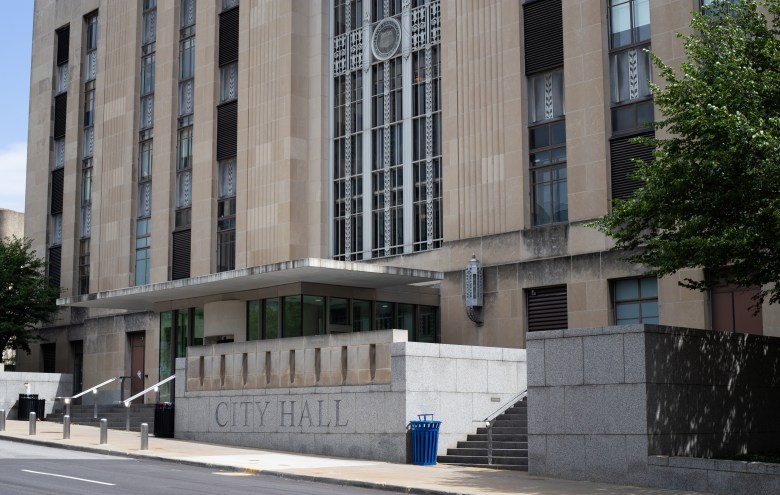
With a date set for when voters will decide whether to eliminate Missouri’s state income tax, Kansas City-area officials are left with questions on what the move would mean for local government operations.
Takeaways
- The bill’s vague guidelines have made it difficult for Kansas City-area officials to predict its exact impact. But they worry that it could hamper local budgets and the ability to provide services.
- Local governments would have limited options on which local tax rates they could adjust to comply with provisions in the bill that prevent a windfall of new revenue. With earnings taxes approved by voters and property taxes mostly going toward schools, it leaves local sales and use taxes as the likely targets.
- Officials also worry that cities close to the state lines could lose out on revenue as consumers and business owners cross over to other states for lower sales taxes.
Voters will decide on the Aug. 4 ballot whether to eliminate the state’s income tax by expanding sales taxes.
It will appear alongside other questions asking voters to reauthorize a sales tax for state parks and soil conservation, whether the Jackson County assessor should be an elected position and whether changes should be made to the initiative petition process that would make it harder to pass such items.
The income tax elimination bill, HJR 173, was a top priority for Republican lawmakers and Gov. Mike Kehoe this year.
If voters approve the measure, lawmakers would be directed to pass legislation to reduce the top income tax rate, which is 4.7% on incomes over $9,191. Once the income tax is eliminated, future legislators would be prohibited from reinstating any individual income tax.
Lawmakers would also have broad authority to raise state sales tax rates and expand what can be taxed for the next five years without additional voter approval. Any changes to the sales tax would have to be directly tied to an income tax rate decrease equivalent to the amount of money the increased sales tax would bring in.
To bring in the same amount of revenue that income taxes generate for the state, the state sales tax rate would have to be raised from 4.225% to 10.7%, or the base must be expanded to tax over $300 billion in economic activity, according to the Missouri Budget Project, a left-leaning policy analysis organization.
Currently, the state sales tax is not applied to most services, such as haircuts, childcare or digital purchases. Certain industries like healthcare, real estate and agriculture are also exempt in most cases from state sales taxes. But the legislation does not outline any carve-outs for specific industries.
The lack of specifics in the plan has caused consternation among seniors and low-income workers who worry that increases to the sales tax could force them to choose between rent, food or medication.
Officials in Kansas City and surrounding counties are also navigating that uncertainty. Kansas City Assistant City Manager Tammy Queen said in an email that the city expects a negative fiscal impact, but is uncertain of the exact amount.
That’s because of the bill’s vague guidelines for increasing the sales tax, the potential impacts on businesses and social services and how the city would adjust rates to comply with the bill.
“At this point, we have more questions than answers on this,” Queen wrote.
Limits on what can be adjusted
Contained within the bill is a provision for local governments, fire districts, libraries and schools to make one-time adjustments to one or more of their local tax rates if the state expands the sales tax base.
Local units of government could choose to change local sales and use taxes; property taxes on personal, residential, commercial or agricultural property; or earnings taxes.
For Kansas City, choosing what to adjust would be complicated by prior commitments.
The city’s 1% earnings tax brings in nearly 45% of the city’s general fund revenue, and voters in April overwhelmingly approved keeping the tax until 2031.
Queen confirmed that the city cannot make any changes to the earnings tax since it was approved by voters.
There’s another catch. Local governments would not be allowed to adjust their local tax rates in a way that would reduce funding for public schools. That would limit what could be adjusted with property taxes.
Local revenue sources — mostly property taxes — account for 57.5% of all revenue for Missouri schools. Property taxes supported 70% of the Kansas City Public Schools’ budget for the 2025-2026 school year.
That leaves local sales and use taxes as the most likely targets for local governments to adjust. But doing so comes with its own risks if cities need to adjust rates in the future to generate revenue for new projects, said Stuart Haynes, deputy director of the Missouri Municipal League.
The Missouri Municipal League is a statewide nonprofit that seeks to strengthen its 650 municipal government members through unity and cooperation.
“Once that sales tax gets up around 10%, it’s going to be hard for anybody to pass a sales tax if it’s at 10% after that,” Haynes said. “And a lot of cities have sales taxes in place that automatically sunset, whether it’s a transportation sales tax, capital improvement, parks, and so getting those to continue after this would be difficult.”
Those constrictions and uncertainty have made planning for future impacts more difficult, Kansas City 2nd District Councilman Wes Rogers said. That has played out in budget discussions so far.
“It makes it impossible to plan,” Rogers said. “Then, before we know it, we’ll be back on the ballot with our earnings tax, and then go through all that uncertainty again.”
Driving business across state lines
Another concern is the potential loss of revenue if sales taxes go too high, since several of Missouri’s biggest cities are astride state lines.
In Kansas City, its dual-state nature is sometimes touted as an economic advantage. But local government officials, like Jackson County 1st District Legislator Manny Abarca, worry that increasing the sales tax would push businesses and customers to cross state lines for their purchases.
“Folks in Kansas come to Missouri to get gas, because we have (a lower) gas tax here, to save 10 cents, and the same will be true of groceries and everything else,” Abarca said. “If it is cheaper and more affordable to buy things on the Kansas side, they’ll go there, and that’s going to cause a slump in our localized economy.”
Kansas has a 6.5% state sales tax rate.
Whether shoppers actually cross state lines would likely depend on how quickly the Missouri legislature raises or expands sales taxes, said Frank Lenk, the director of economic research for the Mid-America Regional Council.
He compared it to the parable of the boiling frog. An instant drop into hot water will cause a frog to jump out — in this case, high sales taxes right out the gate. But if placed in a pot and slowly brought to a boil, the frog won’t notice the gradual change.
“People don’t change their habits that quickly,” Lenk said. “Every time there’s a sale made, if I buy something, my cost is going to be three percentage points higher. I’m going to be unhappy about it, but am I unhappy enough to really change where I shop?”
If Missourians do end up changing their habits and businesses migrate, Abarca said the loss of revenue combined with the difficulties of changing local tax rates to comply with the bill would complicate the area’s ability to fund repairs to infrastructure or health programs.
“It’s a no-catch-up game of chase the rabbit,” Abarca said. “We’re never going to accomplish any new thing. We’re never going to innovate the county like has been done in the past. And all we’re going to do is say, ‘Cool, you kept 100 more dollars in your paycheck, but it costs you millions of dollars more in no bus service, so you got to buy a car.’”
Jackson County could borrow against its future revenues to pay for immediate issues, Abarca said, but it would lead to the same problems in the future since the money would already be spent.
The income tax elimination bill is written to be revenue neutral. But critics point out that any miscalculations, like those that happened with the capital gains tax, in addition to lean budget years could lead to reductions in state services.
But that doesn’t mean the need for those services goes away, Lenk said. As both the federal and state governments move forward with cuts to Medicaid and the Supplemental Nutrition Assistance Program, more people would likely turn to local governments for help.
The money to pay for those services has to come from somewhere, said Haynes of the Missouri Municipal League, which would force governments to prioritize services if they have to reduce local rates or voters deny increases.
“Prices are already going up for services. You try and get a street paved, any type of construction, costs are going up,” Haynes said. “Cities have to live within their budget, and when that’s getting constrained, then they’re faced with tough decisions.”
The entire income tax plan is part of larger debates about the value of government and the services it provides, Abarca said.
“We’ve got to figure out, are we going to work together on this?” Abarca said. “Or are we all going to grab our chips and stand in our own house and try and protect what we got? We’ve always had to work together in this country. We should continue to do that with our taxation models as well.”