
Working with her nursing home residents in Kansas City, every day LaTonya Sullivan sees the struggles some face paying their bills.
Takeaways
- Many low-income workers already do not pay state income taxes, so any increases to the state sales tax rate or base would increase their tax burden. It is estimated that 80% of Missourians will see their tax burden increase under the plan.
- Budgets are already tight. Low-income workers are living on razor-thin margins, where an increase in expenses could mean deciding whether or not to pay rent. For some, it might mean losing their homes.
- There are no fallbacks. Should the proposal end up causing the state to lose more revenue than predicted, as was the case with the capital gains tax elimination last year, it could lead to cuts of state-run services that low-income workers depend on as the state faces tough budget years ahead.
Now, with a proposal to eliminate the state income tax and offset it with increased sales taxes heading to the Missouri ballot, Sullivan worries those struggles will only increase for working people like her.
“It’s emotional for me, because I see it every day,” Sullivan said. “I see it at work. I see it at home. I’m constantly around it.”
The proposal, which awaits Gov. Mike Kehoe’s decision on whether it will appear on the August or November ballot, would direct the Missouri General Assembly to set revenue baselines and triggers for reductions in the income tax rate.
In addition, legislators would get broad authority to increase state sales taxes or expand what is subject to sales tax for the next five years. Any changes to the sales tax that would generate more revenue must be tied to reductions in the top income tax rate.
Currently, legislators must get approval from voters before implementing new sales taxes.
Income taxes now generate roughly $9.2 billion in state revenue. Unless the state expands the sales tax to things that are not currently taxed, it is estimated the state would have to increase the state sales tax rate by 8.5 percentage points to bring in the same revenue. That would increase Missouri’s sales tax rate — currently 4.225%, with 3% going toward state general revenue — to 12.725%.
Missouri Budget Project, a center-left public policy think tank, estimates that 80% of Missourians would see their net tax cost increase. In comparison, the 20% of Missourians — defined as those making $300,000 or more a year — would see their overall taxes decrease.
The sales tax rate could be lower if lawmakers expand what can be taxed, but several major industries like agriculture, real estate and healthcare have tax exemptions. Many worry that should those exemptions disappear, it would hurt seniors and make people choose between meals and medication.
Even if some exemptions were to remain, it would likely be those that special interests managed to carve out, said Sarah Narkiewicz, the director of the Low Income Taxpayer Clinic at Washington University in St. Louis.
“Generally, those people are not the people that are going to be focused on low- and middle-income people,” Narkiewicz said. “They’re focused on businesses and wealthier individuals.”
The potential for higher sales tax rates on everyday necessities has Sullivan and others across the state worried at a time when resources are already stretched thin.
“All these places that are giving out utility assistance and rental assistance and food pantries, they are stretched to the max right now,” Sullivan said. “They said everything is at an all-time high, because so many people are struggling. So many people need that kind of assistance.”
On a knife’s edge
Many low-income and working families already pay little to nothing in state income taxes after deductions.
So eliminating the income tax would do nothing to help, Sullivan said.
People are considered low-income when their family’s taxable income for the preceding year did not exceed 150% of the federal poverty line.The federal poverty line for a household of four is $33,000. To be at 150% of the federal poverty line, that cutoff is $49,500.
The lump sum from tax refunds often actually offers a small boost that can go toward bills or paying for repairs.
“It’s almost like a savings plan, in a way, because I know most people, when they get their income taxes, they’re looking to get a new car, because their car is on its last legs,” said Bill Thompson, a family caretaker for his wife and a member of Stand Up KC, a coalition advocating for better pay and working conditions for low-wage employees in Kansas City.
Plus, credits like the working family tax credit or the circuit breaker tax credit that helps people offset property taxes and rent that are claimed during income tax return filings would need a new process through which people could claim them.
In comparison, there’s nothing to offset sales taxes.
“If it’s all rolled over in a sales tax, there’s no discounts for that,” said Jennifer Layton, a Columbia resident living on disability income.
“They are going to be taxing things that have never been taxed before, or that we don’t pay taxes on now, like a mechanic getting your car fixed, having a repair person come to your home and fix your appliances. These are things that can be very large expenses already.”
In contrast, any sales tax increases could be devastating for those already struggling to make ends meet.
Layton receives around $1,000 a month for disability. By the time bills for her house, utilities, groceries, prescriptions and other expenses are paid, it’s a good month if she has $25 left over to put into savings. Increases to any of her expenses would force her to decide what category to prioritize, but a sales tax on healthcare costs would be especially troublesome.
“My medical costs are astronomical, and I already can barely afford the things that I need to have any sort of quality of life,” Layton said. “I really don’t know what I’m going to do if this passes.”
She’s also worried that increased expenses would force her out of her home, a fear Thompson shared.
“I’m looking at possibly losing our house,” Thompson said. “A fourth-generation house that was built on union labor from previous generations. It’s the only reason that we are sitting here and own our home and we are going to lose that legacy work.”
The only solution many people have would be to cut back on consumption.
“If haircuts are a luxury, then we’re not living in the right way,” Narkiewicz said. “People need haircuts. People need to go to the dentist. People have needs. And just because you’re poor doesn’t mean you don’t have needs and don’t deserve basic living experiences.”
The stress from the income tax elimination proposal is already taking its toll, both mentally and physically, on people. Layton’s anxiety has gotten so bad that it is affecting her energy levels and ability to do her physical therapy.
“Financial strain is a truly, truly horrible state of need,” Layton said. “If you are worried about every penny, that is an extra level of stress that is not helping my disability.”
No other options
As Missourians brace for the impact of potential sales tax increases, they’re also thinking about what could happen to the services they depend on.
The proposal claims to be revenue-neutral, but critics point out the same points were made about the recent capital gains tax elimination. That plan was sold on the claim that it would only reduce state revenue by a little more than $100 million. The cut actually ended up costing the state $500 million in revenue.
Should any income tax rate cut reduce revenues faster than a sales tax increase could keep up, that could pose trouble for state-run services like the family caregiver program Thompson utilizes to care for his wife.
The legislature has already warned that it will need to tighten up the state budget as it prepares for future fiscal troubles.
Thompson laughed, saying there were other tax options to help allay budget problems without shifting the burden of paying for the government onto low-income people.
“My belt’s already tight enough,” Thompson said.
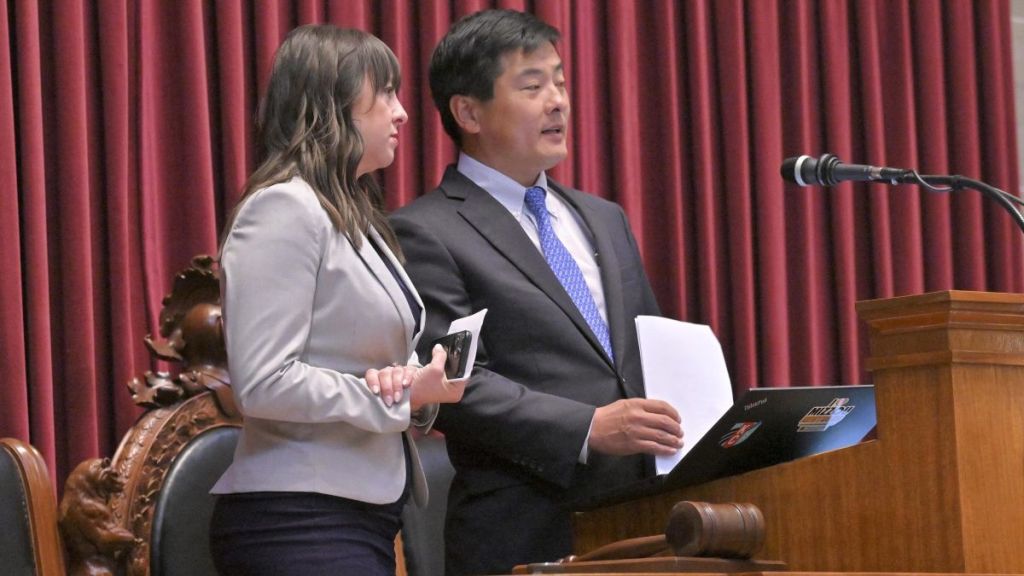
Even for middle-income families that might see modest gains from an income tax elimination, a cut to state services would hurt them as well as they still benefit from the ones people take for granted.
The “state pays for a whole lot of things, roads, schools, higher education, all these things that we take for granted,” Narkiewicz said. “We may think losing some of our tax liability from an income tax standpoint is great, but there’s definitely going to be repercussions to that.”
Voters will have the final say on the income tax elimination. Sullivan hopes that people will see the far-reaching impacts the proposal could have.
“I’m hoping people realize that this is not going to make us any better,” Sullivan said. “This is not going to make our economy any better. The best thing to do is come back to the table. Let’s discuss it some more. Let’s figure out a better way to help these families who are at a low income right now.”