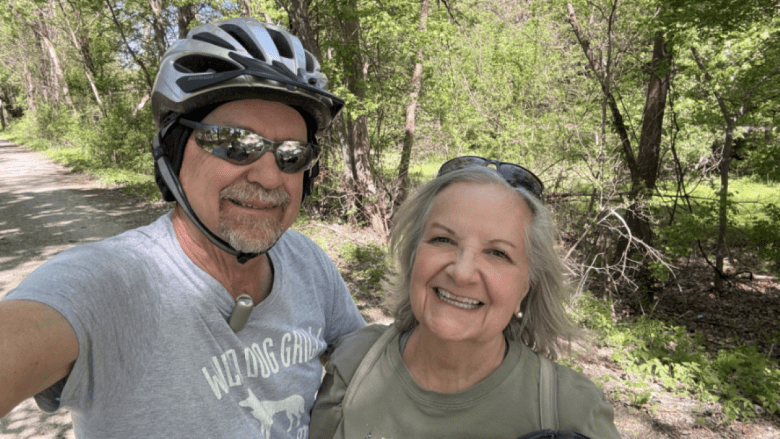
Julie Carel worked as a mental health professional for the Missouri Department of Mental Health for more than 25 years. Since retiring in 2011, she and her husband, Doug, have enjoyed their free time.
As they tend their garden or ride bikes down the Katy Trail, they’re also pondering potential home repairs they’ll need to make in order to age in place. But with sales tax increases possible through a proposal the Missouri legislature is debating that would eliminate state income taxes, worries about what that might cost them have become much more prevalent.
They’re not the only ones.
Older Missourians have come forward in opposition to income tax elimination, saying a subsequent expansion of the sales tax would only hurt them because their tax burden would grow without any income tax cut benefits.
In Missouri, one in four people are age 60 or older.
Carel, who testified against the proposal, said it adds to the financial struggles many older citizens are already facing.
“If we’re not paying any income tax now, but then we have all these other things that are taxed, that means we have less money,” Carel said. “They’re touting and selling this as, ‘Yippee, you don’t have income tax anymore, so you’re going to have a whole lot more money in your pocket.’ Well, we’re not. We’re going to have less money in our pockets.”
The revised version of the income tax elimination measure passed the Senate 18-11 in the wee hours Thursday morning and now goes to the House for a final vote, as an amendment was added to remove the automatic revenue triggers for tax rate cuts.
The proposal directs lawmakers to set tax cut triggers and maintains the five-year window in which lawmakers could decide to raise the sales tax rate or expand the base of what is subject to sales tax. Any legislation that expands the sales tax must also contain an income tax rate reduction that is equivalent to the revenue the expansion would produce.
The legislation will still require approval from voters at the ballot in November.
Much of the consternation around the plan stems from a lack of answers about its impacts. Rob Didriksen, a retired manager of the state’s recycling program who also testified in opposition, said it’s harder to gauge the individual financial impact when it comes to sales tax.
“I can go back and see how much I paid in income tax every year,” Didriksen said. “I can understand what that looks like pretty accurately. But when it comes to sales tax, like how much did I spend on sales tax last year? I have no idea.”
Jay Hardenbrook, the state advocacy director for the Missouri American Association of Retired Persons, estimated that 90% of retirees would see a tax increase under the proposal. Missouri AARP testified against the proposal.
Vague guidance on what could become subject to sales tax or how much the rate could be raised is also contributing to uncertainty.
For example, industries like health care, agriculture and real estate are exempt from state sales tax. Gov. Mike Kehoe, who has made eliminating the income tax his top priority, said in his State of the State address that he wants to continue exemptions for those industries in the legislation.
However, the current language in the proposal has no measures that would prevent future legislatures from removing those exemptions.
If industries like health care were to lose sales tax-exempt status, Missouri Association of Area Agencies on Aging Executive Director Julie Peetz said she worries a shift would financially destabilize seniors. Her group advocates for the 10 Area Agencies on Aging across Missouri that provide support services and resources to aging adults.
“It could severely impact your costs … if health care adds the sales tax,” Peetz said. “It would really disproportionately hit people with lower incomes, because they won’t see any benefit, but they will see a net increase in their overall cost, just based on service costs and sales taxes and just general upswings there.”
Those increases, Peetz said, could force some seniors to choose between meals and medications.
No wiggle room
An increased sales tax could be especially troublesome for seniors who rely solely on Social Security benefits or other fixed-income sources.
“There’s a lot of pressure on seniors. It is for everybody, but seniors, especially who are on fixed incomes, have a real hard time with cost increases,” Peetz said. “We keep seeing increases go up, and of course, the fixed incomes do not.”
The average monthly Social Security benefits check was $2,071 as of January 2026, according to the Social Security Administration.
That becomes an issue as seniors spend the majority of their income on basic necessities compared to those who are wealthier, said Marc Cohen, co-director of the LeadingAge LTSS Center at the University of Massachusetts Boston.
“It’s probably a true statement that people of higher income spend more,” Cohen said. “The issue, though, is relative to their capacities, the tax will consume a smaller share of their overall wealth and income. But if you’re on a fixed income, and almost all of it’s going to consumption, that means you’re being taxed on a much higher share of your income, because it’s going to purchase goods and services.”
For most households ages 65 or older, monthly expenses are around $5,119, according to surveys from the Federal Reserve Bank of St. Louis.
Even when spending on personal services typically associated with the wealthy, those aren’t necessarily luxuries for older people, Hardenbrook said.
“Once you reach a certain age where you can’t drive anymore and you don’t have any way to get to a doctor’s office, that nurse visiting your home is no longer a luxury,” Hardenbrook said. “It’s essential.”
Another worry is that removing the income tax when the state is already facing a fiscal crunch for future budgets could hurt state services like nutrition or transportation assistance that some seniors rely on.
“If you take that away, you’ve got to come up with an awful lot of money,” Carel said. “You’re expecting that to be on the backs of people who don’t work anymore. They don’t have income tax, but they still have to purchase services and goods.”
Without those services, some seniors would not be able to live safely in their homes and would instead turn to Medicaid-funded nursing homes, Peetz said. To prevent that from happening, she hopes that the legislature will carefully account for the impact the proposal will have on some of Missouri’s most vulnerable.
“We want Missouri to be an attractive place for people to live and work,” Peetz said. “We just don’t want it to be at the expense of vulnerable populations, like seniors and people with (a) disability and especially low-income people who just don’t have that wiggle room.”