There’s a world where Kansas City could invest close to half a billion dollars modernizing its aging downtown convention facilities. It’s one that would position the city to build off of momentum from global sporting buzz and better compete for events and visitors with glitzier spaces other big cities are developing.
However, it’s also a world where officials will have to get creative with funding after a year spent pledging millions of available convention dollars to other projects.
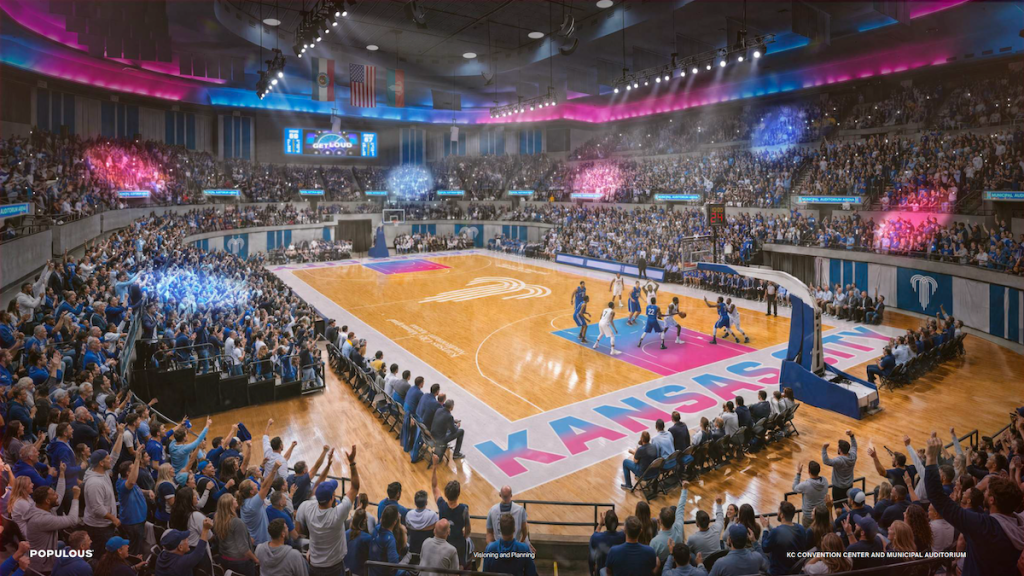
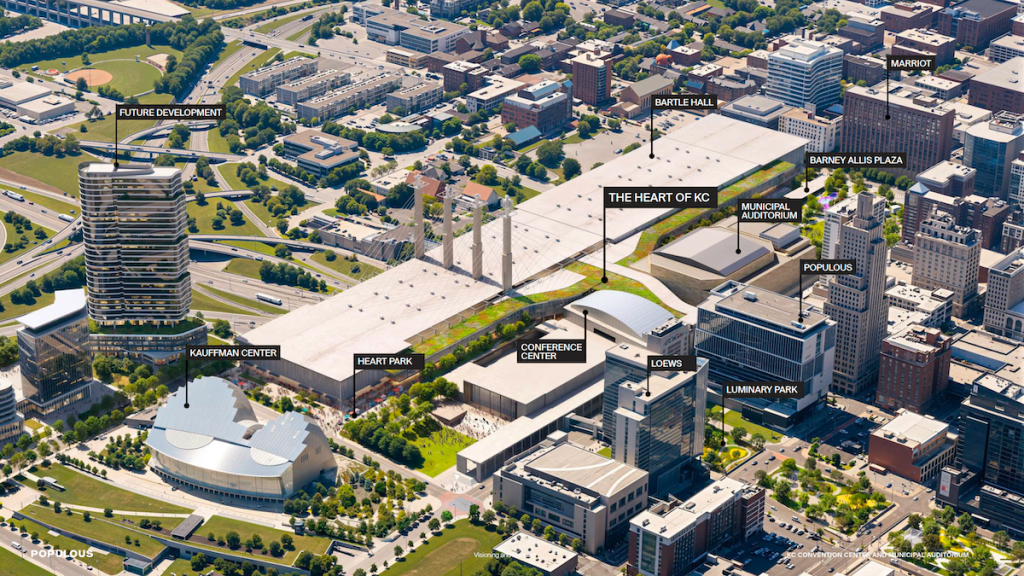
The City Council last week asked for a study of how they could implement “some or all” improvement projects outlined in a “vision plan” for the eight-block Kansas City Convention Center complex. The council also authorized a request for proposals so the city can nail down final costs and other specifics for the plan’s “phase zero”: an estimated $75 million to upgrade seating, concessions, accessibility and building utilities at Municipal Auditorium and the Music Hall.
That $75 million estimate was the amount earmarked for Kansas City convention facilities, out of $100 million in general obligation bonds city voters authorized for civic building upgrades in August. The $25 million balance is supposed to go toward deferred maintenance at City Hall.
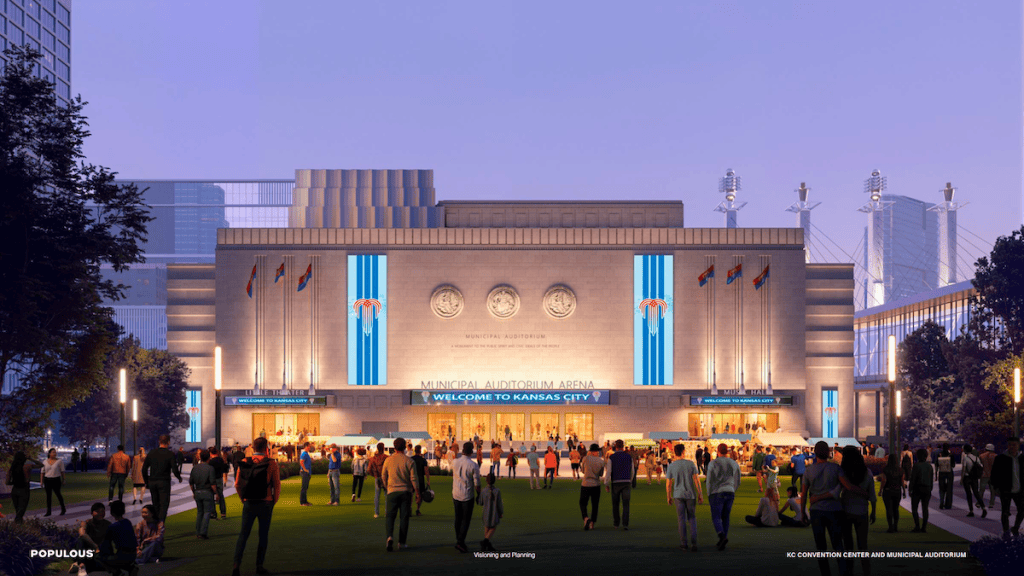
Municipal Auditorium has earned accolades as a city landmark since its 1935 opening and over time developed a wealth of sporting, cultural and civic history. In years past, the auditorium hosted more than 80 NCAA Men’s Basketball Tournament games, including a record nine Final Fours through 1964, as well as speeches by Dr. Martin Luther King Jr. and performances by musical legends like Count Basie, Duke Ellington, Elvis Presley and Frank Sinatra. It’s also home to the University of Missouri-Kansas City Roos, who last week played their homecoming game downtown.
“With UMKC basketball returning, we have a particularly timely opportunity to reinvest in this remarkable facility,” said Kimiko Gilmore, executive director of the city’s Convention & Entertainment Facilities Department, during a Nov. 3 finance committee meeting. “Our objective is to preserve what makes Municipal Auditorium special while ensuring that the building meets the expectations of today’s audiences, performers, event organizers and visitors.”
Inside the vision
The voter-approved bonds will provide dedicated funding for $75 million in initial convention center improvements targeted through August 2028. But it’s an open question how, or if, the city can afford any more of what the “vision plan” shows as up to $440 million in modernization projects for its convention center and surrounding public space through 2036.
The city did not go into much detail on the broader plan, designed by sports architect Populous, during recent public meetings. The Beacon obtained a copy through an open records request.
A 17-page plan summary suggests two potential pathways for the city’s convention complex: a $440 million “full build out” involving several new additions onto Municipal Auditorium and Bartle Hall, or a less costly $370 million option focused on renovations to existing convention facilities.
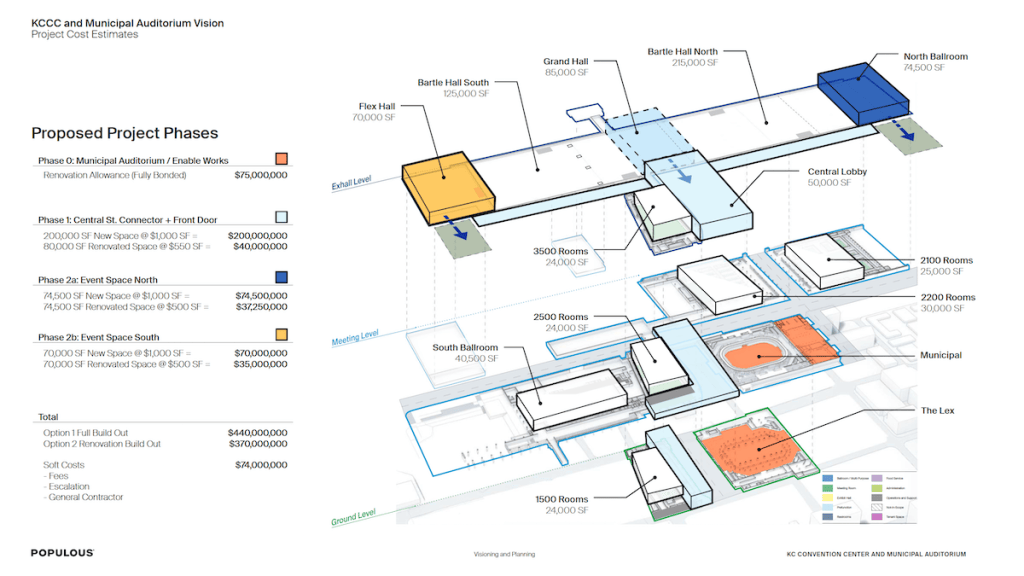
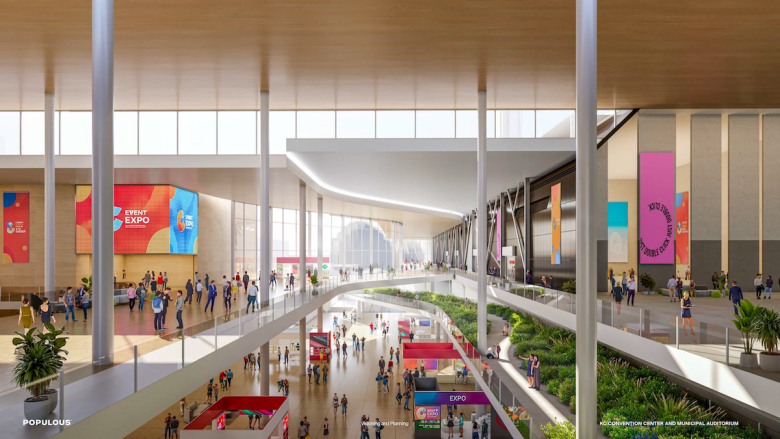
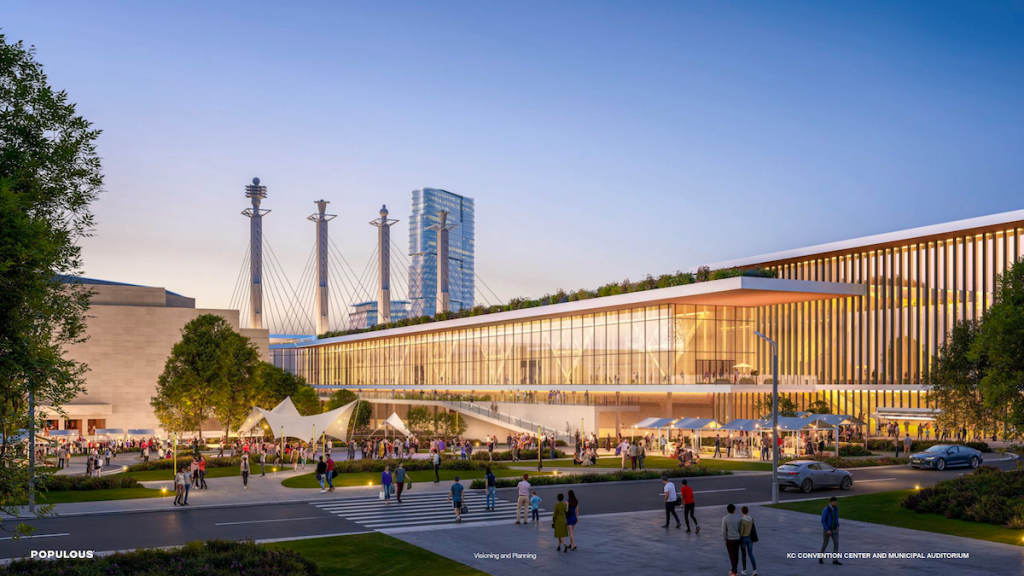
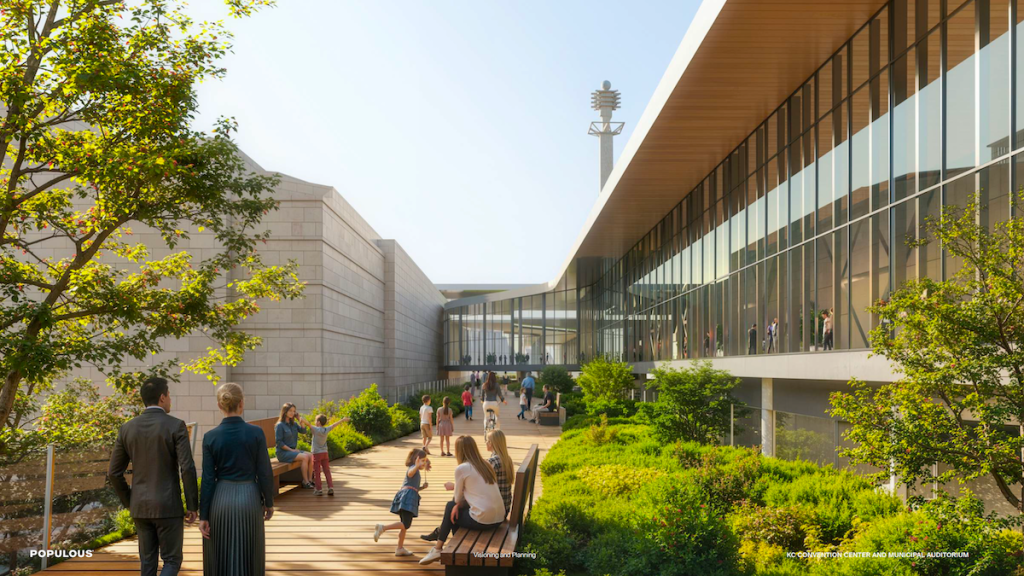
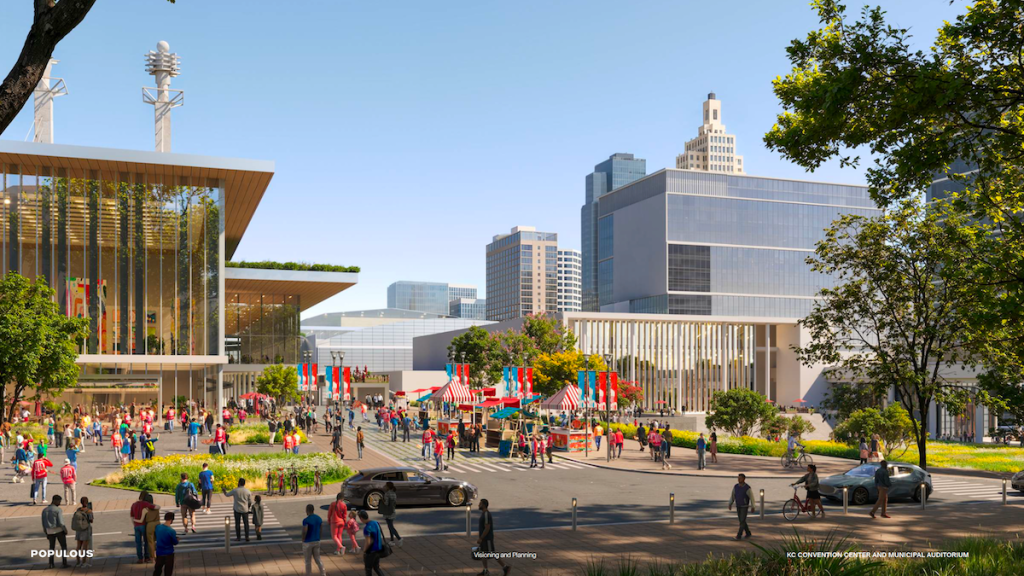
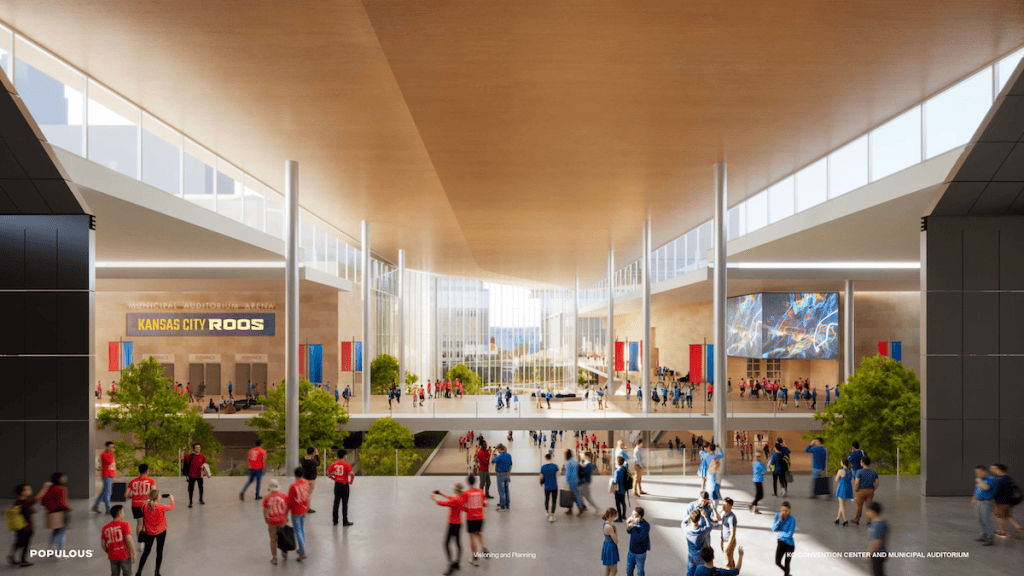
Conceptual renderings in the plan appear to show a large glass lobby connecting the auditorium with Bartle Hall, an elevated pedestrian space along Central Street, new event spaces built above existing loading docks to the north and south and a “Heart Park” at 16th and Wyandotte streets.
The council’s vote last week does not commit the city to any of those concepts. City emails obtained by The Beacon show officials could lean on convention and tourism taxes to fund later “vision plan” phases.
However, they’ll have less tax money at their disposal for the foreseeable future that they could use on those facilities. That’s because council members in recent years pledged convention taxes to several other discretionary projects like Roy Blunt Luminary Park atop Interstate 670 and Royals stadium infrastructure, even as some officials warned of unknown convention facility needs on the horizon.
‘No further real capacity’
Kansas City started its 2026-2027 fiscal year with roughly $22 million available for tourism- and entertainment-related projects in its convention and sports complex fund. The fund is just one of many accounts in the city’s annual budget, replenished in large part from restaurant taxes. It’s effectively a dedicated piggy bank the city can use to fund civic and entertainment projects or save for a rainy day.
In recent years, the City Council has opted for project spending. As a result, the city’s Finance Department predicts Kansas City will spend that balance down to just $3 million by fiscal year 2034. After that, once the city finishes paying off debt for several older projects, the pot of money for tourism projects will jump to around $12 million, according to internal projections shared with council members in early September.
At the start of this fiscal year, the city was already using its convention fund to pay down special obligation bonds approved in 2024 and 2025 for Barney Allis Plaza’s redevelopment, a public parking garage in the 18th & Vine Jazz District and one of two tranches of debt for Luminary Park, intended to get the urban green space to its final design stage.
From there, the council further authorized $20 million in bonds for an initial round of infrastructure for a new Royals stadium in August, and as much as $51.6 million more for Luminary Park, this time to start construction on the first block of the planned park.
The council agreed to support those Luminary Park bonds in early September, but not before some officials, including Mayor Quinton Lucas, pointed out that spending more on the freeway cap park could come at the expense of upgrades to the city’s convention facilities. The discussion drove council members to pump the brakes. They specified that state and federal funds should be spent first on Luminary Park, and more private funds should be raised, before the city issues more bonds down the road, in fiscal 2028. That could free the city up to issue less than the previously planned $51.6 million on the project.
Before the Luminary Park vote, at a Sept. 1 committee, Lucas said of the limited money for convention facilities, “The reason I actually care now instead of saying, ‘I’m gone in 11 months,’ is because I don’t want us to hamstring the next council when they say, ‘Oh, wow, well, we’ve got a $40 million repair, we’ve already spent the bond money here and we have to use these things to keep things going.’”
At the time, Assistant City Manager Tammy Queen told council members that, should they approve the Luminary Park bonds, the convention fund would have “no further real capacity” for other projects — including facility upgrades beyond the $75 million round supported by voters — until 2035.
That doesn’t necessarily mean additional convention projects couldn’t happen until then, but it’s not clear how the city would pay for such upgrades. Officials might need to scale back the concepts cooked up by Populous to save on costs, similar to how the city has needed to rework plans for a permanent jail due to a public safety sales tax shortfall.
Finance Director Brenton Siverly also cautioned council members in a Sept. 2 email to be wary of issuing too many bonds in the city’s name to protect the city’s bond rating, which is similar to a credit score.
While no single project may directly result in a downgrade of the city’s rating, Siverly said, the cumulative impact of issuing bonds for a multitude of projects at the same time “could have a negative impact by overleveraging the City’s debt as a percent of governmental funds revenue.”
The city’s credit rating affects how much interest the city has to pay when borrowing money. Siverly said it will be important for the city to lower the risk of a downgrade by waiting to issue debt until projects are construction-ready, or else do so in phases, while also addressing other relevant factors such as strengthening the city’s reserves and reducing its budget deficit.
The council’s request for a study on the feasibility of potential improvements to the convention complex called for city staff to return with a progress update within 60 days.