


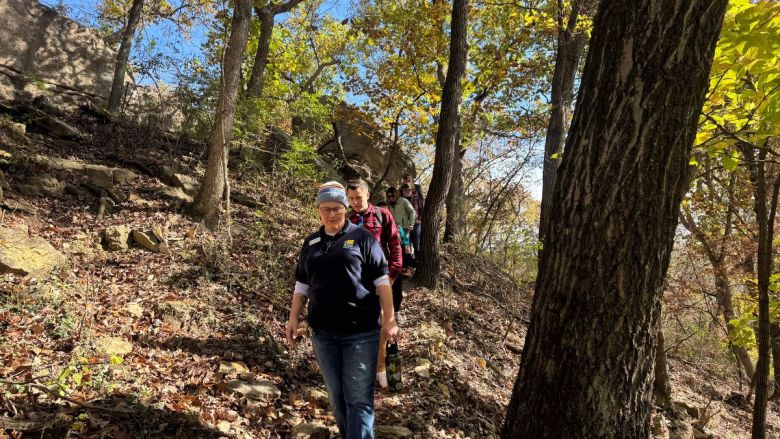
In the heart of Kansas City, two miles south of the zoo, sits a nature preserve home to 300-year-old chinquapin oaks, bobcats and songbirds across limestone bluffs and miles of trails built and cleared by volunteers.
This land has been owned by Jackson County for 80 years and preserved by environmental groups like the Heartland Conservation Alliance and Bridging the Gap.
But instead of beloved trails, interim Jackson County Executive Phil LeVota saw the land — characterized as “empty” and “sitting there for decades” — as a possible solution to a problem he hopes to address before leaving office. A property tax relief program he implemented has created a big hole in the county’s budget.
He had the county Legislature put out a request for proposals — essentially asking if any businesses would be interested in buying the land. In doing so, he surprised those conservation groups and even the county’s own parks department.
After the initial shock, local nature enthusiasts were enraged.
The Heartland Conservation Alliance sent a sharply worded letter to LeVota hinting at potential legal consequences. Social media posts garnered hundreds of likes and shares, with LeVota sparring with dozens of constituents in comment sections. Numerous residents reached out to The Beacon asking if a reporter could look into what was going on.
All of it culminated in a protest on Nov. 7 at the Blue River Glades, attended by dozens of community members and several elected leaders. Two days later, LeVota canceled the request for proposals.
With that, those hikers, volunteers, neighbors and conservationists may have succeeded in preserving the public lands.
But LeVota’s problem still lingers.
Selling the Blue River Glades was one possible way to close some of the county’s budget gap.
Now, without a sale, he said Jackson County may have to make tough decisions.
To sell or not to sell
In their response to the uproar, Jackson County officials have been clear that a sale didn’t happen.
The county executive occasionally sends a list of properties to the county Legislature that the executive believes may be “surplus” property.
That’s the first step for selling the property. It doesn’t mean that the county is necessarily going to sell it, but it’s a designation that means the county does not need it.
LeVota made his case to the Jackson County Legislature on Aug. 3 that this parkland was surplus property.
“This is land that is sitting there empty,” LeVota told the Legislature on Aug. 3. “I don’t know how we got it, when we got it, why we got it, but we’ve had it for a long time, and we’re not doing anything with it.”
At the meeting, LeVota said that nearby Hillcrest Country Club had expressed interest in submitting a bid to extend its golf course.
LeVota told The Beacon that he did not consult with the county’s parks and recreation department before putting the land up for bid.
The Legislature voted unanimously to declare the land surplus and open it up for bids. Jeanie Lauer, who represents the 5th District, did not vote.
Community uproar and government backpedaling
Advocates reject the idea that this land is “surplus.”
“You have so many people who have either invested money, invested time, invested expertise,” said Scott Wagner, the executive director of the environmental nonprofit Bridging the Gap. That includes $40,000 in federal grants to remove invasive honeysuckle.
Wagner said the county never contacted the groups and contractors who were involved in restoring the land.
That was a breach of trust for many of the community members who had been involved in this work over the past four decades. And the silver lining, Wagner said, is that perhaps people are paying more attention to the county than before.
“The fact that it had come forward in the way that it did,” he said, “and to not know or to not ask what some of this history is about, struck people very oddly, to say the least, and certainly galvanized some action.”
LeVota announced on Nov. 9 that he was canceling the request for bids and said the county would not be proceeding with any land sale.
Asked whether that was a result of community backlash, LeVota said no.
“That’s not accurate at all,” he said. “If the community wants to take credit for it, they can. It was my decision to cancel it. … After I’ve seen this uproar, I’m not supportive of them selling it for anything. If they said (it was for) a sanctuary for puppies, I’m not doing it.”
A lingering budget problem
LeVota has maintained that “misinformation” spun the Blue River Glades issue into something that it wasn’t. He said the county was not selling the property. It was simply exploring a sale.
He also said he was hoping a sale could scrounge together an extra few million dollars for the county’s budget.
As interim county executive, LeVota is responsible for preparing the county’s budget. His proposal is due to the Legislature on Nov. 15.
“When the budget comes out next week, it’s not going to be a good picture,” LeVota told The Beacon. “We have lower revenues, we have tax credits we’re going to be losing money on, and it’s going to be bad.”
He told The Beacon that the tax credits the county promised homeowners have created a $7 million hole.
Those tax credits are related to the 2023 property assessment debacle, when the State Tax Commission forced Jackson County to retroactively roll back 75% of its property values. LeVota decided to handle that by granting tax credits to qualifying homeowners, lowering their tax bill for the next three years.
In other words, the county will be getting a lot of coupons instead of cash.
Those coupons are worth a total of somewhere between $6 million and $7 million, LeVota said. That’s the hole he needs to plug.
“I’m trying to figure out how I get $7 million to the county before I go out the door,” LeVota said. “How do we fix that $7 million budget deficit that they’re going to have next year, and one of those ways was to explore what opportunities we could have with sales of properties.”
County legislators were reluctant to comment on a budget that has not been presented to them yet. But some were skeptical that selling off the Blue River Glades would have generated enough money to plug the budget hole anyway.
“I don’t see it helping in a substantive way,” Legislator Sean Smith, who represents the southeastern corner of the county, said in a text message.
Legislature Chair Donna Peyton, who won reelection on Nov. 3, told The Beacon she hasn’t seen the budget yet, but she expects that it will be tough.
“We will definitely have to tighten our belts in the next budget year,” she said.
The budget will be presented later this month at a county Legislature meeting, which you can watch here.

