


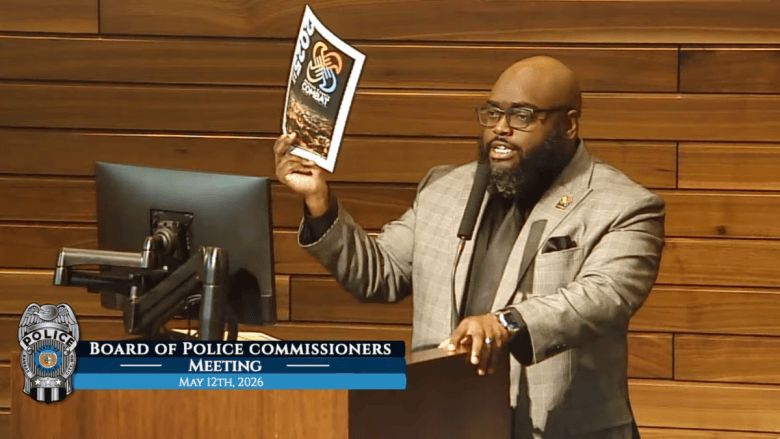
Voters in Jackson County will decide Nov. 3 whether to keep paying a quarter of a cent anti-crime sales tax for the next 10 years.
COMBAT — short for community-backed anti-crime tax — appears on the ballot as Jackson County Question 1. A “yes” vote extends the sales tax for 10 years, while a “no” vote lets the tax expire after March 2027.
Voters first approved the tax in 1989, making Jackson County the first jurisdiction in the country to pass a sales tax dedicated to fighting and preventing drug-related crime. It was then called the Community-Backed Anti-Drug Tax, and was created during the nationwide crack cocaine epidemic.
COMBAT has evolved over time, and the tax has been renewed on four separate occasions — by wide margins — in 1995, 2003, 2009 and 2016. In 2009, voters also approved expanding the scope of COMBAT to include efforts aimed at addressing violent crime.
Today the tax helps pay for enforcement, prevention and treatment meant to address the root causes of violent crime and drug-related crime. That comes in the form of funding for a drug task force, police investigations, prosecution, courts, pretrial supervision, addiction treatment, violence prevention programs and education programs across the county.
A simple majority is needed to renew the tax.
Click the link to jump to sections:
- What exactly is on the ballot?
- What is COMBAT?
- Where does the anti-crime tax money go?
- How much does COMBAT cost?
- How much money does it raise?
- What’s changed since past controversies?
- Who chooses how the money is spent?
- What does a “yes” vote mean?
- What does a “no” vote mean?
What exactly is on the ballot?
On the ballot before every voter in Jackson County will be county Question 1, which reads as follows:
Jackson County, Missouri — Question 1
Shall Jackson County continue its anti-crime sales tax, commonly known as COMBAT, at the rate of one-quarter of one cent for a period of ten years for the purpose of promoting and providing public safety within Jackson County, including the prevention and treatment of drug abuse and addiction and the prevention, investigation, prosecution, and detention of violent criminals and drug dealers? The proceeds of this tax shall be deposited in a special Jackson County Anti-Crime Sales Tax Trust Fund, separate from the general fund or any other county funds.
Voters choose to answer either “Yes” or “No.”
What is COMBAT?
Short for “community backed anti-crime tax,” COMBAT often refers to the countywide tax itself, the pool of funds collected from the tax and the entity that administers and recommends distribution of the money it raises.
COMBAT’s official stated mission is to “identify the root causes of violence and substance abuse in order to empower Jackson County through essential resources and guidance to achieve safer communities.”
Where does the anti-crime tax money go?
COMBAT Executive Director Murray Woodard II said at an Urban Summit meeting last month that COMBAT is “the county’s largest pool of dedicated public safety funds.” It pays for what he called “the entire continuum of public safety,” from preventing crime and treating addiction to investigating and prosecuting crimes after they happen.
More than 60% of the money goes to police, prosecution, courts and corrections in the county, according to COMBAT’s 2025 impact report. Most of the rest goes out as grants to more than 100 programs largely run by local nonprofits, while up to 4% of the tax fund can be used for administration.
Here’s an overview of what that looked like in 2025:
- Prevention — It’s said that the best crime scene is one that never happened. Over 60 prevention programs are funded with COMBAT dollars. For example, COMBAT helped fund support services for crime victims and their families through the AdHoc Group Against Crime, support and skills training through Goodwill of Western Missouri and Eastern Kansas for people coming home to Jackson County after incarceration, and connecting gunshot survivors to mental health resources through University Health’s Project RISE.
- Treatment — In 2025 COMBAT allotted just below $5 million for 23 separate substance use treatment programs.
- Enforcement and justice — COMBAT funds the Jackson County Drug Task Force that does covert investigations to pursue drug traffickers in the county. The tax also helped fund 21 positions in the Kansas City Police Department. It paid for prosecutors, court staff and a treatment court that connects some people charged with nonviolent offenses to treatment for addiction.
COMBAT also provides funding for law enforcement school-based initiatives like D.A.R.E. and community resource hubs through their STRiVIN’ initiative.
For a full list of purposes and programs COMBAT funds were used for — with funding amounts — see COMBAT’s 2025 impact report.
How much does the COMBAT sales tax cost?
The COMBAT anti-crime sales tax is a 0.25% sales tax, meaning that one quarter of a cent for every dollar spent on any purchase subject to sales tax in Jackson County will be added to the purchase price. The tax is added on top of state, county and city sales taxes.
In practical terms that means:
$10 purchase = 2.5 cents in COMBAT tax.
$100 purchase = 25 cents in COMBAT tax.
$1,000 purchase = $2.50 in COMBAT tax.
$10,000 purchase = $25 in COMBAT tax.
The tax is collected from all purchases subject to sales tax in Jackson County, and is therefore paid by anyone making purchases in the county, not just residents. It is a sales tax, not a property or income tax, and approval of county Question 1 would continue the tax rather than create a new one.
How much money does the anti-crime tax raise?
All those portions of a penny for the anti-crime tax add up. From 2021 to 2025 COMBAT raised an average of $31.3 million a year, according to COMBAT’s 2025 impact report.
COMBAT tax collected in the last five years:
- 2021 – $27.4 million
- 2022 – $31.1 million
- 2023 – $32.4 million
- 2024 – $31.5 million
- 2025 – $33.9 million
What’s changed since past controversies?
While the tax has broad support from Jackson County legislators and the county prosecutor’s office, it has spurred controversy.
Audits revealed that previous county administrations, including those under former county executives Mike Sanders and Frank White Jr., mismanaged and misspent COMBAT funds.
Oversight and administration of COMBAT moved from the county executive’s office to the county prosecutor in 2018, and the program has looked to follow auditor recommendations since.
In an Aug. 17, 2026, Jackson County Legislature meeting that discussed COMBAT, County Legislator Jalen Anderson and Woodard explained the changes to the program’s spending processes since then.
“A lot has changed, for the good,” Anderson said.
Anderson pointed to several checks and balances that have been instituted since. He noted that now every expenditure that reaches the county Legislature for approval is first acknowledged by both the COMBAT director and the county prosecutor. Woodard agreed and said that each expenditure also comes before COMBAT staff and outside reviewers, then the COMBAT commission for recommendation before reaching the county Legislature for final approval.
Who chooses how the money is spent?
Three groups oversee and share control of the tax fund:
- Jackson County prosecuting attorney: Currently Melesa Johnson, who oversees COMBAT’s day-to-day operations and appoints its executive director who’s in charge of the program’s small administrative staff.
- COMBAT Commission: This group recommends how the money is spent. The county executive appoints its nine members — one from each of the six county legislative districts plus three at-large members who include a legal professional, a healthcare professional and a substance abuse treatment professional.
- Jackson County Legislature: The legislature has final say and votes on each allocation of funds.
What does a ‘yes’ vote mean?
A “yes” vote continues the COMBAT sales tax at 0.25% for 10 years.
Under county ordinance 6096, the renewal would take effect April 1, 2027, and expire March 31, 2037, unless it is again renewed.
What does a ‘no’ vote mean?
A “no” vote would let the COMBAT tax expire March 31, 2027. The tax would still be collected until that time. Starting April 1, 2027, the county’s dedicated funding source for the programs and positions COMBAT pays for would end.
“Without COMBAT funding, cycles of crime and addiction would spiral out of control,” said Prosecutor Melesa Johnson in the 2025 COMBAT impact report.
The county would lose the roughly $30 million a year in dedicated public safety funds collected.

