When a dental surgery center in Independence opens next month, it will be the first in the state exclusively for Medicaid patients.
The center, which will provide dental care requiring anesthesia to children and adults, wouldn’t have been possible even five years ago, before Missouri began an overhaul of the dental care offered through its Medicaid program, MO HealthNet, said Dr. Aaron Bumann, a pediatric dentist who is one of the center’s founders.
Until recently, Missouri adults receiving Medicaid could only get oral health covered when a tooth problem became an emergency. But since voters moved to expand Medicaid eligibility in the state, Missouri has added limited dental coverage for adults and shored up reimbursement rates paid to dentists, putting them more in line with rates paid by private insurers.
Missouri’s dental reforms didn’t bring about the comprehensive dental coverage provided under some other states’ Medicaid programs, including KanCare in Kansas. For adults, MO HealthNet still doesn’t cover crowns, root canals or dentures, for example. (Pediatric dental care must be covered under federal law.)
But Missouri’s reforms have been enough to noticeably increase access to oral health services in the state.
By 2025, according to the Missouri Coalition for Oral Health, an additional 81,000 MO HealthNet participants had received dental care compared to 2022 when changes began. And in fiscal year 2025 alone, 195 new dentists signed up to take Medicaid, making it slightly easier for Medicaid recipients to find a dental provider.
Bumann, who helped work for those changes in his role as public policy advocate for the Missouri Academy of Pediatric Dentistry, said the reforms were also enough for him and his partners to move ahead with their new surgery center.
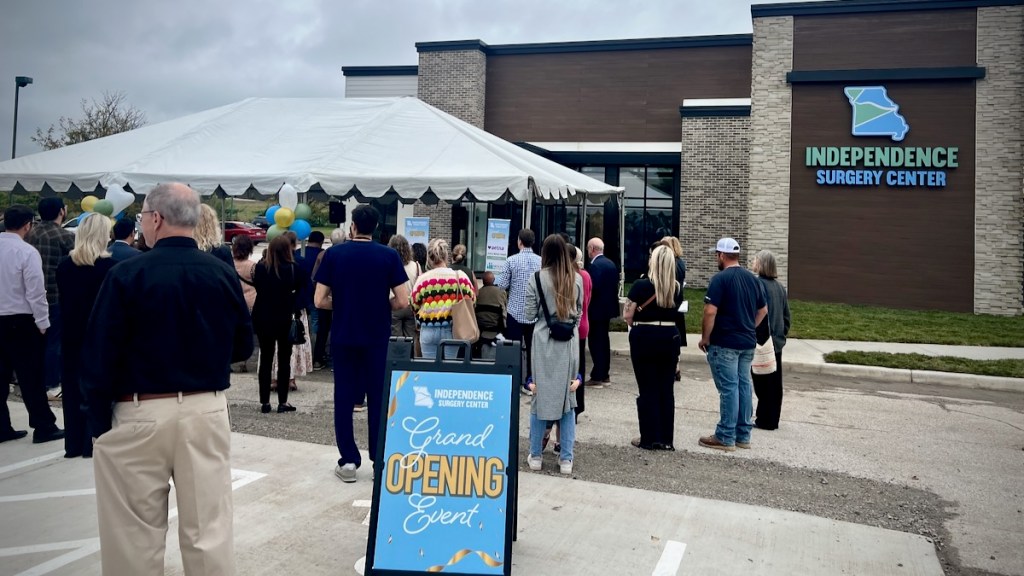
The for-profit, privately owned Independence Surgery Center will treat children and adults, providing care that requires sedation, something that is difficult for people relying on Medicaid to access.
“We understand that need is there and that it’s big,” Bumann said last week after a ceremonial ribbon cutting outside the new center at 19921 E. Jackson Drive in Independence.
The center will provide general anesthesia and oral surgery for children and adults, including adults with intellectual disabilities. Community health centers that provide dental care and other providers can refer patients to the surgery center. It will not serve as a “dental home,” Bumann said, but will complement dental care provided at other places.
Threat of looming cuts
But if the center is emblematic of the state’s progress in oral health access, it is also a reminder of what may be lost if adult dental coverage becomes a casualty of looming federal Medicaid cuts.
Starting next year, federal tax dollars that have long paid a significant share of state Medicaid programs will begin to be reduced, the result of President Donald Trump’s 2025 budget bill, dubbed his “One Big Beautiful Bill.” Those cuts will affect both individuals who lose access to care and providers that count on Medicaid revenue and receive other funding through the program.
According to information from the Congressional Budget Office, Missouri could lose between $11 billion and $18 billion in federal Medicaid funds over the next decade.
The state has not yet spelled out how it will make up the resulting gap starting with next year’s budget. But many observers see cutting optional coverage as a likely possibility. And adult dental care may be high on that list.
“It’s totally on the table,” said Bob Theis, CEO of the Samuel U. Rodgers Health Center, a community health clinic that provides dental care in Kansas City. “The governor is looking for everything.”
Dr. Megan Krohn, chief dental consultant with the Missouri Department of Health and Senior Services, said the state is facing tough choices.
“As a state, we’re at a time where we’re having to be very intentional and thoughtful about how we balance the budget so that we can ensure that we do have the resources available for all Missourians,” Krohn said.
But she emphasized the importance of oral health to overall health. She said she’s hopeful that advocacy work in the state related to expanding oral health access has helped relay that message.
“If we lose access to oral healthcare for this particular group of patients,” Krohn said, “it will have long cascading effects, and really just push off cost to other places.”
‘The mouth is the gateway’
When people don’t get care of dental problems, they can end up with systemic health issues, such as heart disease and high blood pressure, as a direct result. The bad bacteria causing cavities and gum disease can migrate to other parts of the body and lead to other problems.
“I always say the mouth is the gateway to everything else,” said Dr. Raquia Denson, director of oral health, at KC Care, a community health clinic that earlier this year opened a second dental clinic location in an effort to meet growing demand. “It affects so many other things.”
Patients who are diabetic or pregnant, and even those who have had a joint replacement, can be especially vulnerable to the damage caused by untreated dental issues, Denson said. Besides that, dental problems lead to missed work and school and can inhibit a person’s chances of getting a job and making a living.
“I hope that our lawmakers are looking at the whole person,” Denson said.
Speaking last week at the ribbon cutting ceremony of the Independence Surgery Center, U.S. Rep. Emanuel Cleaver told the crowd gathered that he knows personally the importance of preventive dental care.
Cleaver, 81, said he was in college the first time he saw a dentist and he can still recall the toothache that got him there.
“That anger hasn’t subsided,” he said. “That’s why I am so thrilled that people with a vision and heart decided to open this center. In my world, this is God’s work.”
Cleaver said he hopes that Medicaid funding can be restored to the federal budget when a new Congress convenes next year, something that could reduce the risk of erasing Missouri’s oral health progress. Cleaver’s congressional district includes 167,000 people enrolled in Medicaid.
“One of the top priorities for me in January is to go back and redo those budget cuts. I mean, this is not even civilized,” Cleaver said after the event. “I think that there are going to be more people who support the restoration of the Medicaid cuts than we have right now.”
But even with full Medicaid funding, getting access to dental care for everyone in Missouri who needs it will still be an uphill battle, Krohn said.
At least 14 counties don’t have any dentist at all, she said, and three have no hygienist. Shortages are widespread across the state, especially in rural areas. The state needs an additional 350 dentists to fill its gaps, but those reinforcements aren’t on the way. Only about 180 dentists graduate in Missouri each year.
All of that can make finding care even more difficult for people relying on Medicaid coverage.
“If you live in a health professional shortage area, you might have one dentist for five counties,” Krohn said. “If that one dentist doesn’t accept MO HealthNet … you have a problem.”
Although more Missouri dentists now accept Medicaid, many cap the number of Medicaid patients they will see, which also contributes to lack of access, Krohn said.
“Yes, we’ve seen an increase in MO HealthNet providers,” she said, “but the needle still needs to move.”