


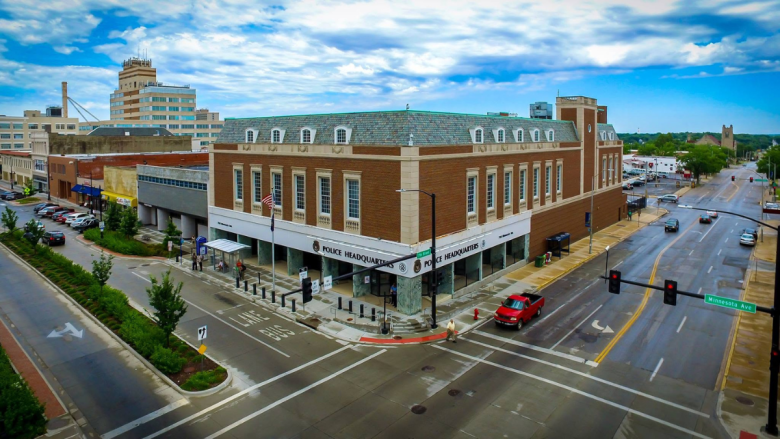
Unified Government of Wyandotte County and Kansas City, Kansas: Public Works & Safety (Sept. 14, 2026)
By Laura Mangan, Kansas City Documenter
These notes were produced through Kansas City Documenters, which trains and pays community members to take fact-checked notes at public meetings, strengthening transparency and accountability in local government.
Summary
- Kansas City, Kansas, Police Chief Karl Oakman briefed the committee on the department’s use of automatic license plate readers (ALPRs), drones and various other technology in its Real-Time Intelligence Crime Center (RTICC). He also discussed the department’s Connect KCK program, where homeowners allow the police department access to their Ring doorbell cameras and other video surveillance technology to help with investigating crimes.
- John Droppelmann, deputy chief and fire marshal with the Kansas City, Kansas, Fire Department, provided an update on Fourth of July incidents.
- The committee approved moving forward with grants to help fund traffic signal upgrades and cover subscription costs for emergency management services.
- Read more Beacon coverage of ALPRs here.
Notes
Minutes
- The committee approved minutes from its special meeting on Aug. 11 and its regular meeting on Aug. 17.
Agenda
- Fiscal Year 2026 Kansas Department of Corrections Adult Case Plan Report. The report officially comes from the Wyandotte County District Court.
- Phillip Lockman, director of community corrections, explained this is an annual report required by KDOC.
- He described the report as a “running narrative that includes information about processes we’re trying to implement.”
- The report covers staff training and feedback from KDOC regarding progress, barriers and questions or concerns from community corrections staff.
- The committee unanimously approved the report.
- Kansas Department of Transportation Innovative Technology Grant for signal improvements.
- The Public Works Department was seeking approval to apply for up to $1 million to upgrade signal equipment and signs. The department plans dedicate money from the signal maintenance debt funds for the required 25% match.
- The funding would go toward upgrading 22 signals in the Legends retail development to add a preemption feature allowing emergency vehicles to override signals.
- Senior engineer Kristofer Finger said the department was still working on the amount it would request.
- The committee unanimously approved the resolution.
- U.S. Department of Justice Community Oriented Policing Services (COPS) technology and equipment program for public alerts and messaging.
- The proposed resolution would authorize the Emergency Management Department to submit a $225,000 grant request to the COPS program.
- The funding would cover subscription costs for Everbridge and Web-based Emergency Operations Center (WebEOC) services.
- Everbridge delivers notifications, such as evacuation or shelter-in-place orders and severe weather alerts, to more than 94,000 subscribers living or working in Wyandotte County. The department is hoping to increase the number of subscribers, which would increase the cost.
- The WebEOC crisis information management system captures and shares secure, real-time situational information to help incident managers make sound decisions quickly.
- UG officials told the committee that the grant has already been awarded, but that the UG has to submit an application to secure the award.
- The committee unanimously approved the resolution.
- Police Department – RTICC, ALPR and Drones as First Responders (DFR).
- Committee Chairman Andrew Kump requested an update on the law enforcement tools. In his update, Oakman:
- Credited U.S. Sen. Jerry Moran of Kansas for helping secure federal funds to start the KCK Real-time Intelligence Crime Center in 2022. Oakman said that ensuring the center was made fully operational was an early priority for him as incoming chief in 2021, and that since the program was fully established in 2024, it has become one of the most advanced centers in the region.
- Said the RTICC utilizes surveillance cameras, ALPRs, drones as first responders, gunshot audio recordings and preemptive cellphone and video forensics as part of its regular operations. The center is staffed by sworn law enforcement officers as well as civilian analysts.
- Regarding ALPRs, Oakman:
- Acknowledged the ongoing level of concern and discussion regarding license plate readers, specifically Flock ALPRs, and stated that ALPRs have been in use since 2020, but that the Kansas City Kansas Police Department also utilizes devices from Axon and Genetec.
- Said Flock and Genetec ALPRs are used as stationary devices, while plate readers from Axon are used as mobile LPRs, such as those attached to police patrol vehicles and on mobile trailers.
- Said KCKPD uses:
- 100 Genetec LPR devices.
- 52 Flock LPR devices.
- All mobile LPRs attached to KCKPD patrol units are through Axon Fleet.
- Regarding cameras, Oakman reviewed use of UG-owned and operated surveillance cameras throughout the downtown area, near Azura Amphitheater in Bonner Springs and the Kansas Speedway, and on all UG and KCK public buildings. These include traffic cameras. He also indicated that these cameras are located in public parks and other public spaces. All cameras go through the RTICC. He added that:
- The UG owns 550 cameras and the KCKPD owns 215 cameras.
- FUSUS Core boxes, devices attached to cameras owned by private businesses that (with the operator’s permission), turn any surveillance camera into a “smart” camera that feeds to the RTICC.
- There are currently 1,193 FUSUS Core boxes in use.
- Through Connect KCK, “We’re not able to view those cameras. But what it does is, for instance, if there’s an incident at, I’ll just throw out an address, 18th and Minnesota, and we see a house that’s on the register that says, ‘Hey, we’ll share our camera footage.’ So then, detectives or patrol officers will contact them for the footage because they sign the register to help support (fighting) crime in their neighborhood.”
- There are more than 3,300 cameras registered in the program. Nearly 1,200 camera owners have taken the next step by allowing the department direct access to their feeds.
- Regarding drones as first responders, Oakman said KCKPD has one of “the most robust drone programs in the metro.” He said:
- KCKPD’s program began approximately two years ago.
- The department has 11 drones and about 15 trained drone pilots.
- At the time of the meeting, the department had logged 1,073 drone deployments this year. They average about 12 flights a day.
- Top reasons drones are deployed include: disturbances, suspicious persons and area checks.
- Regarding gunshot-detection, Oakman said the devices are made by Flock but are not connected to the Flock ALPRs.
- The department has 227 audio detection devices that were rolled out in 2024 and funded through a federal grant.
- They activate at the sound of gunshots, crashes, fireworks and “loud sideshow-type activity.”
- The devices are placed based on crime data.
- Regarding cellphone and video forensics, Oakman said:
- The police department and UG use Cellebrite and Magnet Graykey for cellphone data retrieval, storage and analysis, as well as video forensics.
- As of the meeting, KCKPD had confiscated 253 phones this year and extracted data from 173 of the phones.
- Regarding the KCKPD Crime Gun Intelligence Center (CGIC), Oakman said:
- The KCK center is one of 54 CGICs in the U.S. and the only one in Kansas besides one in Wichita.
- KCKPD’s center was started in 2022 using a $700,000 grant from the U.S. Department of Justice and in partnership with the National Public Safety Institute and the Bureau of Alcohol, Tobacco, Firearms and Explosives.
- CGICs function as intelligence hubs and coordination centers where local, state and federal law enforcement pool information and resources in response to mass shootings and other major firearms-related crimes.
- One resource utilized by CGICs is the National Integrated Ballistic Information Network, which centralizes ballistic evidence into a database of firearms used in the commission of a crime.
- Oakman also said KCKPD has “one of the most advanced drone detection systems in the metro,” which includes a mobile detection system as well as fixed detection sites.
- The purpose is to monitor and interdict unauthorized drone activity. This is done with authorization from the FBI.
- The drone monitoring system was funded through a $2.5 million federal grant.
- In response to questions from committee members, Oakman said:
- The arrest of suspects in a Sept. 12 double homicide in KCK was “one of our many success stories” involving automated license plate readers.
- Footage from ALPRs was crucial to identifying individuals involved as well as identifying the vehicle of the suspects within 10 to 30 minutes of the incident.
- In cooperation with officers from the Kansas City Police Department, the suspects were identified and apprehended within six hours of the shooting.
- The drones have a range of up to 6 miles, but to maintain consistent connectivity, operators stay within about 2 to 3 miles.
- Drones are usually only deployed after specific calls, not to investigate potential criminal activity.
- The department’s IT unit performs audits of ALPR searches every 90 days.
- ALPR data searches require an ID, case number and stated reason for search, including for partner agencies to conduct searches of ALPR data.
- All searches are logged and only sworn officers and civilians working in the RTICC can access ALPR data. All employees with access must complete an annual technology awareness training to maintain their access.
- Any violation of this policy can and has resulted in consequences ranging from internal disciplinary measures, termination of employment and even criminal charges.
- All searches have to have a purpose, are audited, and are deleted after 30 days.
- KCKPD is reviewing what agencies have access to KCK datasets to ensure that data is only shared within the state or with agencies on or near state lines.
- The arrest of suspects in a Sept. 12 double homicide in KCK was “one of our many success stories” involving automated license plate readers.
- Committee Chairman Andrew Kump requested an update on the law enforcement tools. In his update, Oakman:
- Fourth of July Incidents Review
- Droppelmann presented the 2026 Fireworks Summary. It said:
- Revenue generated by firework vendor permits, sales tax from fireworks sales and permits for neighborhood block parties was:
- $35,775 in business licensing fees.
- An estimated $57,375 in sales taxes.
- $8,660 in fire department permitting.
- $2,400 in Public Works block party permitting.
- Costs to the Unified Government included $2,345 in damages tallied by Parks & Recreation and $31,434 for fire department personnel.
- The KCKPD logged 148 calls for service regarding fireworks between June 27 and July 5. The fire department received 18 fireworks-related calls during the same period.
- The report detailed four structure fires including one on July 8 where the home was a total loss and the family did not have insurance.
- The department tallied approximately $235,500 in property damage from the fires.
- Revenue generated by firework vendor permits, sales tax from fireworks sales and permits for neighborhood block parties was:
- Droppelmann presented the 2026 Fireworks Summary. It said:
Observations & Follow-Up Questions
- Due to the arrangement of the committee members’ and presenters’ seating, it is very difficult to see or read committee members’ nameplates when attending in person.
- How long is data taken from individuals’ phones or other electronic devices held by the city/the vendors (Cellebrite/Graykey) pending a judicial warrant for a search/indictment/trial? If no warrant is ever granted, what happens to all the data pulled from a person’s device? Same question regarding video surveillance footage in the absence of any warrant/indictment/charge.
- What, if any, data or reporting exists showing the efficacy of technologies like Flock, Genetec, Axon, DFRs and Cellebrite/Graykey digital forensics, i.e., what impact have these technologies had on arrest/conviction rates since KCKPD began using them or since it created the RTICC? Where are these reports and how would a member of the public obtain these reports?
If you believe anything in these notes is inaccurate, please email us at documenters@thebeacon.media with “Correction Request” in the subject line. Learn more about Documenters on our website.
Documenters notes are free and publicly available under a Creative Commons Attribution 4.0 license (CC BY 4.0). They may be shared, remixed, or reused with appropriate credit to Documenters.org and the local partners. For full guidance, see: https://www.documenters.org/creative-commons/

