


Takeaways
- A parent created a program to match teachers with donors so they don’t have to spend as much of their own money on classroom supplies.
- Teachers became more hesitant about participating in the program after the district warned them they needed approval for any crowdfunding efforts and that any donations they received were district property.
- The district said it encourages donations but needs to be informed of crowdfunding efforts to thank donors and ensure supplies are used for their intended purpose.
It sounds like a straightforward feel-good story.
A parent realizes that teachers are spending their own money on classroom supplies, so she creates a donation program. The initial response from teachers and donors is enthusiastic.
That’s how it started for Brittanye Rimpson, a parent who founded and owns Connect Work, a company focused on small-business development and community partnerships.
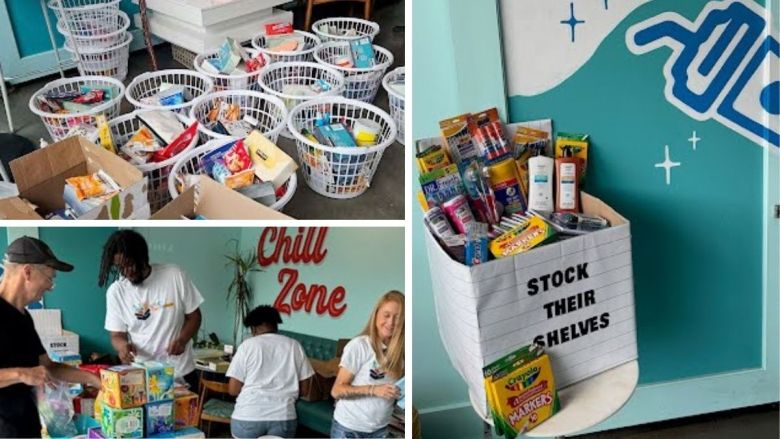
In July, Rimpson founded Stock Their Shelves to connect donors, especially local small businesses, with Raytown teachers. Teachers would request specific supplies — often basics like wet wipes, snacks or ponytail holders — and donors would buy them.
She saw it as a way to support teachers and students while also increasing mutually beneficial connections among schools, local businesses and other community members.
The tagline on the website’s homepage is “Teachers give enough. Let’s give back.”
Then things took an unexpected turn.
A local organization emailed Rimpson, withdrawing as a donor. The email said Raytown School District personnel had clarified they already had official channels to receive gifts for classrooms.
Then teachers started asking to withdraw too. They said they’d received an email from the school district, warning them they needed approval for any crowdfunding efforts and that any donations they received were district property.
“They felt like by taking donations from their own community, that they’re in fear of their job for being in violation of board policy,” Rimpson said.
She coaxed teachers to stay enrolled and looked for ways to protect their anonymity, such as handing off supplies in grocery stores instead of bringing them to schools.
Marissa Cleaver Wamble, the district’s chief communications officer, said the email was not meant to deter teachers from seeking community support. But the district wants to be informed.
“We love donations and the generosity of our community,” Wamble said. “Our intent for sending the email to our building principals was a reminder. We are not discouraging people from donating at all. In fact, it’s the opposite.”
Raytown is one of many districts across the nation grappling with how to handle crowdfunding for classroom supplies.
On one hand, national surveys have found that most teachers spend their own money to stock their classrooms, averaging hundreds of dollars. Crowdfunding helps lift that burden.
On the other hand, school administrators worry about legal or reputational pitfalls from unsupervised, untracked donation requests.
Navigating that tension can be confusing for everyone involved, especially when communication breaks down.
Rimpson said she wished the initial email sent to teachers had included some of the more reassuring information that Wamble shared with The Beacon.
“But that was not initially what was relayed to them, and that was why they were like, ‘Nope, can’t do it. I’m not going to risk my job,’” she said.
Teacher spending on classroom supplies
When a Raytown teacher approached a colleague with information about how to pick up Stock Their Shelves donations, the colleague loudly insisted that she wasn’t involved.
The teacher, who was emphatic that she remain anonymous out of fear of repercussions at work, said that exemplifies the atmosphere of suspicion and fear surrounding the program.
“They’re afraid to discuss it,” she said. “They don’t know who they can trust, which is really sad. … (It) just kind of makes it feel like the building’s divided or the staff is divided in the district, which is not how we should feel. We should feel united.”
When she first heard about Stock Their Shelves, the teacher thought it was a great idea.
“We’ve seen a decline in parents being involved in the district,” she said, “and we definitely need our parents to be more involved.”
She didn’t expect that the district would object to her participating. She signed up, asking for pencils, papers, glue sticks, sanitary wipes and hygiene supplies.
The teacher, who has worked in the district for several years, said she often spends her own money on classroom supplies such as pens, pencils, paper, art supplies, posters and snacks.
She said the district gives each department a stipend for those sorts of purchases but it isn’t enough. She estimated she spends $1,000 of her own money on her classroom annually.
The average regular-term teacher salary in the district is about $60,000, according to the latest data from the Missouri Department of Elementary and Secondary Education.
The National Center for Education Statistics found that more than 90% of teachers spent money on classroom supplies without reimbursement during the 2019-20 school year, averaging more than $400.
A 2025 survey from Adopt a Classroom, another platform for donors to buy classroom supplies, found that teachers spent $895 out-of-pocket during the 2024-25 school year.
Teachers’ classroom spending is so well-known that a Missouri lawmaker suggested tax breaks for teachers for up to $500 of unreimbursed spending on school supplies or professional development.
Missouri’s Department of Revenue also notes that teachers who use their own money on classroom supplies qualify for the back-to-school sales tax holiday, which is generally meant for personal, not business, expenses.
Stock Their Shelves is a new, local addition to a list of ways teachers crowdsource supplies, including Adopt a Classroom, DonorsChoose and asking people to purchase items from Amazon wish lists.
District policy
Rimpson said she was careful to protect teachers’ privacy from the start. But at first, she didn’t register any concern about secrecy or anonymity from the 68 teachers who signed up.
Then the email from the district arrived, making it clear that teachers were not to crowdfund without principal approval and that any donations would become district property.
Given that the school district email arrived shortly after she’d told a board member about the program and she had received the email from a donor withdrawing, Rimpson assumed it was a reaction to Stock Their Shelves.
Rimpson has been vocal on social media about her questions and criticisms related to the district, which she thinks have rubbed some people the wrong way. She said she tries to be solutions-oriented and open to learning, and many of her posts encourage collaboration among parents, local organizations and the district.
Rimpson said she has done social media work for some of the program donors before, but none of them are clients of Connect Work.
The school district email — which Wamble shared with The Beacon and the teacher confirmed was the same one she received — specifically mentioned Amazon wish lists and DonorsChoose. It didn’t mention Stock Their Shelves, and Wamble told The Beacon in an email that it was “not related to a specific person or donation drive.”
Raytown School District Email
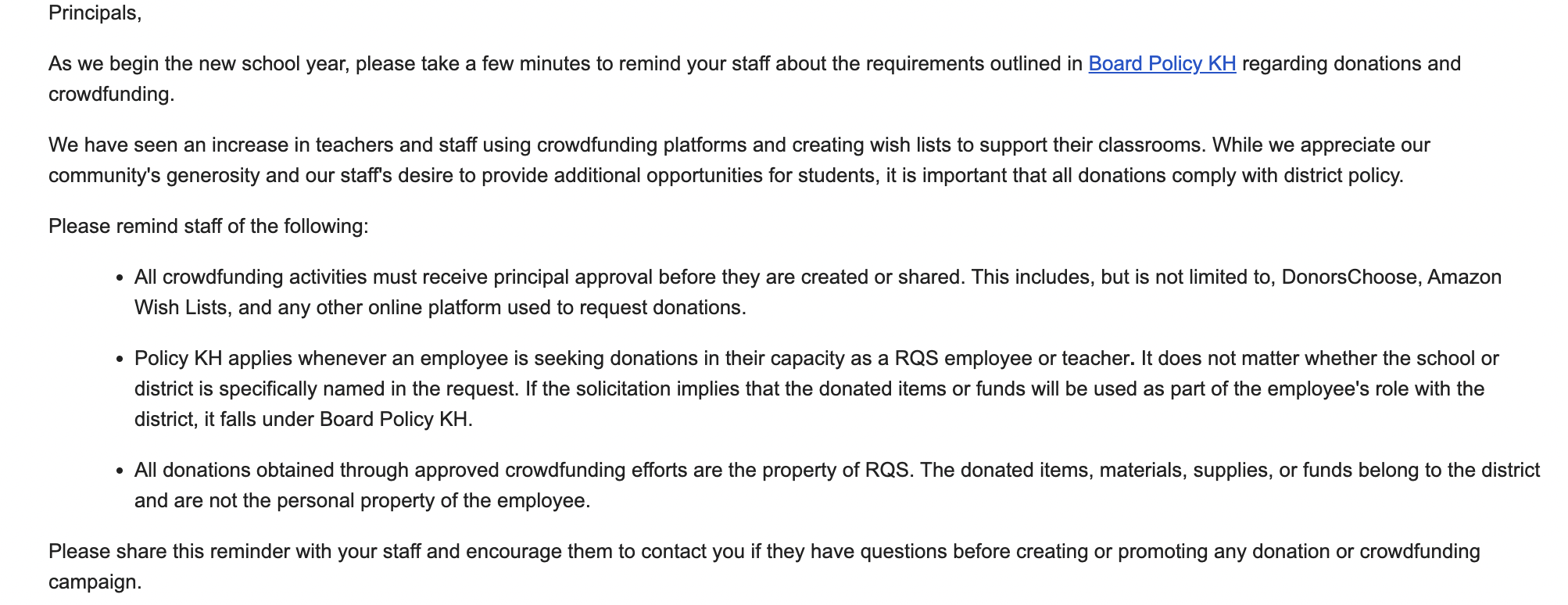
The email notes the district has “seen an increase in teachers and staff using crowdfunding platforms and creating wish lists to support their classrooms. While we appreciate our community’s generosity and our staff’s desire to provide additional opportunities for students, it is important that all donations comply with district policy.”
It says any requests that imply the supplies will be used as part of the employee’s role with the district fall under board policy KH, even if they don’t actually name the district or school.
Policy KH defines crowdfunding as “the activity or process of raising money through solicitations, typically via an online community or platform.” It says the policy’s purpose “is not to thwart the charitable intentions of donors but to promote legal compliance, consistent messaging, and confidence in the handling of funds.”
The policy dictates that administrators should vet crowdfunding platforms, determine whether the crowdfunding will impede other fundraising efforts, check that the district doesn’t already have the requested supplies and ensure it’s equipped to store and maintain the gift. Items should be sent directly to the district when possible.
Raytown isn’t alone in its efforts to put guardrails on crowdfunding.
Nationally, some school districts — including Nashville — have banned teachers from crowdfunding altogether while others have set guidelines or outright encouraged the practice, according to EdWeek.
Concerns include difficulty of tracking where materials are being used, equity among schools and classrooms, and teachers requesting items that don’t conform to the district’s curriculum or technology standards.
In Ohio, a former state auditor, Dave Yost, urged districts to make policies about crowdfunding to protect student privacy and avoid legal issues if funds aren’t accounted for.
In 2022, three Las Vegas charter school employees — including a principal who signed off on the requests — were criminally charged in a scheme to steal $154,000 worth of items from DonorsChoose. Two teachers repeatedly used fake names to evade dollar limits and brought some of the items home instead of using them for their classrooms.
A post on crowdfunding from the national School Superintendents Association is subtitled “Simple solutions to big liability.”
It gave examples of teacher crowdfunding posts that reflect poorly on the district, imply the district is not meeting its legal obligations or violate student privacy. Sometimes the items requested, like sugary treats, violated policy.
The association recommends some of the safeguards in the Raytown policy, such as requiring approval of all crowdfunding, selecting reputable sites and requiring that any money or items donated remain with the school. It also suggests schools forbid student images in posts.
A teacher’s reaction
Wamble said the email wasn’t meant to entirely shut down teachers’ crowdfunding efforts, but to keep the district in the loop. If teachers fill out the correct paperwork, she said, the board can thank donors at its regular meetings.
The district also wants to ensure donors are aligned with its mission, she said. She gave liquor, marijuana and vape stores as examples of businesses that would not align, but said the district doesn’t necessarily rule out restaurants or bars that serve alcohol.
It would be rare to reject a donation, Wamble said, and she couldn’t remember it happening during her five years with the district. Teachers’ requests to crowdfund would likely be approved.
“I do not know of one instance where a principal has told a teacher they can’t have the wish list,” she said.
If teachers are in need of supplies, Wamble said, they can also ask their principal for help finding resources, such through the school’s Caring for Kids partners.
Wamble said the district also needs to know what is being donated to ensure the supplies are used for the school’s benefit. She said that doesn’t mean they’ll be taken from the teacher, just that they should be used for the donor’s intended purpose and remain with the school.
If teachers crowdfund without permission, Wamble said, the result would probably be a conversation with their principal to remind them of the policy, not serious discipline such as firing.
“A lot of teachers either have forgotten about it or didn’t know about (the policy), which is why we send the reminders,” she said. “We send a lot of yearly reminders.”
The anonymous teacher said she and some of her colleagues didn’t take the email as a gentle reminder. Some are afraid to pick up donations and “are freaking out because they’re afraid that they’re going to get told on,” she said.
Asked what she thinks would happen if teachers requested permission to participate, the teacher said she didn’t know how to answer the question and didn’t understand why it would be a problem to seek the community’s support, especially if done outside of contract hours.
“You either comply, or if you choose not to comply, then you’re stuck with the ramifications that could follow,” she said. “So you’re afraid, and when you’re afraid, you’re not going to push back too much because you don’t want to lose your job.”
Wamble said she wasn’t aware that any teachers had expressed concerns about the policy.
The teacher said she and, to her knowledge, her colleagues haven’t asked administrators for clarification.
“That is probably because when we’ve approached them on other subjects, it’s a kind of runaround of ‘We have these in place for this reason, and that’s the final answer,’” she said. “There’s really no sit-down and true communication or honest conversations about seeing it from both sides.”
Rimpson also said she hadn’t contacted the district, though she would be open to talking about how to make Stock Their Shelves better comply with district policy if the district were to reach out to her.
Wamble said it’s normal for the district not to make the first overture. She said she’s not familiar with Stock Their Shelves but the district welcomes donations and encourages teachers to fill out paperwork so the district can publicly thank donors.
“Usually, when somebody wants to do a coordinated donation, they’ll reach out to my department specifically,” and she can help direct them, Wamble said. “But I have not had any communication with the person. They have not reached out to the district.”
Wamble wasn’t aware of any Stock Their Shelves donations being reported, but said it was possible the reports would name the donor who adopted a specific teacher rather than the program that coordinated the donation.
How Stock Their Shelves is going
Rimpson said the teacher who spoke to The Beacon isn’t alone in her concern. Those she has corresponded with express the need for anonymity, and some have thought about dropping out.
But the program has continued successfully, she said. While not all of the teachers who registered were paired with donors who purchased their specific wish lists, she collected baskets of commonly requested items such as snacks and hygiene supplies for all of them.
Frost Frozen Bar in Kansas City’s Westport neighborhood allowed Stock Their Shelves to use its space as a drop-off location and hosted a gathering for volunteers to pack baskets for teachers. The bar also offered discounts and prizes as an incentive for people to donate items.
Ali Crownover, one of the bar’s owners, said it’s important to help upcoming generations.
“Ultimately, you pour into your community in hopes that your community pours back into you,” she said.
Crownover said she had no idea there would be any tension surrounding the program and just thought of it as “jumping in on a good cause.”
Triple Threat KC, a cheerleading gym that moved to Raytown from Lenexa this spring, also served as a drop-off location and sponsored three teachers.
Brittany Moore, who owns the business with her husband, said they spent about $100 on supplies such as snacks, backpacks, folders, feminine hygiene products, books and Clorox wipes and collected about $100 in gift cards with a raffle for customers.
“Kids need support, and the best way to support them is also by supporting the teachers that are taking care of them all day, helping to meet their needs,” Moore said.
Moore said her family had been thinking about a move to Raytown to be closer to the business.
“Everything that has surrounded this specific project has really made us look more into things and how the school handles different situations, and it actually made us not want to put our kids into the Raytown district,” she said.
In addition to hearing about other families’ experiences, Moore said she was upset when she notified coaches that Triple Threat KC offers a discounted price for high school students to participate in tumbling classes and they either didn’t pass the information along or waited until the last minute.
“It’s honestly really frustrating as a new business to the community when we are trying to help these kids stay safe and learn and advance, and it feels like every possible way that we could be doing that is being blocked,” she said.
The family now plans to move to Grandview instead.
Rimpson said one of her goals is to create tighter relationships between the school and the community. She envisions local businesses providing donations, volunteers and internships while gaining foot traffic, visibility and customers, maybe even becoming vendors for the district.
Those relationships are also a way to be “aware and prepared” amid concerns about cuts to state and federal funding for schools, Rimpson said.
“If something were to occur,” she said, “we already have these relationships going in the community to address what could happen.”

