
Takeaways
- The Trump administration has revoked Temporary Protected Status (TPS) for more than 330,000 Haitians, a move that ends their legal status and work authorization.
- TPS was first offered to Haitians in 2010 after a 7.3-magnitude earthquake killed at least 200,000 people and devastated much of the Caribbean nation’s infrastructure.
- Kansas City’s Haitian community has grown in recent years with people arriving from other states, joining a community generations deep with many professionals.
A steady downpour soaked Midtown on a recent sultry afternoon.
Still, customers patiently stood by the CreoleKC food truck parked near 33rd and Main streets, content to wait for the Haitian cuisine “born from the streets of Port-au-Prince.”
CreoleKC’s menu includes staples like plantains with pikliz (pickled relish), griot (fried pork), tassot cabrit (goat braised then fried) and savory rice and beans.
The dishes and the Caribbean landscape depicted in the truck’s design were carefully chosen, said Cherven Desauguste, who with his brother operates the truck and the popular Black Garlic restaurant.
Traditional food evokes the comfort of home at a time when both Haiti and the United States can feel increasingly unsafe for some members of the Haitian community.
On July 27, about 330,000 Haitians living in the U.S. were stripped of a humanitarian measure that had allowed them to legally reside and work here.
They are now deportable and could be sent back to Haiti, which is beset with brutal mass murders and kidnappings.
Haitians who have more recently moved to the Kansas City area from other states are more likely to have immigration paperwork tied to the now-revoked temporary protected status, or TPS.
“I didn’t think anyone knew or cared,” said Jims Desauguste, Cherven’s brother and business partner, as he delivered orders.
That sentiment — feeling invisible — is often echoed by other members of the Haitian community in Kansas City.
For at least three decades, they’ve been a sizable and stable part of the local immigrant community, and most are legally present.
They are members of a deeply religious Christian community, with at least four Haitian churches in greater Kansas City.
Most Haitians in the Kansas City area are trilingual — Creole, French and English.
Many are college-educated and work in healthcare as nurses, therapists, certified nursing assistants and specialized therapists in nursing homes.
Others work in manufacturing, including a St. Joseph pork processing plant.
“All they want to do is work, to finish their shifts each day,” said Cherven Desauguste.
Deported to Haiti, where gangs slaughtered nearly 50 people
Haitians are being deported, despite ongoing violence led by armed gangs in and near the capital, Port-au-Prince.
The first deportation flight to Haiti since the elimination of TPS happened on Aug. 20. About 160 people were on board.
The flight, chartered by the Department of Homeland Security, landed in a northern city because Port-au-Prince is too dangerous, dominated by armed gangs also controlling nearby roadways.
The U.S. government has banned commercial flights into the Haitian capital.
Within days of the first deportation flight that included TPS holders, gangs murdered 47 people and kidnapped nearly as many in a community north of the capital.
The United Nations reports that more than 3,100 people were killed in Haiti in the first six months of the year and nearly 1,200 were injured by gang violence.
DHS announced the first deportation flight in a release titled Home Sweet Haiti and emphasized that people convicted of violent crimes were on the flight.
Haitians in Kansas City are used to monitoring the news of gangs in Haiti. Now, they’re also monitoring ramped up immigration enforcement.
The Haitian Community Center of the Mid-West (HACMI) brought Haitian lawyers to Kansas City to teach community members about their legal rights and what to do if stopped by immigration agents.
The training has included people with legal permanent residency and U.S. citizenship, because concern is widespread.
Haitians have seen the highly publicized incidents of aggressive tactics by immigration agents.
“Since the new administration came into power, they have been living in fear,” Nickita Desert said of her fellow Haitians in the Kansas City area.
Desert, a nurse, is a U.S. citizen.
“I would say, and most recently with the new deportation talk, they basically are scared to go out to shopping places or to even to go to Walmart,” she said.
Estimates of the local Haitian community vary greatly, from about 5,000 to more than 15,000 people. Much of the difference is due to whether second and third generations are included.
But the population has grown in recent years, as Haitians who had been living in other states like Florida relocated. A growing cluster resides in Olathe.
Yet for the first time in recent memory, there was no Haitian booth at the annual Ethnic Enrichment Festival, held Aug. 21- 23 in Swope Park.
The annual Labor Day Haitian picnic will be held in Loose Park. But there is apprehension that some members of the community might stay away, fearful of immigration agents.
The 14th Annual KC Haitian Symposium is scheduled for Sept. 12 at Village Presbyterian Church. The free event has ties to several organizations that have long worked to provide medical services in Haiti.
Miami Herald Caribbean correspondent Jacqueline Charles will be the featured speaker. Her reporting is among the most comprehensive available, and often leads other media outlets in breaking developments.
On Aug. 24 she confirmed a second planned deportation flight, writing: “The flights, which DHS has warned will increase, pose a looming challenge for Haiti, which woke up on Monday reeling from another deadly gang massacre in the hills above Port-au-Prince.” With the recent end of TPS, the Trump administration is targeting not only “people with violent criminal records who have completed prison sentences or have longstanding removal orders,” but also “hard-working and law-abiding Haitians.”
Haitians in Kansas City study, work, pray, repeat
Temporary protected status was created by Congress in 1990 and designated for 29 countries or territories in the world. TPS was intended for immigrants in the U.S. who were unable to return to their home countries due to armed conflict, natural disaster or other crisis.
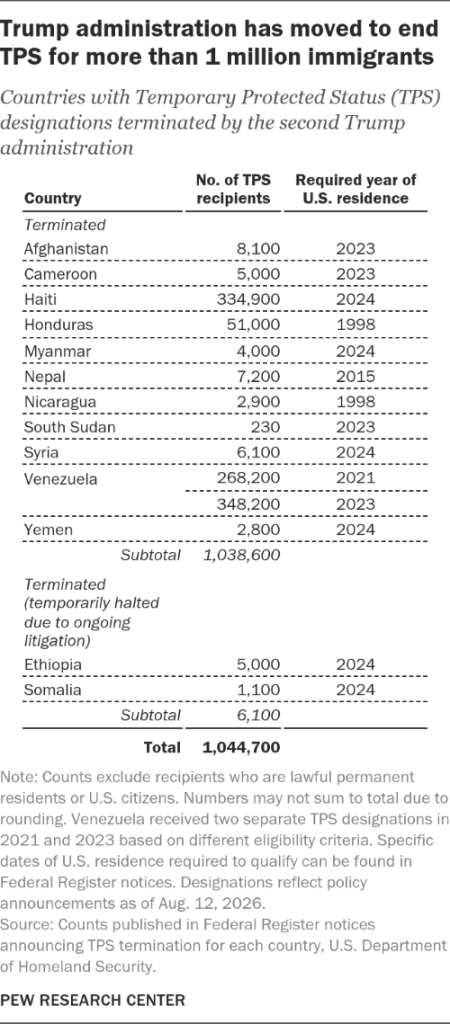
Temporary protected status was extended to Haitians after a 2010 earthquake devastated the country.
The Trump administration wants to eliminate TPS, which affects 1.3 million immigrants and their families.
Haitians and Syrians with TPS are among the first being targeted for deportation, after the U.S. Supreme Court ruled in the administration’s favor.
Escalating immigration enforcement has affected attendance at area Haitian churches.
A church pastor stands in an empty parking lot of a Northland church, ready to greet arrivals for Sunday services at Multi Nation Christian Church, a smaller congregation of several Christian churches serving the Haitian community.
Families begin arriving by late morning. Little girls wear ruffled dresses of tulle and lace with patent leather shoes. Mothers are in dresses and many men wear suits.
About two dozen people eventually fill the sanctuary. It’s about half the normal attendance.
Services are given predominantly in Creole, with a few readings in English.
The congregation welcomes a visitor. They take a vote to decide who will be allowed to speak for them.
A woman who works as a respiratory therapist is chosen. She has legal status, but wishes to remain anonymous.
The issues driving migration from Haiti are layered — a lack of safety, grinding poverty, the collapse of the government that holds no one responsible for the violence.
The threat of kidnappings is especially traumatizing.
“You will hear your family member crying over the phone as they are beating them,” she said.
Kidnap victims are sometimes killed even if the ransom is paid, she said.

“It’s not easy for somebody to just leave your home country to a destination that you don’t even know,” she said. “Some people are coming here and they don’t have anybody.”
Once In North America, some said, they face anti-Black racism.
“There is just hatred everywhere,” she said. “We just want to live in mutual respect, but we don’t always get it back.”
Jean Vil, secretary of the Haitian Community Center of the Mid-West, has lived in the Overland Park area for nearly 30 years after earning a master’s degree at the University of Kansas. He works in technology and telecommunications.
“I’ve never seen a group of people so resilient,” Vil said. “They get up, they go to work, get back from work, cook for their family, then sleep. And wake up the next day and do it again.”
Vil points out that many people with TPS have been working legally in the U.S. for more than 15 years.
During that time they have been paying taxes, paying into the Social Security system, buying houses and starting businesses. All of it will be abandoned if they are deported due to the loss of TPS.
The majority of Haitians would return to their homeland if it was safe, with a working government and other social structures like law enforcement, Vil and others said.
“So many hands are choking the country,” Vil said.
Corrupt officials provide guns to young people, fueling the gang violence, and without a working police presence or other infrastructure, Haitians are trapped.
“The people don’t have the means to defend themselves, so if they find a way out, they take it,” he said.
With Haitians concentrated in healthcare careers, some cities with large Caribbean immigrant populations are already seeing staffing problems in nursing homes and hospitals.
National advocacy organizations like the Haitian Bridge Alliance are pressing the U.S. Senate to take up a bill that would extend TPS for qualifying Haitians for another three years.
Vil recently received a call from an organization working to get the support of Republican Sen. Jerry Moran of Kansas for the legislation. But he hasn’t heard any updates and is doubtful that the legislation would be a priority for the senator.
The alliance, in a statement, is forthright about the expected consequences: “Without the passing of S.4814, we will witness one of the largest family separation events in modern-day history.”