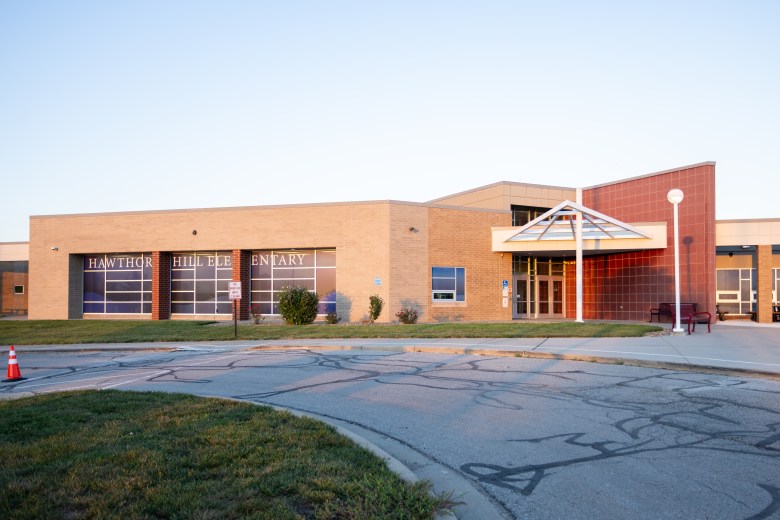
When Kelli Knapp went to vote during the Aug. 4 primary, she was surprised to find a long line of people waiting outside Hawthorn Hill Elementary School in Lee’s Summit.
Her husband, who was ahead of her in line, texted her after about 20 minutes of waiting that the poll workers had run out of preprinted Democratic ballots. Once Knapp got to the front, they were out of nonpartisan ballots as well.
Voters could use the electronic voting machine authorized under the Americans With Disabilities Act, but that also had a 30-minute plus wait. Knapp, who was on carpool duty that day, ended up voting on a Republican ballot for various issues before she had to leave.
The long wait and inability to vote for the candidates she wanted made it a scary and frustrating process, Knapp said.
“It felt like there was a restriction on our ability to access” voting, Knapp said.
Takeaways
- Voters at several precincts in Jackson, Pulaski and Callaway counties experienced shortages for Democrat and nonpartisan paper ballots, leading to long wait times.
- Election officials point to the difficulties of Missouri’s open primary system and difficulties anticipating higher voter turnout than in previous primaries.
- Those mistakes can have repercussions for voter confidence in elections. Officials say they have better plans in place for November.
Van Wiley Jr., another voter at Hawthorn Hill, said he arrived at the polls around 5 p.m. but additional ballots didn’t arrive until closer to 7 p.m., the time the polls were scheduled to close.
“Somebody finally came to deliver Democratic ballots, and so it was a kind of a little scramble,” Wiley said. “Everybody just grabbed one, you just waited for the guy or the lady ahead of you to finish, and then they passed the pen back to you.”
Hawthorn Hill wasn’t the only polling location in Jackson County that ran out of preprinted ballots that day. Fifty-eight out of 103 polling places ran out of some type of ballot, with almost all needing additional nonpartisan ballots.
Hawthorn Hill and Holy Spirit Church were the only two that needed additional preprinted Democrat ballots.
Other counties across the state had similar experiences.
In Pulaski County, preprinted nonpartisan and party-affiliated ballots ran out across some of the county’s smaller polling locations, County Clerk David Ernst said. He said it was the first time it had happened in his eight years of experience.
Callaway County Clerk Ronda Miller said in an email that half of the 18 polling locations in the county ran out of nonpartisan paper ballots, adding that they had never had that many people wanting to vote nonpartisan before.
In each case, voters had access to an ADA machine if they wanted to vote nonpartisan or Democrat.
The culprit for the shortages across all of these counties was higher-than-expected voter turnout.
Statewide Democratic turnout — calculated using the state auditor’s race — saw almost 160,000 more people casting votes than in the 2022 primary, an increase of 49.5%. Republican turnout also saw a boost, with over 58,000 more votes cast in the primary this year than in 2022, an increase of almost 10%.
Jackson County alone saw over 16,000 more Democratic ballots and over 4,000 more nonpartisan ballots cast than in the 2024 August primary.
As voters remained frustrated and wary about a similar situation happening in November, election officials pointed to the difficulties in determining turnout and laid out a plan for improvements.
The art of election turnout prediction
Determining voter turnout uses a mix of prior data and a little bit of guesswork.
Election authorities use turnout numbers from previous primaries and elections to predict how many ballots will be needed.
However, big races or issues, like the constitutional amendments Missourians voted on, can easily throw off those numbers as more motivated voters go to the polls.
For example, primary turnout in Jackson County typically sits between 26% and 30% of registered voters, or about 68,000 people at the high end. The 2026 primary saw nearly 88,000 people cast votes, representing 35.5% of registered voters.
Chris Mann, the research director at the Center for Election Innovation and Research, said preprinted ballot shortages aren’t entirely unusual because of those fluctuations.
“It’s not common, but it’s not unexpected,” Mann said. “There’s an art in looking at elections. If you’ve got a big high-profile race that’s spending a lot of money, that might drive turnout in the way the last one didn’t.”
The Jackson County Election Board initially ordered 107,610 ballots, costing roughly $38,300. That breaks down into 49,585 Democratic ballots, 54,195 Republican ballots, 965 Libertarian and 2,865 nonpartisan ballots.
JCEB Co-director Sara Zorich said the board had ordered more ballots overall this year in anticipation of more people turning out to vote on the constitutional amendments.
“It’s not that we didn’t recognize,” Zorich said. “We were doing what we thought was enough, and obviously we fell a little bit short.”
It ended up ordering 4,300 additional ballots, most of which were nonpartisan, and 20 additional machines as precincts reported shortages.
Tyler Spencer, the other co-director for JCEB, said in an email that primaries in particular can be difficult to plan for because there are multiple ballot types available. He said they don’t want to overprint in any one category and waste resources, especially since Jackson County has 247,018 registered voters.
“Ordering enough of every ballot type for every registered voter would mean ordering over 988,000 ballots,” Spencer said. “That would create a significant amount of unnecessary printing expense and waste, which is why (we) use historical turnout and ballot selection to determine reasonable quantities.”
Even if the board had elected to print one of each of the four types of ballots based off of previous peak voter turnout of 68,000 ballots cast, it would have resulted in roughly 184,400 unused ballots. That would have cost the county roughly $66,240.
By party, that would have roughly broken down into 21,000 unused Democratic ballots, 33,000 unused Republican ballots, 67,600 unused Libertarian ballots and 63,000 unused nonpartisan ballots.
Missouri’s open primary system can also make estimating particularly difficult, Mann said. While someone might be registered as a Republican, there’s nothing prohibiting them from taking a Democratic or nonpartisan ballot.
“How many people are going to show up for the Democratic primary to vote a nonpartisan ballot about nonpartisan questions, and how many are going to show up for the Republican primary?” Mann said. “So there’s just more uncertainty there, which increases the likelihood that they get one of those estimates incorrect.”
That was part of what happened in Jackson County. Spencer said the board heard from voters who normally identify with one party but chose the other party’s ballot because they were interested in particular races.
But missing the estimate can result in long waits, frustration and, for some, the inability to vote.
“It is true that someone might have to leave the line because they have childcare or work, and so that cost can be real, and it can mean that people lose the opportunity to vote,” Mann said. “But the system has fail-safes to try to ensure that everyone can be able to vote.”
Missing the estimate can also have repercussions for future elections.
Voter confidence for November
Mistakes can rattle voter confidence.
The August primary shortages came at a time when the country is already seeing increased election worries. American confidence in election fairness and accuracy has fallen to 55%, according to the Pew Research Center. That’s the lowest rating since the start of the 2020s.
Because of that, everything is under heightened scrutiny, Mann said. But he stressed that poll workers are still human and mistakes happen, and the important takeaway is to make sure it doesn’t become a pattern.
“Making a mistake over and over again is a very different level of accountability for not doing their job correctly. But in some ways, the fact that this is a bit of a novel story tells you that this is something that happened in this primary because there’s something (else) going on,” Mann said. “This is an important thing to shine the light on, but also to shine the light of ‘this is an honest mistake.’”
Tyler McCall, executive director for the Jackson County Democrats, said the fact that more Democratic ballots were pulled in this election is another indicator that officials were likely just caught off guard by the high turnout.
“I have again a lot of faith in the Jackson County Election Board and Kansas City Election Board, both the Republican and Democratic officials,” McCall said. “Especially with all of the energy surrounding stopping Amendments 4 and 5, I think that seeing those nonpartisan ballots and Democratic ballots being pulled in numbers they weren’t expecting is a sign of that kind of energy and support.”
Residents also acknowledged that the shortages were likely unintentional. But they expressed frustration that election authorities didn’t expect the higher turnout with so many important issues on the ballot.
“There was a lot of that going on with this election and so I don’t feel like even if you have statistics from previous ones that that’s necessarily going to define what is going to happen,” Knapp said.
Moving forward, she hopes to see that rectified, along with the slow response time in getting more ballots to polling places.
JCEB officials told The Beacon it has already talked about improvements. Zorich said for the next elections, they will have two electronic ADA machines at every polling location and more ballots available.
The board’s headquarters location in Independence also proved to be a challenge, Zorich said, since it’s not centrally located in the district, so it took longer than they would have liked to deliver more ballots. Spencer said they intend to learn from that experience and use it to better prepare for November.
To avoid any repeat problems, Wiley said he intends to vote earlier in the day regardless of any changes the board might make.
“I decided to wait until after work,” Wiley said. “But next time to avoid this, the earlier I get there, I shouldn’t run into that problem. … I know that that’s the best way that I can mitigate that situation.”
That’s where early voting can be useful as well, Mann said, as it allows greater flexibility for both voters and election workers. Missouri has a no-excuse absentee voting period that runs from the second Tuesday before the election to the day before the election.
“Real life happens in the middle of elections,” Mann said. “If that happens and the line is long, or you just happen to go on a busy day, you can look at that and go, ‘I can come back tomorrow,’ or two days from now, or three days from now, or even on election day in a week.”
Heading into November, McCall said he hopes that this doesn’t turn people off to the idea of voting and instead the momentum carries forward.
“I think this was just like the 100-year-flood kind of thing,” McCall said. “They really were not expecting the turnout that happened, but I would like to say let’s start to expect that turnout.”