


Takeaways
- The community impact partnership agreement sets a floor of $55 million from the Royals over a lease that runs 30 years.
- Several commitments restate obligations the city already imposes, including prevailing wages on construction and the One Percent for Art requirement.
- The Royals are giving $14 million for the arts, $10 million for youth sports, $5 million for the Negro Leagues Baseball Museum and $5 million for homelessness services.
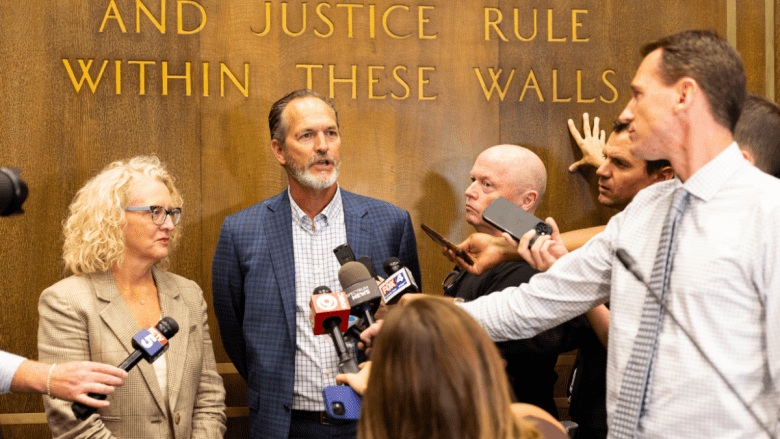
Debate over whether a new Royals ballpark is a transformational project or a public handout to a billionaire and whether it should face a public vote has ratcheted up in recent weeks, after years of public discourse on stadium financing.
With so much focus on how to finance the $1.9 billion ballpark, you might be forgiven for missing the shortest document in the ballpark package that the City Council passed 11-2 last week.
Buried amid four agreements totaling about 165 pages — detailing a $600 million commitment from the city in the form of bonds and tax redirection, triggering another roughly $540 million from the state — is an 11-page community impact partnership agreement. It commits the Royals to spend at least $55 million over the term of the proposed stadium lease, which can run between 30 to 40 years.
Arlene Martinez reads a lot of agreements like these.
She’s the communications director at Good Jobs First, a national nonprofit that promotes government and corporate accountability in economic development. She told The Beacon they are often called community benefits agreements, negotiated between organized community groups and a developer. The Royals’ version has a different name, she said, likely because it was negotiated between the team and the city.
She’s not impressed.
“It’s one of the worst I’ve seen,” Martinez said. “This $55 million over three decades is pretty pathetic.”
Brooks Sherman, Royals president of real estate and development, sees it differently.
Presenting the agreement at the City Council’s Finance, Governance and Public Safety Committee on Aug. 18, he framed the $55 million as money on top of what the team already does.
“We will continue the programs and activities we do today, which have amounted to more than $50 million from the Royals Foundation into the community over the last 10 years,” Sherman said. “That will continue in its own right. In addition, with this community impact partnership agreement, we’ve committed another $55 million as part of this project.”
He told members the team had picked its funding targets deliberately.
“We will work with the city to ensure these funds are used appropriately,” Sherman said. “We believe we’ve selected meaningful projects and scopes to best put these funds to use on behalf of the city.”
The money would go to things like the arts, youth sports, homelessness services and the Negro Leagues Baseball Museum.
The Royals must also build and maintain improvements to the nearby Washington Square Park and have free-to-the-public year-round programming. The agreement includes labor provisions, workforce training participation, a rail study to examine bringing fans to games through Union Station, a ticket discount for Kansas City residents and rules governing the years of construction. It also lists a series of smaller promises — down to the two sensory rooms at the ballpark for families who need a quiet place to step away from a game.
For perspective, the top-line number of $55 million coming back to the community equals about 9 cents on every dollar the city has committed to back the stadium project.
Whether that’s enough is open for debate. But it’s worth knowing what’s actually in the agreement and what other cities got in similar deals.
So The Beacon read it. Line by line, checking which promises are new or unique and which would have been required anyway. Then we compared that to four other agreements: the “Plaza Promise” from developers of the Country Club Plaza, the Athletics’ agreement for their new stadium in Las Vegas, the Chiefs’ term sheet with Kansas, and the Royals’ own offer to Jackson County voters two years ago.
Some of the agreement is straightforwardly good with concrete benefits, although scale will always be a debate when development dollar figures get this high. Some of it comes with an asterisk — as is baseball tradition. And some of the things other cities got or what the Royals put on the table two years ago aren’t in this document.
New defined community benefits
The community impact partnership agreement sets a floor — what it calls a “minimum financial commitment” — of $55 million from the Royals and their affiliates over the life of the ballpark lease at Crown Center. That 30-year lease also allows five two-year extensions that could stretch it to 40 years.
That $55 million includes $14 million for the arts, $5 million for youth sports up front and $5 million for homelessness services. The remaining $31 million would be paid year by year.
Worker considerations
The agreement lists a prevailing wage on stadium construction — a real protection that raises wages for the people doing the work. But Missouri law and city statute already both require the prevailing wage floor for a project like this.
Organized labor has been one of the most vocal supporters of the project, and the math explains why. For the construction trades and workers building a $1.9 billion stadium, with another $1 billion expected later in surrounding development, those numbers represent years of work.
That work will help them build their apprenticeship pipeline. The Royals will also participate in workforce development through the Missouri Works Initiative.
But for the people who will work inside the finished ballpark, the document says less. Its only wage commitment is that the club maintains rates “equal to or better than average wage rates paid by other professional sports teams in the Kansas City region” — an average rather than a floor.
“That was written in a way that allows the club to pay whatever wage they want — as low wages as they want,” Martinez said.
The bigger labor news — which may have solidified “yes” votes from more than one City Council member — wasn’t in the community impact partnership agreement. The Royals and Service Employees International Union (SEIU) Local 1, which represents roughly 350 workers at Kauffman Stadium, reached an agreement.
“We are proud to announce that last night we got an agreement with the Royals for a labor peace agreement,” David Cooper of SEIU Local 1 told the Aug. 18 Finance Committee. “We are looking forward to working with them to make sure that there are good jobs waiting for workers on the other end of this move.”
Details of the deal have not been made public. Both the Royals and representatives from SEIU declined requests from The Beacon to review the agreement.
“There is nobody in this city who deserves a raise more than the workers of the SEIU,” Councilman Wes Rogers said at the Aug. 18 committee meeting. “Those folks, they’re getting some of the best part-time jobs in all of Major League Baseball with this deal. And they’re also going to have really good full-time jobs and year-round jobs.”
Rogers told The Beacon that he’s heard directly from the SEIU that they are happy with the deal, even if the details aren’t public.
$5 million to Negro Leagues Baseball Museum
The $5 million takes a dent out of the $35 million capital campaign to expand the museum and link it to the Paseo YMCA where the Negro Leagues were founded. The museum has become a stop for out-of-town visitors coming to Royals games who are interested in baseball history.
Museum President Bob Kendrick has backed the Royals stadium project, calling the deal transformational for the 18th and Vine district.
The money comes out of the pot of $31 million that’s paid out annually and goes to the museum’s capital campaign, paid across the life of the lease rather than up front.
The Royals also agreed to continue paying for free museum admission for the general public every February and for student field trips.
$10 million for youth sports
Councilwoman Melissa Patterson-Hazley pushed to add money for youth sports the day the development agreements were passed by the City Council.
The goal is to bring sports facilities and programming to youth in Kansas City.
Patterson-Hazley told The Beacon that she wants to bring something to Kansas City that largely exists only in the suburbs. She pointed to Homefield in Kansas City, Kansas, and Bluhawk in Overland Park as examples of what she’d like to see.
The agreement gives $5 million up front, and at least $5 million more comes out of the yearly payments, aimed at health department-determined focus ZIP codes within the city. She said the money given to youth sports by the community impact agreement can help right away and can be leveraged into even more.
She said the facilities and programming are needed in the city, adding that private equity has moved into youth sports leagues, creating a pay-to-play model that shuts out many kids from participating in youth sports.
“When you have a municipal partner, then you don’t have to behave like private equity, which is essentially screwing everything up,” said Patterson-Hazley. “Kids need reasonable access, preferably in facilities that are beautiful and comparable to what we see in the suburbs, without them having to go to the suburbs.”
New defined community benefits* (with an asterisk)
$14 million for the arts
The agreement commits $14 million to the arts over the term of the lease.
The money satisfies the city’s longstanding One Percent for Art requirement for any municipal project. Since 1986, the city has required a 1% set-aside of municipal construction costs for public art.
Notably, that $14 million is not 1% of the $1.9 billion stadium. Of the $1.9 billion for the stadium development, $500 million is for infrastructure, $1.2 billion for the stadium and $200 million for team offices. The 1% for art is only being applied against the $1.4 billion in actual building construction, generating $14 million.
Another caveat is that the Royals can satisfy the commitment through in-kind contributions, sponsorships or program support rather than cash — including the cost of moving the World Cup fanfest favorite 65-foot KC Heart Gateway sculpture into the ballpark plans.
$5 million toward services for unhoused people
The money goes to the city’s Housing Gateway Program, which launched in February with a $1 million city investment to move people out of encampments using rental assistance, deposits and utility payments. The Royals’ contribution is five times the $1 million that the city issued to start the program.
Scale cuts both ways.
According to the community impact agreement this money from the Royals comes “…as contribution to the City’s Housing Trust Fund.” Kansas City voters recently approved $100 million in bonds for affordable housing.
$31 million paid out over years
The team also committed to contribute at least $31 million in annual installments. The first payment would be roughly $1.03 million and each year after would be adjusted for inflation according to the consumer price index, but capped at 2% a year.
That means that the $31 million minimum could grow to $41.9 million after 30 years. That would push the whole commitment closer to $66 million rather than $55 million.
However, that doesn’t guarantee that the $31 commitment would keep up with inflation. According to the Federal Reserve, the consumer price index rose by more than 2% in seven of the last 10 years. The average yearly increase over the last 10 years is 3.14%.
There’s another thing to know about that $31 million — $10 million of it is already spoken for. The Negro League Baseball Museum’s $5 million and the second $5 million for ongoing support for youth sports both come out of the yearly stream rather than sitting on top of it.
That leaves roughly $21 million genuinely undesignated across three decades, about $700,000 a year, to be allocated in annual meetings between the city and the team.
Comparisons to peer projects
Now, let’s compare the Royals’ community impact partnership agreement’s top-line figures to similar developments with Kansas City ties.
This week, Port KC approved an estimated $149 million property tax break for Gillon Property Group’s $1.49 billion Country Club Plaza redevelopment.
The developer’s “Plaza Promise” commits about $4 million toward affordable housing plus smaller sums for down-payment assistance and work on issues stemming from intimate-partner violence. That’s a fraction of the Royals’ number, despite similar-sized developments — the new Royals stadium is $1.9 billion and Plaza redevelopment could be as high as $1.49 billion. It should be noted, though, that Gillon is responsible for backing repayment of its own bond debt while the city is backing its $600 million commitment to the Royals.
The Athletics, the Major League Baseball team that played in Kansas City from 1955 to 1967 before the Royals, are moving to a new stadium in Las Vegas. For context, that deal was also backed by public money that wasn’t voter-approved.
Their community benefits plan is the greater of $2 million a year or 1% of ticket revenue — a number that rises if the team succeeds.
Over 30 years, that floor for the Athletics deal comes to at least $60 million — against $380 million in public financing for their Las Vegas ballpark. The Royals’ $55 million comes against $600 million from Kansas City alone. The comparison is favorable or unfavorable depending on how far above the floor each team goes. The Athletics would also be starting out in a new city, while the Royals have a long philanthropic history locally.
The Kansas City Chiefs plan to move to Kansas, and while there isn’t a formal community benefits agreement yet, there is a term sheet with the state of Kansas.
The term sheet sets the team’s minimum community contribution at $3 million a year — well above the Royals’ average of about $1.83 million.
But there is a catch sitting in the same paragraph of the Chiefs deal. At least half of that money must go to projects in Kansas but outside the Kansas City metropolitan area. Cut the local share in half and it lands below the Royals’ pace. The Chiefs deal also isn’t final, and the overall public financial commitment is larger than for the Royals project.

The Royals of two years ago also offer an apt comparison. Ahead of the Jackson County sales tax vote in 2024 that would have funded a downtown ballpark in the Crossroads, the Royals and Chiefs together pledged more than $260 million in community benefits. The Royals’ share was $140 million, described at the time as the largest in Major League Baseball.
That top-line discrepancy is large: $55 million to $140 million.
Part of that is the lease term, the $140 million in the community benefits agreement of 2024 paid out over 40 years. To compare apples to apples, the Royals of 2024 were going to put $3.5 million a year towards community benefits while the Royals of today are agreeing to a minimum average of $1.83 million paid each year.
In addition, some of the criticism of the Royals community benefits agreement in 2024 was that too much of what was included was charitable work that the Royals foundation already does. Brooks Sherman was sure to note at the committee meeting that this current community impact partnership agreement separates their existing foundation work.
If we assume that the Royals would continue giving through their foundation at the same pace, that equates to roughly $150 million more over the next 30 years. But the Royals also said in their joint announcement with the Chiefs that the 2024 community benefits were also “on top of the Kansas City Royals Foundation’s robust charitable contributions and programs…”
Is the community benefit enough?
Gary Rhoades defends the legal rights of low-wage workers and low-income tenants as the executive director at the Heartland Center for Jobs and Freedom. The organization was part of the coalition that negotiated the community benefits agreement with the team in 2024 before walking away frustrated.
Rhoades, who started in his position at the Heartland Center in June, wasn’t personally involved in the 2024 negotiation or this one. But he has followed the stadium developments and offered his personal thoughts to The Beacon, presented here.
“I look at this deal and the process that led to it … as having the good, the bad, and then what’s missing.”
“The good is that the vast majority of us want to keep the Royals in Kansas City. … And then there are some worker protection terms in this agreement, like prevailing wages and the training and apprenticeship opportunities for the construction workers.”
“The bad or troubling part of this is the sheer amount of public money involved. Kansas City is committing up to $600 million on top of the hundreds of millions more from the state going to billionaires. Federal support for housing and community development under this administration is under enormous pressure for cities. So every public dollar is becoming more precious.”
“Then there are the really serious shortcomings. The public had too little input and voice before the city made this enormous commitment, and the protections for the low-wage workers are not nearly strong enough, especially for this project, and for development of this magnitude, especially one that could increase housing costs…”
So is it enough?
Eleven of 13 City Council members plus the mayor thought it was. So do the area’s organized labor unions. Meanwhile some community low-wage worker advocacy groups like Missouri Workers Power, which is seeking a public vote on stadium subsidies, emphatically do not.
Brooks Sherman, in a written statement to The Beacon, said that the Royals were founded as a way to make Kansas City stronger and that the deal takes that intended mission to the next level.
“This partnership with Hallmark and the city will create jobs, protect workers, bring millions of new visitors downtown, and continue our city’s transformative progress without displacing businesses or raising taxes,” Sherman said. “That’s why we’ve seen broad support from our local and regional leaders, small business owners in and around the Crossroads, labor unions, our stadium workers, and Royals fans everywhere.”
Martinez from Good Jobs First certainly doesn’t think it’s enough.
“The research is clear that there isn’t a community benefits agreement that would be good enough to justify a subsidy to a stadium,” Martinez said.
One unconventional measure may be helpful to decide whether this is a good deal. And it’s more apt than it appears on first blush.
A tithe is the religious practice of giving a tenth of your income to charitable works. Set the Royals’ $55 million against the $600 million Kansas City is committing and it comes to about 9.2% — just short.
The comparison fits for a reason beyond arithmetic.
A historic Catholic church sits directly south of the ballpark site, Our Lady of Sorrows — close enough that its steeple appears above the roofline in the team’s renderings. The parish has welcomed the ballpark, even though it learned of details late and fast, like the rest of us.
The Catholic faith tradition doesn’t impose a hard 10% rule like some other denominations. It asks that people give according to their means.

