


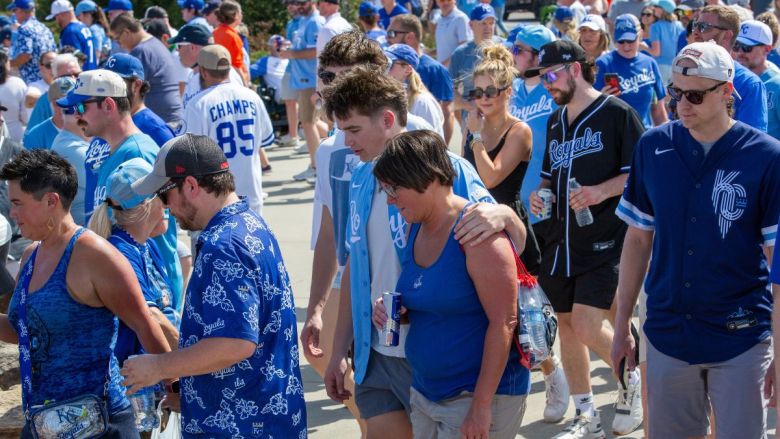
Kansas City officials are looking to cut a ballpark deal within weeks that will define the city for decades.
Takeaways
- Kansas City is racing to approve a $600 million deal to help finance a new Royals stadium at Crown Center within the next few weeks, but key details remain unknown to the public.
- Taxpayers would be on the hook for the next three decades for tens of millions of dollars per year to pay down a city-backed loan.
- A petition effort led by Missouri Workers Power is attempting to force a vote on the stadium, but city officials are pushing to get the deal signed before it goes on the ballot.
- Mayor Quinton Lucas denies that the petition is causing any time pressure, but one City Council member said the council was advised to finish the deal by Aug. 31 for the best legal position in case of a lawsuit.
Publicly, at least, the details remain sparse.
City officials are scrambling to finalize plans to help finance the Royals’ proposed $1.9 billion ballpark at Crown Center before the end of the month.
If things had gone according to plan, the Kansas City Council could have been voting on the deal to provide $600 million for the project on the afternoon of Aug. 13 — less than three days after paperwork was distributed to City Council members on Monday night.
Instead, the city’s Finance, Governance and Public Safety committee held the ordinance on Tuesday, delaying the vote for at least a week.
But the public still has precious little information about where the money will come from, whether the deal will impact other taxing jurisdictions or whether Hallmark and the Royals intend to deliver any of the community benefits the City Council previously promised to negotiate.
And the clock is ticking.
According to one council member, the city’s legal department told the council that Kansas City could be forced to let voters have a say on the deal if the agreements are not signed by Aug. 31.
That, Mayor Quinton Lucas said, would delay the deal by more than six months.
The alternative path — the one the council appears to be taking — means that a $600 million deal with 30-year contracts and debt obligations could move forward with limited public input or oversight.
Let’s make a deal
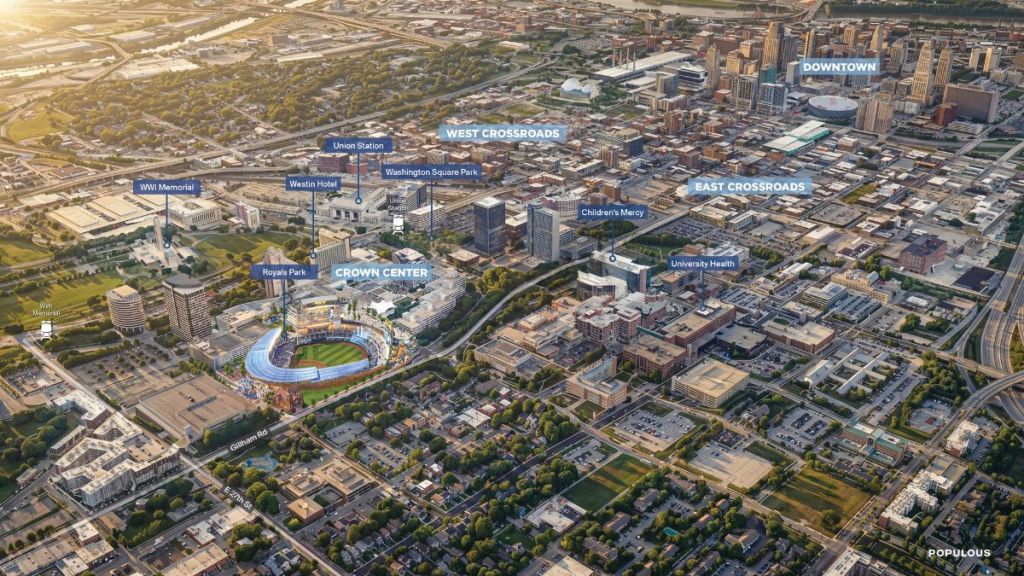
The new Royals ballpark is proposed for the current Hallmark Cards headquarters site at Crown Center.
The stadium would cost a total of $1.9 billion, making it the fourth-most expensive major league ballpark of all time, after adjusting for inflation. The broader ballpark district plan calls for an additional $1 billion in nearby development.
Out of that $1.9 billion for the ballpark, Kansas City intends to finance $600 million. The local contribution is required to unlock an additional $200 million to $300 million that would be financed by Missouri taxpayers.
Including extra money for debt service, upward of $1.5 billion in state and local subsidies would go toward financing the stadium over the next 30 years.
Technically, Kansas City’s portion will be covered by a tax-increment financing deal. Under that plan, the city will draw a “tax redirection” area surrounding Crown Center. The boundaries of that area have not been disclosed.
The city expects tax revenues to increase in that area, in part due to the Royals stadium. The increase in revenue from that area will be used to pay down the $600 million in debt until it’s paid off in 30 years.
Under a traditional TIF deal, half of the increase in tax revenue would be used for the ballpark development. In theory, at least, the rest would go toward financing public services.
The reasoning goes that the increase in tax revenue would not happen without the stadium. So in that sense, some argue, the stadium is paying for itself.
(You can read more about the mechanics of a tax-increment financing deal, or TIF, in this previous article.)
But in practice, Kansas City taxpayers would be on the hook for tens of millions of dollars per year for the next 30 years.
That’s because the city is expected to guarantee repayment of the $600 million debt, instead of the Royals or Hallmark.
If the project doesn’t generate enough tax revenue to cover its own debt, that money would come from the city’s general fund at the expense of services including police, fire, public transit and neighborhoods.
The city financed the Power & Light District under a similar structure. As of 2023, the city had paid a total of $167 million over 16 years to cover debt payments.
To prevent that from happening with the Royals ballpark, the city plans to draw the boundaries of that tax-redirection area so large that it can collect enough money to pay off the debt.
In the process, the city is making the assumption that increased economic activity in that area over the next 30 years is a result of the stadium.
In addition to the TIF deal, the city may create a community improvement district in the area around the stadium to help subsidize the stadium. Council member Johnathan Duncan suggested on Tuesday that this is included in the documents that were distributed to the City Council on Monday night that have not yet been made available to the public.
What’s the rush?
Looming over the City Council’s deliberations this month are nearly 4,000 petition signatures that were certified in June.
That petition, organized by Missouri Workers Power, calls for a city ordinance that would require a public vote before the city can give a subsidy for a “stadium, arena or similar venue” with more than 2,500 seats, such as the Royals ballpark.
The City Council has until Aug. 31, 60 days from when the petition signatures were certified, to either approve that ordinance or schedule an election for voters to weigh in.
If that ordinance is approved, the petition organizers argue, the city would then need to call a second election to ask voters for permission to subsidize the Royals ballpark.
But when the signatures were turned in, Lucas said it was too late.
“I think the deal is likely to get done before we even have some of these discussions,” Lucas said in June, “if we ever get to the point of a public vote.”
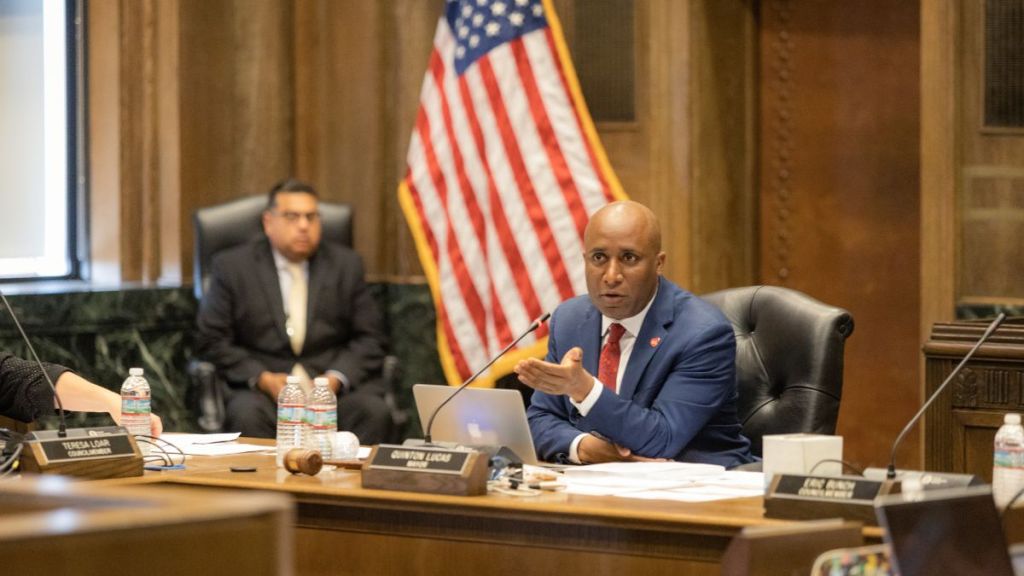
Now, two months later, the city is scheduling last-minute votes and potentially even special council sessions to get the development and funding agreements signed.
City staff worked overtime last weekend to prepare the agreements in time to present them to the Finance, Governance and Public Safety committee on Aug. 11.
Those documents include:
- The team’s proposed lease
- Nonrelocation agreement for the Royals
- Development agreement
- Community impact partnership agreement (also known as a community benefits agreement)
- Funding agreement
Those documents were distributed to the City Council less than 12 hours before Tuesday’s committee meeting. If the plan had moved forward, the public could have had just two days to review them before the council finalized the 30-year deal.
Lucas said the committee vote was delayed so that the council and the public could have more time to review the agreements.
So The Beacon submitted an open-records request to review those documents.
Kansas City rejected The Beacon’s request because “records pertaining to ongoing negotiations for agreements not yet executed are closed pursuant to RSMo. Sec. 610.021(12).”
Reporting by The Kansas City Star suggests that Lucas may have been misrepresenting the reason for the delay. Duncan told The Star that he’d heard the delay was because the Royals had backpedaled on a verbal commitment.
Political math
If you ask Lucas, the citizens’ petition and the Aug. 31 deadline to put it on the ballot have nothing to do with the city’s rush to reach a deal.
“The city does not have a deadline or a timeline” to approve the Royals deal, he told reporters on Tuesday, “at least as to how it would act on any ordinances either before us or in the future relating to the baseball stadium that are triggered by any outside petition efforts.”
Council member Duncan, however, disagrees.
After reporters spoke with Lucas, Duncan said the entire City Council had received an email briefing that the city would be in the best legal position if it approved the agreements before Aug. 31.
“Maybe the mayor should go back and check his email about the briefings we received,” Duncan told reporters. “The whole point of rushing these agreements is to ensure that these agreements are finalized and signed prior to a vote of the people, to circumvent the will of the people and to prevent this from going to a public vote.”

Duncan said the council’s rush to approve a $600 million subsidy for the Royals is coming at the expense of taxpayers.
He has been advocating for a provision in the Royals agreement that would give Kansas City a share of the revenues — ideally 30%, which is the portion of stadium costs that the city is shouldering.
But because the deal is moving so quickly, Duncan said it’s limiting the city’s ability to get more concessions from the team and Hallmark.
“The Royals cannot move forward with this development without the city’s equity,” he said. “We deserve an equity position and a return on investment that includes a portion of the profits. Is it 30 percent? I think it should be, but I’m happy to negotiate. Right now, it’s zero percent.”
In addition, Duncan said that the taxing jurisdictions like the school district and the library have not had a seat at the table for any negotiations.
The last time the Royals pitched a downtown ballpark in 2024 — tied to renewal of a Jackson County sales tax, which voters overwhelmingly rejected — the team had promised to make payments to the school district with annual increases to make up for the property taxes the team wouldn’t have to pay. It’s unclear whether this is the case in the latest proposal the council is considering.
Sam Mellinger, a spokesman for the Royals, declined to comment on the city’s process. He added that under the proposed agreements, the school districts will not see a drop in property tax revenue.
The City Council has not yet announced when it will take up the Royals agreements again. The committee held the ordinance until the next committee meeting.
Lucas suggested on Tuesday that he may call a special meeting as soon as next week.
The City Council would otherwise be taking the week off.
Here is a list of the current members of the City Council, with members of the Finance, Governance and Public Safety committee bolded, as well as whether they are expected to appear on the next council election ballot April 6, 2027.
- Mayor — Quinton Lucas, who is term-limited out and will not be running for reelection.
- 1st District (at-large) — Kevin O’Neill, who is term-limited out and will not be running for reelection.
- 1st District (in-district) — Nathan Willett, who lost a Republican primary election for Missouri’s 6th Congressional District on Aug. 4. If he chooses to run for reelection, he will appear on the ballot.
- 2nd District (at-large) — Lindsay French, who is running for reelection.
- 2nd District (in-district) — Wes Rogers, who is running for mayor.
- 3rd District (at-large) — Melissa Patterson Hazley, who is running for reelection.
- 3rd District (in-district) — Melissa Robinson, who is term-limited out and will not be running for reelection.
- 4th District (at-large) — Crispin Rea, who is running for mayor.
- 4th District (in-district) — Eric Bunch, who is term-limited out and will not be running for reelection.
- 5th District (at-large) — Darrell Curls, who is running for reelection.
- 5th District (in-district) — Ryana Parks-Shaw, who is running for mayor.
- 6th District (at-large) — Andrea Bough, who is term-limited out and will not be running for reelection.
- 6th District (in-district) — Johnathan Duncan, who is running for reelection.

