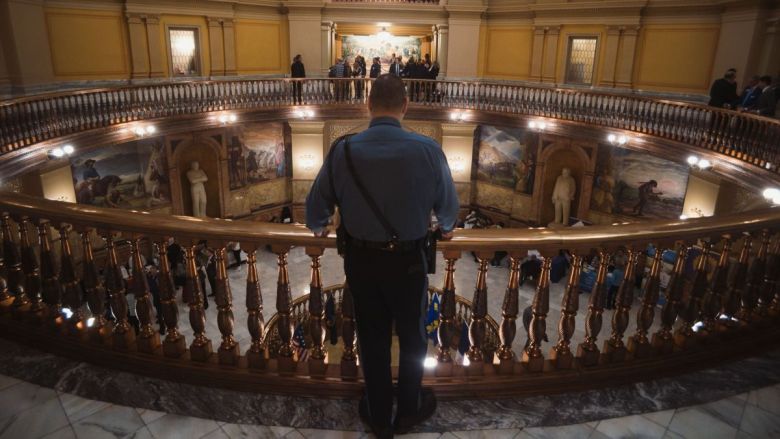
For 22 years, Kansas leaders protected a law allowing some undocumented students to pay in-state tuition to attend the state’s public colleges, universities and technical schools.
Those days are over.
Takeaways
- The U.S. Department of Justice is suing states that allow undocumented students to pay in-state tuition fees at colleges and universities, instead of charging them much higher international student rates.
- Delays for extra vetting also are causing some students to lose their protection against deportation through an Obama-era program called DACA (Deferred Action for Childhood Arrivals).
- The Kansas Legislature passed a bill in March that would have ended in the 22-year-old in-state tuition option for undocumented students. Gov. Laura Kelly vetoed the bill.
- Kansas Attorney General Kris Kobach has long argued that Kansas’ in-state tuition option for some immigrant students violates federal law and incentivizes unauthorized immigration.
During the recently ended session, the GOP-dominated state legislature passed a bill overturning the policy that has allowed thousands of young Kansans to pay for and earn a college education. Only the veto of Gov. Laura Kelly, a Democrat, saved the law from repeal.
National challenges are also looming.
The Trump administration has begun systematically suing the more than 20 states that have such laws. The Department of Justice argues in-state tuition laws incentivize unauthorized immigration and favor immigrants over U.S. citizens.
On June 3, a federal judge struck down Nebraska’s law, which is similar to the one in Kansas. Nebraska’s Republican governor had agreed to a consent decree to end the law after being sued.
Kansas Attorney General Kris Kobach warns that Kansas could be next.
“If Kansas were to be sued by the federal government over this statute, Kansas would likely lose the lawsuit,” Kobach said in a legal opinion given to state legislators.
Other GOP legislators are pressing the same message.
Sen. Mike Thompson, a Johnson County Republican, led efforts in the last legislative session to reframe in-state tuition as a public benefit, arguing the Kansas law is out of sync with federal law, a view that Kobach also holds.
“The DOJ is watching Kansas closely and if we allow this to continue, we will be sued, and we will lose,” Thompson said in a social media post.
Targeting Dreamers
Since 2004, thousands of immigrant Kansas high school graduates, often called Dreamers, have used the law to earn degrees by paying in-state fees instead of far higher international student rates.
Republican legislators have targeted the law each session, trying to overturn it.
Supporters have long pushed back, including the Kansas Board of Regents, the Kansas Association of School Boards and immigrant rights advocates.
Rep. Louis Ruiz, a Kansas City, Kansas, Democrat who is retiring at the end of this term, fears what the future holds for the state’s undocumented K-12 students.
Ruiz has long supported the students, knowing that many were brought to the U.S. as young children by their parents. They view Kansas as home.
“Some people, especially some Republicans, try to claim that these students are getting a free tuition,” Ruiz said. “No, that’s not accurate. They are paying a rate as residents of the state.”
Qualifications include graduating from an accredited Kansas high school after attending for at least three years.
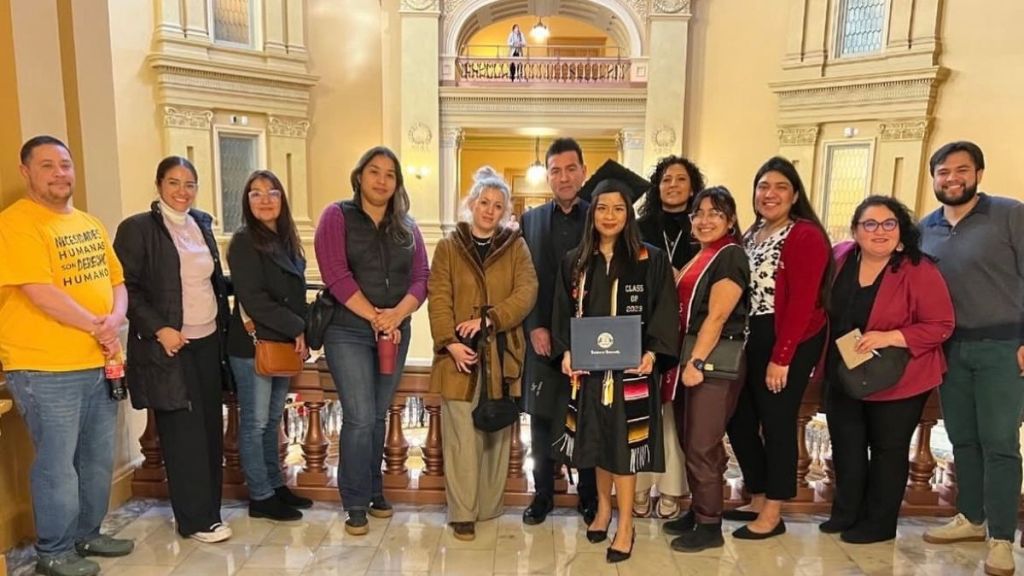
An Obama-era program has also aided undocumented immigrant students. But it also is under heightened scrutiny from the Trump administration.
Deferred Action for Childhood Arrivals, or DACA, offers temporary protection against deportation for those who qualify and undergo vetting, including biometrics.
DACA recipients can get a work permit and often begin putting their degrees to work in chosen professions.
New applications to the program are on hold while federal court challenges play out.
DACA approval must be renewed every two years.
Processing delays by the administration are causing people to lose their status. And some have been deported.
The Trump administration says extra vetting is behind the lengthened wait times.
“I was terrified that it wouldn’t be a quick renewal,” said one Kansas City area DACA recipient of her renewal, which was granted in August 2025.
Still, her concerns linger. She requested to remain anonymous. Similar to several people interviewed for this story, she is protective of extended family and other immigrants in her social circles.
“Even if you’re a permanent resident, you’re not safe,” she said. “They’re looking for anything to detain you and deport you without giving you your day in court.”
There were 505,940 active DACA recipients in the nation as of Sept. 30, 2025, according to U.S. Citizenship and Immigration Services.
Kansas had 4,230 DACA recipients at that time. Missouri, which does not allow in-state tuition rates for undocumented students, had 2,490 DACA recipients.
Also, a Board of Immigration Appeals decision in late April found that holding an active DACA status is not sufficient alone to protect against deportation. The decision conflicts with rulings in federal courts that have upheld the program’s constitutionality.
The National Immigration Law Center is trying to calm DACA recipients’ fears, releasing detailed information about the ruling. The center emphasizes that DACA still offers protections from deportation. But the situation can become more complicated if a person is detained by immigration officials.
“I feel like every day I wake up and it’s something else, something new,” said Maria, a former DACA recipient and a graduate of Olathe East High School.
Last year, Maria completed the process to become a legal permanent resident through marriage to her U.S.-born husband.
Maria grew up in Olathe, with no memories of her native Puebla, Mexico.
She immigrated at 2 years old with her mother, reuniting with her father who had migrated earlier.
Maria fully understood her legal situation as a 16-year-old.
She wanted to study abroad, along with some of her classmates. Her mother explained that it would be impossible for Maria to leave the country and safely return, because of her lack of legal status then.
The Kansas in-state law made college financially feasible. She earned an associate degree at Johnson County Community College, then a bachelor’s degree in business administration and a minor in psychology from the University of Kansas.
Undocumented Kansas students, even with the in-state tuition law, cannot receive public federal or state grants and scholarships or subsidized student loans.
“Had it been out-of-state tuition, even for Johnson County Community College, I would not have been able to graduate at all,” Maria said.
A mother’s plan to protect her U.S.-born children
Karina Valtierra prepared her four sons for the possibility that she could be deported.
Valtierra’s DACA status lapsed for eight tense weeks this spring.
A native of Durango, Mexico, she’s lived in the U.S. since the age of 11 and applied for her DACA renewal early. But it didn’t arrive by her February expiration date.
As a result, she couldn’t legally drive, or work, and had to step away from her job teaching young children at a school in Wichita.
She gave an aunt power of attorney. She arranged for house payments to be covered for the family home. She spoke to her oldest child, a 17-year-old, about assuming the role as head of the household.

The youngest, at 13, struggled to understand.
“Just having to have that conversation with them was awful,” Valtierra said. “And trying to explain, ‘I’m protecting you guys, making sure you’ll be OK if anything happens.’”
Valtierra’s renewal was approved in late March.
She’s resumed teaching, putting the early childhood/leadership degree she earned from Fort Hays State University into practice.
DACA was never intended to be a permanent fix. It was a stopgap for a generation of immigrants who had been brought to the U.S. without documentation as children.
Obama instituted it by executive order in 2012.
Congress, despite periods of strong bipartisan support, never passed the DREAM Act, which would offer a route to permanent legal status for some undocumented students.
DREAM stands for Development, Relief and Education for Alien Minors Act. The act was first introduced in 2001.
Most of the original DACA recipients, and many former students known as Dreamers, are now in their 30s or older.
“We consider this our country, even though we don’t have a piece of paper that says this is our country,” Valtierra said. “Now we have kids, and we’ve built a life in here.”
‘In their crosshairs’
Kansas Attorney General Kris Kobach has been a leading critic of in-state tuition laws and DACA. He has either filed or joined lawsuits against both, in Kansas and through national networks.
“Congress declared that no state may give in-state tuition benefits to illegal aliens unless the state extends the same tuition benefits to out-of-state U.S. citizens,” Kobach said in testimony submitted during the last legislative session.
More than two decades ago, the law’s authors took care to craft it around residency, ensuring that undocumented students had a higher burden to meet than native-born people, who can often establish residency for the purposes of tuition, in a year.
Early predictions of thousands of Kansas immigrant students enrolling using the in-state law each semester never materialized.
Enrollment peaked at 670 undocumented students statewide at institutions in 2015 and then again in 2017. The low was 169 students in 2006, according to state enrollment data.
The enrollments have been steadily declining for nearly a decade, with 310 in 2024.
Advocates worry that students aren’t being told by some colleges or academic advisers that the law still exists. Also, young people might be discouraged, given highly publicized crackdowns on undocumented immigrants by the current administration.
So far, the Justice Department has settled lawsuits with Nebraska, Texas, Kentucky and Oklahoma, ending in-state tuition programs in those states.
Lawsuits are pending in Democrat-led states of Illinois, Minnesota, Virginia and California.
If Kansas is sued, the legal action could reignite conflicts between Kobach, a Republican, and Kelly, a Democrat, or possibly her successor.
As attorney general, Kobach would need to defend the state’s law. Kobach is seeking reelection. Kelly is barred from doing so by term limits.
The two have wrangled in court recently over their respective legal lanes.
Kelly sued Kobach in October 2025, alleging that he was failing to defend the state against the overreaches of the Trump administration.
In March, the Kansas Supreme Court issued a narrow decision that dismissed Kelly’s petition. Both sides claimed victory.
Kelly said that if Kobach continued to “refuse to stand up for the state, Kansans can be assured that I will,” according to the Kansas Reflector.
“We know the fight isn’t over yet because of the national environment and that we’re probably in their crosshairs.”
Alejandro Rangel-Lopez, campaign manager for New Frontiers, Loud Light’s project in southwest Kansas.
Advocates for immigrant students are preparing for the possible court challenge and other headwinds.
“The environment has definitely changed around the issue,” said Alejandro Rangel-Lopez, campaign manager for New Frontiers, Loud Light’s project in southwest Kansas. “But I do believe we still have a really good law in place.”
Rangel-Lopez, of Dodge City, helped organize some of the pushback during debates on SB254, the bill that sought to end in-state tuition.
Planning continues, including gaining insights from states that have already been sued. And national organizations such as the Mexican American Legal Defense and Educational Fund, also known as MALDEF, have also been contacted.
“We know the fight isn’t over yet because of the national environment and that we’re probably in their crosshairs,” Rangel-Lopez said.