



There’s a kid with dyslexia — maybe more than one — in the average classroom. But the disability, which makes it harder to learn to read and write, is often misunderstood.
This story is part of a series
Part 1: Parents push for dyslexia to be taken seriously
Part 2: Horizon Academy
Louise Spear-Swerling, vice president of the board with the Center for Effective Reading Instruction, estimates that 5-10% of people have dyslexia. Another commonly cited number is 20%. In either case, practically every teacher encounters a student with it every single year.
Yet Spear-Swerling — also a professor emerita in Southern Connecticut State University’s special education department — said there’s still a myth that dyslexia involves seeing letters backwards. It’s actually a language-based disorder that can’t be fixed with vision training.
Parents can also be uncertain about when and how to push for more support.
But there’s growing awareness that dyslexia is widespread and that there are proven ways to help children who have it.
“I’ve been doing these evaluations for over 20 years, and I will say this is the best time to be dyslexic, because things are changing,” said Chris Scranton, a speech-language pathologist at Children’s Mercy Kansas City. “Maybe not as fast as we would have hoped.”
Scranton used to see about two referrals for dyslexia per month at Children’s Mercy. Now the hospital sees about 60. New laws address dyslexia identification and support. Helpful technology exists.
Still, access to services can be tricky. The Beacon reported in May that some families have to push for schools to take their children’s dyslexia seriously.
So we asked experts what dyslexia is, signs to look out for and where to find resources if your child struggles to read.
What is dyslexia?
Dyslexia is a disability that makes it more difficult to learn how to read, write and spell.
Reading struggles that stem from dyslexia are often unexpected given a child’s IQ or other skills, Scranton said. It’s rooted in how the brain is wired and often runs in families.
People with dyslexia struggle to process, remember and manipulate the sounds of language. Because letters represent sounds, that’s a serious problem for reading and writing.
For more information see…
- The International Dyslexia Association’s definition of dyslexia, frequently asked questions and “What Every Family Should Know” handbook.
- The Yale Center for Dyslexia and Creativity’s “What is Dyslexia?” page.
- Dyslexia information on Understood.
How is dyslexia identified?
Cindy Daniels, another speech-language pathologist at Children’s Mercy, said medically diagnosing dyslexia can involve about four hours of testing.
During dyslexia testing, speech pathologists assess various areas of language ability, attempt to rule out other causes of reading struggles and examine the child’s personal and family history.
Schools have their own criteria when evaluating eligibility for special education services.
Spear-Swerling said state guidelines can’t contradict the federal guidelines under the Individuals with Disabilities Education Act. The IDEA guidelines say the student should have low achievement in reading, specifically struggling to decode printed words and read text “with reasonable ease and speed,” she said.
Those struggles shouldn’t primarily be caused by another factor such as poor instruction, lack of exposure to English or low income, she said, but students experiencing those challenges can also be dyslexic.
For more information see…
- Children’s Mercy’s page on Dyslexia and Reading Concerns.
- A brief self-assessment from the International Dyslexia Association.
- Chapter 3 of the International Dyslexia Association handbook.
What are some common misconceptions about dyslexia?
People sometimes conflate poor reading with low intelligence, Spear-Swerling said.
But instead of reducing their expectations for dyslexic students, teachers should “find another avenue for the student to comprehend,” she said, such as presenting content orally.
It can also be hard to explain to a layperson how dyslexic children may excel in some areas of language — such as understanding someone speak — but still have a language-based disorder, she said.
There’s a perception that dyslexia has to do with reading letters backwards and can be solved by eye training, Spear-Swerling said, but that isn’t true.
Scranton said dyslexic children sometimes do reverse or scramble letters in words, but not because they can’t see correctly. Rather, it’s hard to remember the order of letters without a good grasp of how spelling connects to sounds.
Special fonts or overlays marketed as dyslexia fixes miss the underlying issue, she said.
“If a kid is more attentive to a green sheet being placed over their words … go ahead and use it,” she said. But “it’s not a visual disorder. It’s not going to make their sounding out and spelling better.”
For more information see…
- Common myths about dyslexia from Understood.
What are some early signs of dyslexia?
Young children with dyslexia may struggle to “play with sounds,” such as rhyming or following instructions like “say alphabet without ‘al,’” said Colleen Zink, a Kansas educator and board member with the International Dyslexia Association Kansas-Missouri branch.
“Realizing, ‘Oh, (words are) made up of these individual sounds, and I can manipulate them,’” is key for reading and writing, Zink said.
Other early risk factors can include speech delays, a family history of reading trouble and difficulty remembering the alphabet, letter sounds or phone numbers.
Sometimes, dyslexic children also have trouble distinguishing left and right, learning how to tie shoes or understanding the concepts of before and after, Scranton said.
Spear-Swerling said teachers should recognize when a student is struggling “even with the kinds of feedback and help that work for more typical kids,” and seek specialized help.
For older children, signs include difficulty with reading, spelling and handwriting. They may struggle more broadly as subjects become more dependent on reading.
Kids may lose motivation to read, choose smaller or familiar words when writing and fall behind on picking up vocabulary and knowledge that they would normally get from reading.
For more information see….
- Children’s Mercy’s page on dyslexia and reading concerns.
- Signs of dyslexia at different ages from Understood.
- The Mayo Clinic page on dyslexia.
What do people with dyslexia need to help them learn how to read well?
Children with dyslexia are particularly harmed by poor reading instruction, Spear-Swerling said, and most also need help beyond high-quality classroom instruction.
“If they’re identified early, usually the need (for intervention) is not as severe,” she said.
Spear-Swerling said successful programs have certain features in common, including:
- Explicit, systematic teaching of phonics, phonemic awareness and spelling.
- Text reading beginning with “decodeable” books, meaning they use spelling patterns students have studied, becoming more complex as they advance.
- Plenty of teacher-student interaction one-on-one or in small groups.
- Attention to comprehension and vocabulary.
Scranton said she tells parents to seek out a structured literacy program, whether that’s through their child’s existing school, a tutor or private school.
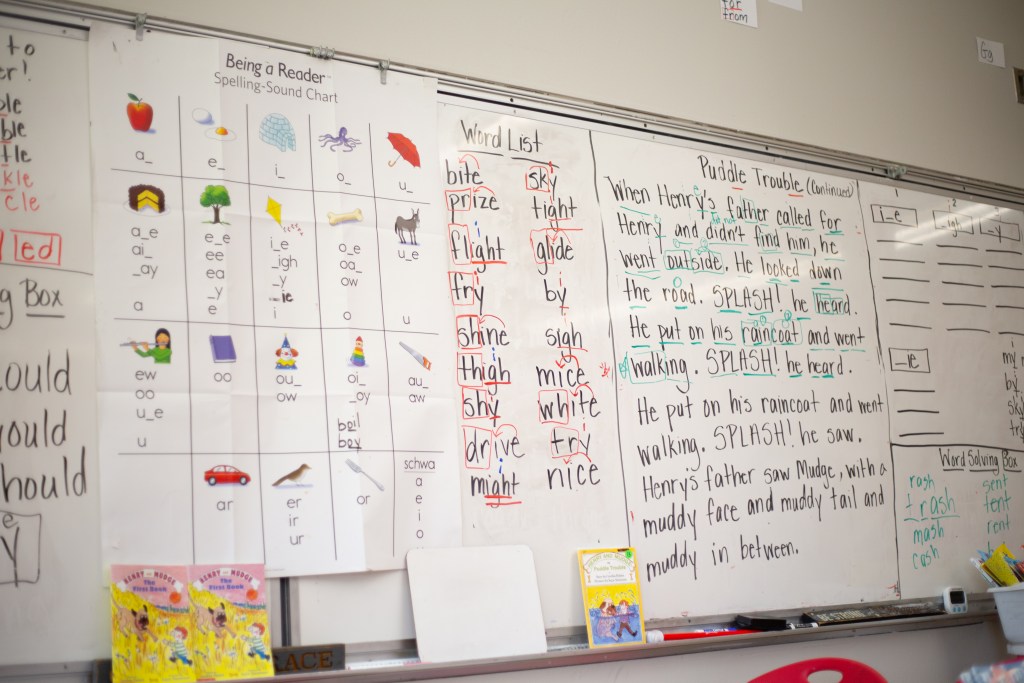
In the Kansas City area, the private school Horizon Academy focuses on students with dyslexia and similar disabilities.
Gabi Guillory Welsh, Horizon’s director of therapeutic language and literacy, said students spend some time every day getting intensive instruction either one-on-one or in a small group of students at the same skill level. Lessons are customized and paced to build confidence while introducing new material in controlled doses.
Lots of repetition and multisensory techniques — like incorporating movement or using mirrors to focus on how certain letter sounds feel and look in your mouth — help reinforce lessons.
All teachers are trained in Orton-Gillingham, a method specifically designed for dyslexic students that is the basis for many structured literacy programs.
Students also explicitly learn the complex patterns of the English language that many adult readers may intuit without being able to explain them.
“Yes, there are rules,” Guillory Welsh said. “You have to be taught them if you are a person who it doesn’t come naturally to.”
For more information see…
- List of teacher training programs accredited by the International Dyslexia Association.
- IDA list of independent schools, including Horizon Academy.
What should I do if I suspect my child has dyslexia?
A good first step is to reach out to your child’s teacher to ask whether they’re concerned. But you might need to be persistent.
Schools generally have processes in place to flag when students need extra help and provide it. But some can misunderstand how serious a child’s struggles are, and not all have staff members trained to work with dyslexic kids.
If teachers aren’t knowledgeable about dyslexia or don’t have context about a specific child’s background, they can end up dismissing problems that require specific support.
Teachers might say, “‘She’ll grow out of it,’” said Zink, the Kansas-Missouri IDA board member. “That’s not true. Dyslexia starts at birth and goes your entire life. You can get help for it, but you’re never going to be cured.”
Lisa Salazar Tingey, the parent of a dyslexic student in the North Kansas City School District, said she’s learned parents may need to speak up even if teachers tell them not to worry.
“We are our child’s best advocate,” she said. “If you have that gut instinct that there’s something that you need to bring up, you just can’t be afraid of being the annoying parent.”
Parents should also know what kind of support to ask for rather than pushing for special education services more broadly, Scranton said.
“I’ve had families come and say, ‘I’m gonna get an IEP (individualized education program) no matter what, and I’m like, ‘Well, let’s wait a minute. Let’s find out what you’re fighting for,’” she said. “Does the school have somebody trained in that type of intervention?”
If a school doesn’t have staff members trained in structured literacy, she recommends parents look for those services elsewhere — which can be quite expensive.
Trying to get proper services from a school can sometimes be “maddening,” said Pamela Taylor, a dyslexia specialist who founded LexiAbility and an online structured literacy program called LexiaHeroes. She believes parents often have to turn to services outside of schools for adequate help.
“Instead of spending all the time on what a school can’t do for you, focus on what a school can do for you,” she said. “Maybe they can formalize accommodation plans and make sure that they’re implemented, not just for your kiddo, but for the other kiddos in the classroom too.”
Accommodations for dyslexic students can include extra time on tests and being able to use voice-to-text or ebooks in certain situations.
For more information see…
Missouri and Kansas groups that may offer local resources and support:
- Kansas-Missouri branch of the International Dyslexia Association
- Decoding Dyslexia Kansas
- Decoding Dyslexia Missouri
- Families Together Inc. (Federally funded parent training and information center focused on special education in Kansas)
- MPACT (Federally funded training, information and one-on-one support to help you advocate for your child in the special education process in Missouri)
Ideas for accommodations:
- Learning Ally’s list of common accommodations for students with dyslexia.
Advice on choosing a tutor or evaluating services at school:
- The International Dyslexia Association’s advice on evaluating professionals.
- List of teacher training programs accredited by the International Dyslexia Association.
- Barton Reading and Spelling System list of suggested questions to ask prospective tutors.
Provider directories from:
- The Center for Effective Reading Instruction
- The International Dyslexia Association (scroll down for a directory organized by state)
- Wilson Language Training
- Learning Ally
- The Institute for Multisensory Education (scroll to the bottom of the page to search by state)
- Academic Language Therapy Association
- The Orton-Gillingham Academy (email for a list of providers in your area)
Programs to teach your child at home:
- Becoming a tutor through Barton
- LexiaHeroes (online program)
Should I get an official diagnosis?
Typically, schools don’t give a formal diagnosis of dyslexia. But they can do their own testing to decide if students receive extra help or a formalized support plan.
Schools might use the term “specific learning disability in the area of reading” instead of “dyslexia,” Scranton said.
Seeking a formal dyslexia diagnosis from a medical provider can be helpful if it’s financially feasible, she said. Children’s Mercy bills insurance between $1,500 and $2,100 for dyslexia testing, and the amount families pay varies widely based on their insurance.
Parents who turn to Children’s Mercy have often struggled to get enough help from their school, Scranton said. Dyslexia testing results can prompt schools to take concerns more seriously, and having answers about how their brain works can also be good for a child’s self-esteem.
“It explains to the child what kind of a learner they are,” she said. “It gives them answers to why this is hard.”
But an official diagnosis of dyslexia doesn’t automatically qualify a student for a formal special education or accommodations plan such as an individualized education program (IEP) or 504 plan. In general, it’s easier to qualify for 504 plans but they are less intensive, providing accommodations but not special education services.
For more information see…
- Children’s Mercy’s page on Dyslexia and Reading Concerns.
- Learning Ally’s list of common accommodations for students with dyslexia.
Why isn’t it easier to get proper support, and how can I help make things better?
A lot of components have to line up to create a system where dyslexic kids are being identified and offered the instruction and accommodations they need.
Advocacy can happen on multiple levels, from educating a specific teacher or school administrator on what dyslexic kids need, to encouraging a school board to adjust its policies or budget, to promoting state law changes.
Many states have passed laws related to reading instruction or dyslexia — including a recent law from Missouri requiring reading instruction to be primarily based in phonics.
But for laws to be effective, schools need resources and teachers need to implement them on a day-to-day basis in every classroom. That can require additional education and funding.
For example, Taylor said she’s seen schools claim teachers are certified when they only had a brief training. Schools can also strictly limit who qualifies for services when they have limited funding.
“I see a lot of really great legislation in place that has very little effect because we don’t have the resources,” she said.
Decoding Dyslexia, a national parent-led group with chapters in Missouri and Kansas, advocates for mandatory teacher training, early screening, remediation programs available to all and access to appropriate technology.
Spear-Swerling said that helpful laws include universal screening and early intervention. Laws should also cover teacher preparation, she said, such as creating licensure exams that gauge understanding of effective reading instruction.
For more information see…
Opportunities to connect with other parents and get involved in advocacy:
State guidelines and policy:
- Kansas Dyslexia Handbook
- Kansas Parent Guide to Special Education
- Missouri Department of Education Guidance and Resources
Special education support and advocacy:
- The International Dyslexia Association’s advocacy toolkit.
- Families Together Inc. (Federally funded parent training and information center focused on special education in Kansas).
- MPACT (Federally funded training, information and one-on-one support to help you advocate for your child in the special education process in Missouri).
- Wright’s Law (Information about special education law recommended by Decoding Dyslexia Kansas).
- The Beacon’s guides to advocating and your rights in the special education process.
Background on education trends and state laws:
- Sold a Story podcast by American Public Media.

