When the Trump administration appointed Robert F. Kennedy Jr. to head the Department of Health and Human Services, it was with the promise to “Make America Healthy Again,” dubbed MAHA.
Two months into his second term in office, President Donald Trump and Kennedy began a major restructuring at Health and Human Services, laying off tens of thousands of people and cutting millions of dollars from the federal agency that oversees everything from vaccines to clean drinking water.
In a Truth Social post Trump wrote in March praising his Department of Government Efficiency budget cuts, he touted the use of a “scalpel” rather than a “hatchet.”
That may come as a surprise to the nearly 49 million Americans who suffer from addiction, according to the 2023 National Survey on Drug Use and Health from the Substance Abuse and Mental Health Services Administration, also known as SAMHSA.
“It’s become very clear that they’re not using a scalpel,” said Emily Hage, CEO of First Call KC, a nonprofit that provides substance abuse prevention, education and harm-reduction resources in the Kansas City area.
Many parts of HHS have been scaled down, eliminated altogether or repackaged into the new conglomerate Administration for a Healthy America, or AHA.
SAMHSA: A history of harm reduction
Two years ago, opioids and synthetic opioids like fentanyl took the lives of more than 100,000 Americans. Last year, that number fell by over 25%.
Progress in the nationwide opioid overdose epidemic can be credited in part to local harm-reduction and prevention efforts and the funding they get from SAMHSA.
SAMHSA has been dissolved and restructured into the Administration for a Healthy America. It has historically awarded three major block grants to support harm reduction, treatment and prevention services across the country.
In the case of SAMHSA, the Trump administration is concerned about programs that “either duplicate spending or are too small to have a national impact,” according to the president’s “skinny budget” proposal.
Hage is confused about the cuts.
“We know that money spent in prevention across any field saves us money in the future. If the whole push is for efficiency, I was surprised to see the prevention funding getting cut so drastically,” she said.
Uncertain future for opioid crisis efforts
The battle against the opioid epidemic in the Kansas City area, which has seen a bigger drop in overdose rates than the nationwide average, takes place on three fronts — prevention, harm reduction and treatment/rehabilitation.
Nonprofit, community-based substance abuse prevention services like First Call KC rely on three federal block grants provided by SAMHSA — the Substance Use Prevention, Treatment and Recovery Services, State Opioid Response and Community Mental Health Services block grants.
The three grants are being combined into one Community Mental Health Services block grant distributed by AHA, with no mention of continued substance use disorder or addiction services funding under the new administration.
There is an air of panicked uncertainty about the future of these grants, which provided Missouri with nearly $50 million in 2024.
“Where would they cut from? Would they cut from SOR funds that’s been used to develop a statewide naloxone distribution program? Would they cut prevention research centers, which have been in the Kansas City area for decades?” Hage questioned.
Twenty percent of the Substance Use Prevention, Treatment and Recovery Services grant was mandated to go towards prevention, something Hage believes to be a critical part of Missouri’s fight against the addiction crisis.
First Call and nine other organizations across the state provide prevention services, including programs at schools where students in grades 3 through 12 are taught age-appropriate skills ranging from effective communication and stress management to overdose education.
Hage is unsure whether the 20% mandate will remain in effect.
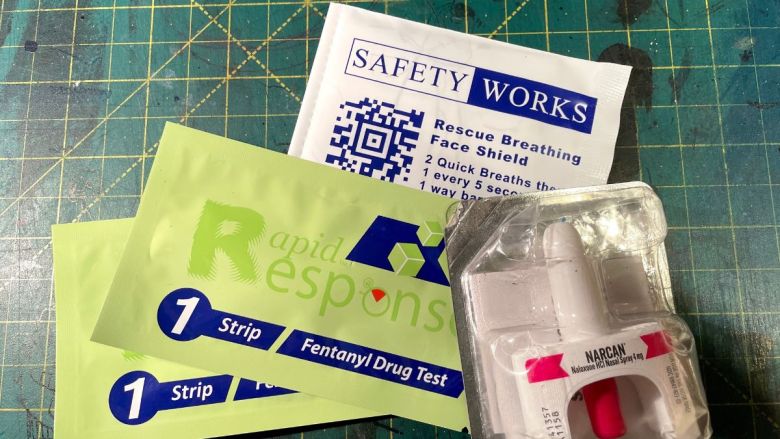
State Opioid Response funds are used to fund harm-reduction services like free naloxone (Narcan) distribution. Cuts to the grant will make the lifesaving drug, which goes for around $40 for a box of two doses, prohibitively expensive for these groups.
First Call and other local community-based harm-reduction organizations are stockpiling resources in preparation for the financial fallout they expect in 2026, once the budget cuts take full effect.
A silver lining, Hage said, is that, “local communities are getting better at figuring out what to do with opioid settlement funds.” While she wishes the money was additive, not just replacing federal funds, money from opioid settlements has been used by the Johnson County Health Department to supply six of the 14 county libraries with naloxone.
“We certainly don’t want our elected officials to take this loss (lightly), because they think that opioid settlement funds can fill the gaps but they absolutely cannot,” Hage said.
Going underground
Other community-based organizations noted that the federal government has only been providing funds for harm reduction since 2021. For years, these organizations had to operate with private-sector support, tapping small individual donations and larger ones from wealthier people and groups who valued their work.
With federal funds drying up, these organizations are cutting hours, staff and services. One Kansas City group once provided hygiene products, but is now saving the money for naloxone and other direct harm-reduction resources.
Money for advocacy, policy work and public education is being diverted to resources, in effect making these groups’ public presence smaller and accessible largely through word of mouth, which excludes many who may need their services.
A return of harm-reduction and substance abuse services to the shadows of our society is bound to perpetuate the stigma people who struggle with addiction face, experts say.
“It’s pretty easy to draw a correlation between the stigma that could exist around the services provided and the importance of those services and the resources that are allocated to care for those individuals,” said Kim Probst, director of improving systems of care with the University of Missouri-St. Louis Missouri Institute of Mental Health’s addiction sciences team.
The Trump administration’s qualms with addiction services funding are about more than just money. It believes that SAMHSA’s harm-reduction funding encourages the use of illegal drugs, an idea that has been widely disproved.
Probst points out that “harm reduction is everywhere.”
“There are practices that you can employ to make things that are dangerous safer. (That) doesn’t mean that we’re encouraging more of that activity.”
Similar to how wearing a seat belt makes driving a car safer while not encouraging reckless driving, providing safety resources for other dangerous activities like substance use saves lives without promoting their use.
In fact, “people who have had their lives saved by harm reduction practices are more likely to encourage those practices in people that they care about,” she said.
Though there has been progress in the field and elected officials have gained understanding of the ramifications of drug use as the opioid crisis has wracked all geographies in the country, lifesaving aspects of harm reduction remain illegal in some states.
Clean needle exchange programs, which reduce the risk of blood-borne diseases like HIV and hepatitis C, are illegal in Kansas and Missouri, though the Centers for Disease Control and Prevention has promoted these programs as, “safe, effective and cost-saving, (and) do not increase illegal drug use or crime.”
More than one-third of people who inject drugs are infected with hepatitis C within one year, a number that rises to over 50% after five years of continued use, according to the Missouri Department of Health and Senior Services.
“The field has come a really long way in understanding that we need a lot of different pathways to recovery,” Hage said. “There is no single solution. People need to have self-determination — they’re ready when they’re ready and they need to be given the opportunity not to die in the meantime.”
“To me, it’s a very simple equation — these are preventable deaths, and our elected officials will need to decide if they want to save those lives or not.”
If you or someone you know is struggling, resources are available
- First Call’s 24/7 Crisis Hotline: 816-361-5900
- Local rehabilitation centers such as Midwest Recovery Centers and Kansas City Addiction & Treatment Recovery Center
- Call 988 if you are in a crisis and/or considering suicide
Where to access free Narcan in Kansas and Missouri
- Missouri: Visit this link for a map of Missouri locations offering free Narcan.
- Kansas: Visit this link for a map of Kansas locations offering free Narcan.
How to recognize an overdose
According to the CDC, these symptoms can point to an overdose:
- Small, constricted “pinpoint pupils”
- Falling asleep or losing consciousness
- Slow, weak or no breathing
- Choking or gurgling sounds
- Limp body, cold and/or clammy skin
- Discolored skin (especially in lips and nails)
To administer nasal spray naloxone, follow these simple steps:
Call 911 immediately to report the medical emergency and the exact location. Remove the naloxone cartridge from the packaging. Hold the nozzle between your index and third finger, with your thumb on the plunger at the bottom. Insert the nozzle into one nostril of the person experiencing an overdose and firmly press the plunger to release the spray into their nose.
Lay the person on their side to prevent choking. Wait a few minutes to see if the person becomes responsive. If they don’t, you can administer naloxone again in the other nostril. Stay with the person until emergency assistance arrives.
(Courtesy of United Way of Greater Kansas City)