


Ralph Oropeza was telling a crowd at Union Station how he made it out of poverty.
Takeaways
- Kansas City’s building trades and a low-wage workers organization are both fighting for workers — but have differing views of the Royals stadium project in Crown Center.
- Missouri Workers Power seeks a public vote before the city commits money. The building trades union representatives argue that’s not how development deals normally work.
- Mayor Quinton Lucas met with both groups on Aug. 10, two weeks after a public meeting at Union Station ended early.
- A building trades business manager estimated the stadium project would put more than 1,000 construction workers on the site at peak.
- Missouri Workers Power wants a wage floor for the service workers who would staff the ballpark district long after construction ends.
Thirty-five years ago, as the son of an immigrant single mother, he got an opportunity for an apprenticeship with the International Brotherhood of Electrical Workers. Now he’s business manager of the Greater Kansas City Building and Construction Trades Council.
On July 27 he stood on stage at a public hearing at Union Station to say that a new Royals ballpark at Crown Center would hand that same opportunity to the next generation.
“Every time we say no to development,” Oropeza said, “we’re saying no to an opportunity for apprenticeship.”
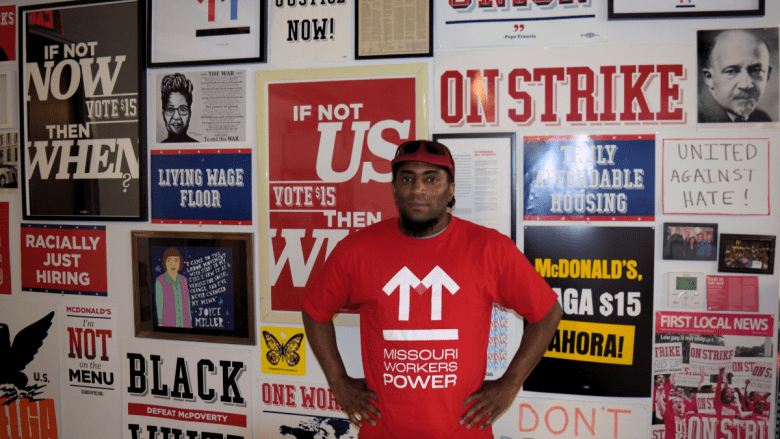
As Oropeza ended his remarks, chanting and shouts began coming from red-shirt-clad members of Missouri Workers Power — a political affiliate of the Missouri Workers Center, which organizes locally as Stand Up KC — in the crowd.
“Put it to a vote! Let us vote! Respect our vote!”
The man at the microphone and the people shouting were both there on behalf of distinct sectors of Kansas City’s working people.
The hearing devolved with disruptions from that point and was cut short. Among the jeers were lines like “Working people are Kansas City!” and “We’d like to speak!”
That opportunity to speak came two weeks later.
Mayor Quinton Lucas invited the groups in the same room Aug. 10, where they spoke for more than two hours. Oropeza and Greater Kansas City AFL-CIO President Patrick “Duke” Dujakovich sat with Missouri Workers Power members, including one of their longtime leaders, Terrence Wise, along with the mayor and city staff.
The groups agree on a great deal about the proposed $1.9 billion downtown stadium — including that none of them loves the idea of public money flowing to billionaire team owners.
Where they split is on what to do about it.
Members of Missouri Workers Power, who view the stadium deal as a risk with public money and as an unfair tax giveaway, want it to face a public vote.
Oropeza and the building trades view the stadium as a generational opportunity for workers and say that development deals like the proposed ballpark project are standard practice and don’t normally require a public vote.
While the meeting fell short of a “kumbaya moment,” the groups were talking at a lower volume, hoping to work toward common goals.
Inside the room
Lucas said the point of Monday’s meeting was simple.
“It was to understand perspectives in a clearer way, beyond just the quotes in The Beacon or elsewhere,” Lucas said. “They’re not saying they hate a stadium, and we’re not saying we don’t want to see workers uplifted.”
Oropeza left believing the temperature had dropped. The shouting at Union Station, he said, came from a place he recognized.
“They’ve explained why they were so frustrated, that they felt like they weren’t being heard,” Oropeza said. “They apologized for yelling at me.”
Wise agreed the room was cordial, but he also pointed at the empty chair.
“The biggest difference between even the zoning meeting and how we worked together in the past, and how we’re working together today, is who wasn’t in the room today,” Wise told The Beacon after the meeting. “The Royals weren’t at the table, and that’s what’s kind of wedged in the middle.”
Representatives from the Royals did not respond to a request for comment.
The people who were in the room share a long history on the same side of labor fights. Lucas has stood with low-wage workers alongside Wise. Organized labor has backed Stand Up KC’s campaigns for better pay. And Wise says his members show up when the unions call.
“Tell us where to show up … and we’re standing shoulder to shoulder,” Wise said. “But we’re not going to stand shoulder to shoulder with the Royals.”
According to Oropeza and Wise, topics discussed in the closed-door meeting included public financing, labor negotiations with the Royals, debate over a potential public vote, and what the groups would want to see in a community benefit agreement stemming from the project.
“I think that we can see eye to eye on a few things, and some things we’re never going to get there because we come from two different organizations,” Oropeza said. “But ultimately, I think it was a good talk. Had some really good side conversations. I think they understand that I’m not their enemy.”
‘Let us vote’
Missouri Workers Power gathered signatures for a citizen initiative that would require voter approval before the city puts major support behind large stadium projects. The city clerk certified the petition in June.
For Wise, one of the named petitioners, the request is basic.
“It seems so fundamental that people like myself and low-wage workers in Kansas City should have an opportunity to vote when their tax dollars are being used in this city,” Wise said.
Certification of the petition for a public vote started a 60-day clock. Under the City Charter, the City Council has options. They could send the measure to voters at the next election, which would put it on the November ballot. If voters approve it, that would create a requirement that the Royals stadium would be put to a vote at a second election, likely in April.
Or, the council could skip the first election and put the Royals deal directly on the ballot in November.
But if the city does nothing and the 60-day window lapses — it closes later this month — the petitioners can go back to the city clerk and ask that the measure be sent to the election boards.
That timing is no small part of the debate.
“Where you see agreement is in substantive jobs issues, pay issues, benefits,” Lucas said. “The difference is, frankly, a timing issue.”
The deadline to get on the November ballot is Aug. 25. In an interview with The Beacon, Lucas said it was “fair to say” that the earliest a stadium question could realistically reach a ballot is April, by which point agreements would likely already be signed.
“If it’s so good for Kansas City, let’s vote. And if it passes, you won’t hear from Missouri Workers. You will not,” Wise said. “I respect democracy.”
Oropeza said these types of development deals don’t normally go before a public vote.
“We also have governance through elected officials. We’ve elected our city officials. If they don’t do their job, then we vote them out in the next term,” Oropeza said. “But if we have to bring everything to a ballot, then how do we govern?”
For the mayor, he said the leverage exists now — but could evaporate at a ballot box.
“Now’s the time. I think that we can get real things done for workers,” Lucas said.
Whose money builds it?
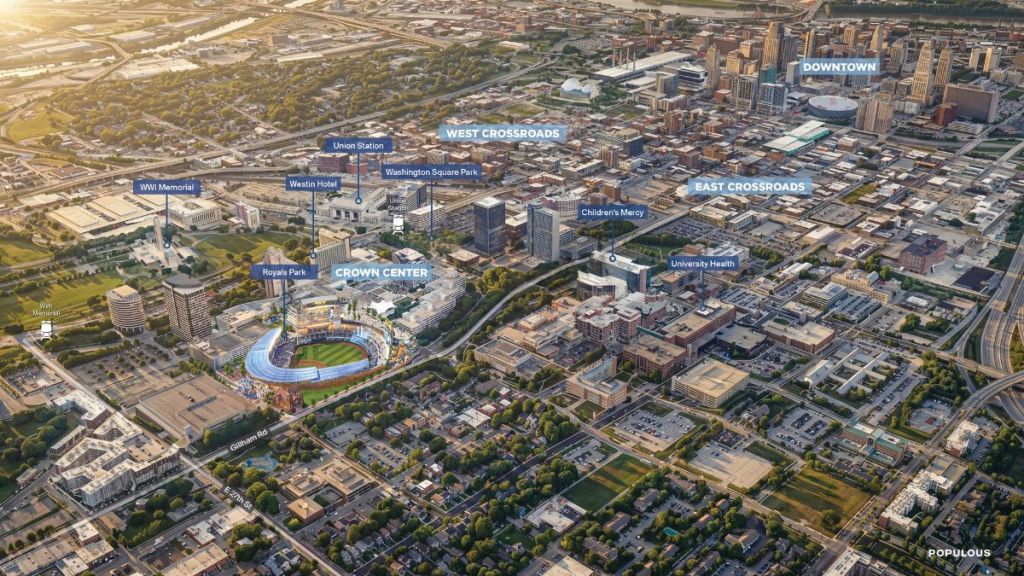
The full Crown Center transformation carries roughly a $3 billion price tag. The ballpark itself is projected to cost $1.9 billion with another $1 billion expected to be spent on the surrounding ballpark district.
The state of Missouri is expected to help subsidize the stadium as well as the city. The framework the City Council approved in April is for up to $600 million.

The city is not simply writing a check for $600 million. The plan is a $600 million bond supported by tax increment financing, or TIF. The city would draw a TIF district and pay off the borrowing with new taxes generated inside that district. The idea is that without the development the additional tax revenue wouldn’t be there, and the project is in theory paid for by the people who use it.
It’s a familiar tool. Kansas City has used TIF on projects such as the Midtown Costco, Home Depot and the Power & Light District, and none of those deals went to a public vote.
Lucas draws his own line between this structure and the one Jackson County voters rejected two years ago.
“I see a sales tax that every man, woman and child is being asked to pay in Jackson County,” Lucas said. “Whereas the Kansas City project (Royals ballpark in Crown Center), I see something more akin to what we do in economic development more regularly.”
However, if the TIF district doesn’t generate enough revenue, Kansas City is being asked to cover the shortfall with money that would otherwise pay for city services.
That has happened before. The city has covered more than $167 million of the Power & Light District’s debt since 2006 — a shortfall variously blamed on the Great Recession, a TIF district drawn too small to capture the activity around it, and projections that left too little margin for error. The city has since refinanced that debt to bring payments down.
Wise noted the Power & Light District without prompting.
“We’ve seen the Power & Light and other developments, and how they have not brought about this great resurrection to our city, or a great benefit to workers in our city in general,” Wise said. “We just can’t keep drinking that Kool-Aid forever.”
Oropeza says he also doesn’t love helping billionaires.
“I don’t like the system but it’s the way the system is,” Oropeza said. “I hate it. I don’t like that we help them. But if they have skin in the game, then that hurt is a little less.”
He says he and the union members he represents rely on development projects.
“Unfortunately, that’s the sandbox that we all have to play in,” Oropeza said. “And I’m just hoping that our ‘thousand-aires’ get a little piece of that.”
What workers get out of it
In 2024, Wise was at the bargaining table with the Royals.
A coalition including Missouri Workers Power spent months negotiating a community benefits agreement (CBA) tied to the Jackson County stadium sales tax. A CBA is a legally binding contract between a developer and community groups that locks in commitments — such as wage standards, local hiring, affordable housing — as a condition of the project.
Some coalition members walked away from the table, saying the Royals had gutted their proposed affordable housing assurances. The teams released their own community benefits documents days later. Then the coalition dismissed them as nonbinding statements of intent with no enforcement mechanism. Less than two weeks after that, in April 2024, voters rejected the three-eighths-cent tax.
Wise carries that history into his objections.
“The Royals have already showed us who they are, and we should believe them,” Wise said. “We voted no. You went to our elected leaders downtown at City Hall and in Jeff City, and you worked a deal that circumvented the will of the people.”
Oropeza said he’s heard about that mistrust, but that the labor unions are negotiating enforceable contracts.
“I wasn’t at the table during Jackson County’s three-eighths-cent sales tax extension,” Oropeza said. “Now I am speaking directly with the Royals.”
Oropeza estimates the project would put 1,000-plus workers on the site at peak. The team’s consultants have projected $1.4 billion in construction labor income across the ballpark and surrounding district.
At the July 27 hearing at Union Station, Oropeza shared what those wages and demand for trades workers can do. He cited statistics from the Missouri Works Initiative’s pre-apprenticeship programs from January 2025 through June 2026. He said 144 Kansas City workers entered, and came in with a median income of $17,500. Nearly half were previously unemployed, 16 were single parents and two reported being homeless.
Statewide, participants’ incomes grew 204% after their first year — and their wages would rise to 478% by the time they finished their apprenticeships.
“That $17,500 median income turned into almost $90,000,” Oropeza said. Behind the wage also sits a pension and family health insurance — “the ability to one day retire with dignity.”
A building boom in recent years has created a swell in demand for workers in building and construction trades, which has seen apprentice class sizes double. According to Oropeza, large projects like the Royals’ proposed ballpark district help to continue to grow union membership and elevate more people into the middle class.
Beyond the building phase, the question is what’s in it for the people who would pour drinks, clean concourses and staff the shops of a district meant to run for decades.
Dujakovich, as the head of the Greater Kansas City AFL-CIO, represents hundreds of families who are already unionized and who work Royals games at Kauffman Stadium. He has also been a vocal supporter of the stadium project.
However, not all the stadium workers are represented by unions. Wise wants to see a livable wage for workers in and around the proposed ballpark district as well as affordable housing and other low-wage worker benefits.
Oropeza says those are goals he can support.
“Wage floors for people, better living conditions, insurance — those are the kind of things we can get behind. We can definitely help you,” Oropeza said. “But don’t block me from building something, or else I can’t help you.”
Lucas wants worker protections in the deal, too. But says he’s skeptical of the one-time variety.
“Even more than what’s in the CBA — because that, frankly, is fleeting — how do you protect workers long term?” Lucas said. “How do we look at long-term wage protections? How do you look at a (consumer price index) calculator within said wage protections, to make sure that these are the types of not just construction but service industry jobs that are helping someone long-term build a career — rather than perhaps a CBA that pays for one thing, one time?”
Council members have pushed for a community benefits agreement with benefits such as affordable housing, labor and apprenticeship programs, childcare and small-business support.
As negotiations go on, details of any community benefits agreement and other community impacts are not yet solidified by contract or publicly known.
Where things stand
The City Council’s Finance, Governance and Public Safety Committee was set to take up two stadium items the morning of Aug. 11.
On the agenda was rezoning Crown Center, which the City Plan Commission recommended unanimously on Aug. 5, and an ordinance “… authorizing the City Manager to execute a lease, non-relocation agreement, development agreement, community impact partnership agreement, and funding agreement with the Kansas City Royals…”
Both those agenda items are currently on pause.
Hours after Monday’s meeting with worker groups ended, Lucas wrote on social media that he did not “expect Council action this week or next,” on those items and others — to make sure, he wrote, that the city hears from more people.
The accelerated pace of stadium developments had drawn objections from inside City Hall just hours prior. Councilman Johnathan Duncan posted online that City Manager Mario Vasquez circulated a summary of the stadium agreement at 7:06 p.m. Monday — with the final agreements not yet complete — while the finance committee was set to vote the next morning.
The petition for a public vote on large stadium deals, meanwhile, remains before the council, with its 60-day window closing at the end of the month.
“We’ll take all legal avenues that we can,” Wise said, “to make sure and assure that people do get an opportunity to participate.”
Oropeza is pushing forward, viewing the stadium project as an opportunity for workers.
“Nothing happens if the stadium doesn’t get built. That’s where I’m at,” he said. “I’m laser-focused on getting us to the finish line.”
Oropeza says he and the unions don’t intend to bargain only for people holding a union card, but would have area workers in mind as well.
“I’m an ally, but if we don’t have a stadium to be built, there’s a lot of things I can’t do for them,” Oropeza said. “I would like to see some guardrails for (area service and low-wage workers) so that they could have some better living conditions. I think we as union leaders have an obligation to do that.”

