
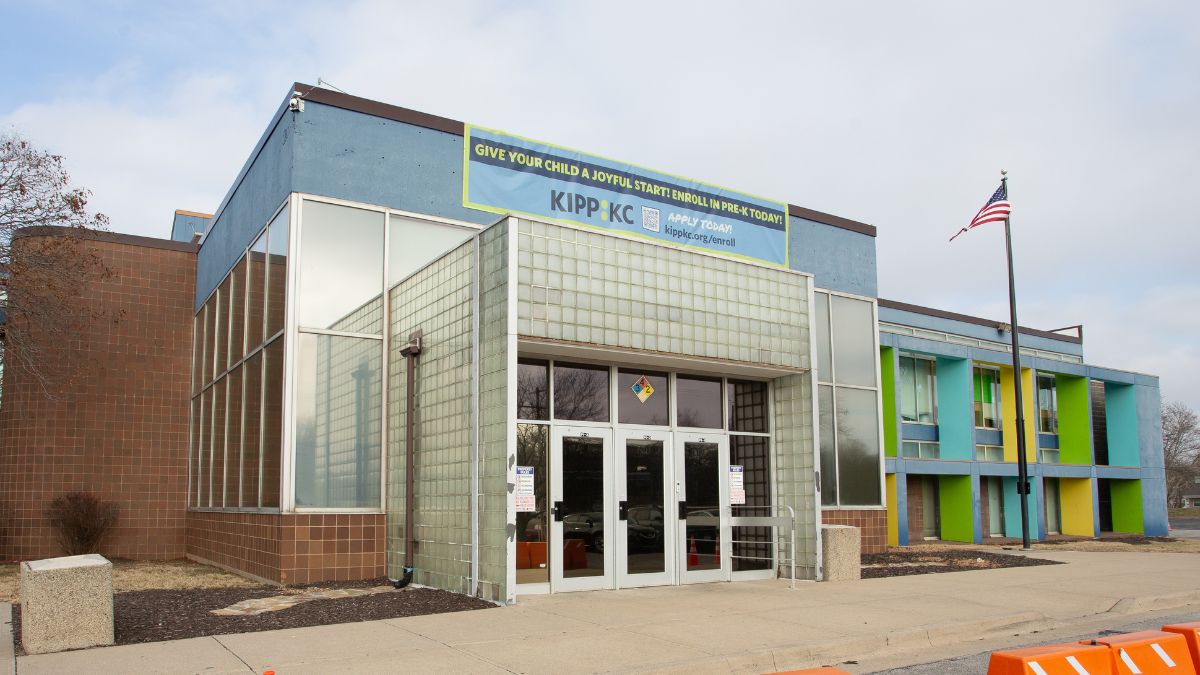


This story is part one of a series
Part three coming January 22
Jonna Skinner thought she’d work at KIPP Kansas City until she retired.
Takeaways
- Less than 40% of the employees KIPP Kansas City reported to the state last school year still worked at KIPP KC this school year, according to state records.
- KIPP KC officials say the charter school system is in the midst of necessary changes, which don’t sit well with everyone.
- Some employees say KIPP KC’s leadership hasn’t stabilized, causing issues with how the schools function.
In her imagination, the high school counselor performing both academic and mental health support for students would grow old with her colleagues, still “doing fantastic things for kids.”
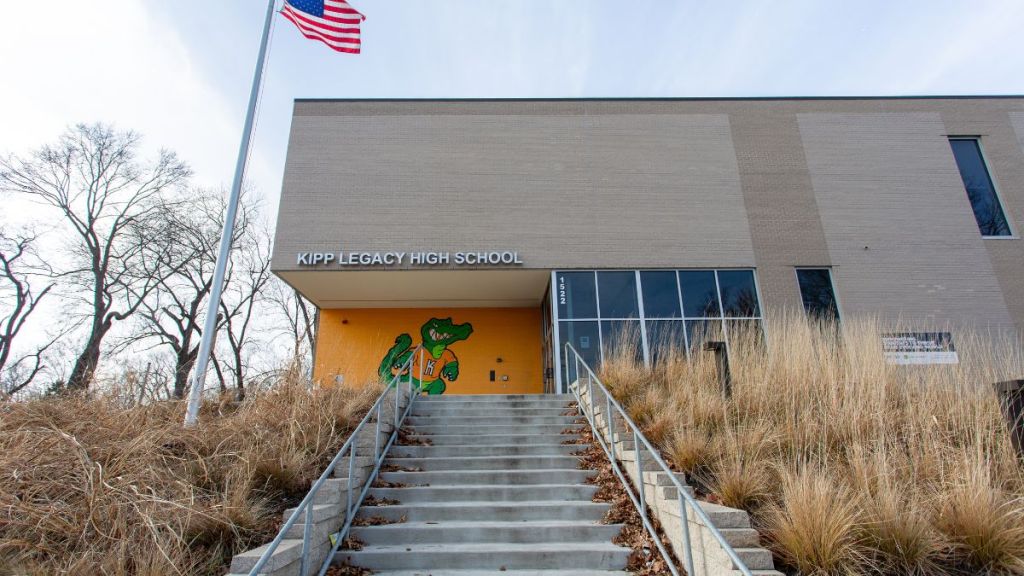
But in mid-2024, Executive Director Dayna Sanders took charge of KIPP KC — an independent local branch of the national KIPP charter schools network — including both KIPP Legacy High School and KIPP Endeavor Academy.
After a year in which KIPP KC lacked a permanent executive director for months and its annual performance scores were among the state’s lowest, the board wanted a leader prepared to shake up the status quo.
“Transformational change is challenging, but it is also necessary — and absolutely possible,” Sanders said in a statement a KIPP KC spokesperson emailed to The Beacon. “We are committed to creating a joyful, stable, and supportive environment for both students and staff.”
In October 2024, KIPP KC shared a new organizational chart. It looked promising, Skinner thought, until the presenter added, “‘I just want you all to know that you should polish up your resumes.’”
That sounded ominous.
Before long, Skinner’s future at KIPP was murky. Many leaders had to reapply for their roles, stirring unease. Her job got harder due to staff cuts and rushed enrollment of new students.
“The mental health support of the students basically went to zero,” Skinner said.
She worked late, watched colleagues leave and saw her own mental health and family life suffer. Her breaking point was a series of delays and mistakes related to her contract, and she said KIPP still owes her for unpaid work.
Skinner isn’t alone.
Less than 40% of the employees KIPP KC reported to the state last school year — such as teachers, aides, principals, administrators and guidance personnel — still worked at KIPP KC this school year, according to Missouri Department of Elementary and Secondary Education records.
The other 60% left, some in the middle of the school year. Data presented to the school board showed an 18% turnover rate in December 2024 alone. Turnover among KIPP KC employees included in the state data is about four times higher than the statewide rate among teachers.
Asked about the 40% retention rate, KIPP KC officials didn’t dispute the figure but said it “reflects a period of significant transition at KIPP KC due to leadership changes, post-pandemic burnout, and a highly competitive teacher labor market.”
The comments were emailed by Saki Indakwa, a marketing, communications and development consultant for KIPP KC, who said they reflect input from multiple people. Through Indakwa, Sanders declined to be interviewed in light of “pending litigation.” State data shows she earns $200,000 annually.
Since fall 2025, the emailed response said, KIPP KC has taken steps to improve staff retention.
“While there is still work to do, early indicators show improved stability, and leadership remains committed to creating a supportive, sustainable environment where educators can thrive and grow long-term,” according to the statement.
But some employees say KIPP KC isn’t stabilizing after the initial round of changes.
“Our revolving door of regional leadership has continued,” KIPP Legacy High School Principal Josh Swartzlander told the board during public comment at its December 2025 meeting. “Our lack of consistent, competent regional leadership in key positions, as well as failure to fill those gaps by current leaders, continues to create key issues with our day-to-day functioning.”
The Beacon spoke with a KIPP student and a dozen current and recent former KIPP employees, including teachers, administrators and other staff. Most asked to speak anonymously to protect their employment or because of potential litigation.
They describe a chaotic environment with frequent mishaps that frustrate staff and disrupt education. Preliminary state data show enrollment at KIPP KC dropped nearly 20% since last school year, declining about 10 times faster than overall Kansas City charter school enrollment.
Past and present employees — including Swartzlander — have publicly asked the board to remove Sanders.
Board members Christopher Perkins and Charles King framed the employee turnover as a result of necessarily change. The latest report from KIPP KC’s charter school sponsor shows that concerns with academics, staff turnover and operations predated Sanders.
The two board members wanted a leader with the ability to turn KIPP around, and they believe that Sanders’ plan — known as Reimagine — is working. Even as the changes frustrate some staff. KIPP’s state performance scores rose 21 percentage points this year.
“We’re not happy about where we are,” Perkins said. But he thinks KIPP is “on the path to being one of the best schools in the region.”
Employee turnover
On Oct. 27, Erica Kenney, the high school’s assistant principal of operations, told KIPP KC’s board she had reported to five different managers in 12 months and hadn’t met one-on-one with any of them.
“About 15 months ago, I would have told anyone that this was the best place I had ever worked,” she said. “But what has happened over the last year has shattered that stability and trust. … Each change brings new, often contradictory demands, some that even conflict with state compliance requirements. And the results have been devastating.”
At the same public meeting, Swartzlander — the high school principal who has worked at KIPP for 16 years — said recent leadership turnover has driven turnover of other staff, hitting pre-K-to-8 school Endeavor the hardest last winter and the high school in May and June.
A spokesperson told The Beacon that KIPP KC does not maintain employee turnover data.
But KIPP does submit lists of employees to the state’s Department of Elementary and Secondary Education. And those lists — obtained by The Beacon in a records request to DESE — show that less than 70 of the approximately 170 employees listed for the 2024-25 school year returned this year.
In other words, KIPP’s turnover rate among those employees was about 60%.
About KIPP Kansas City
Founded: 2007
Schools: KIPP Endeavor Academy (grades pre-K-to-8) and KIPP Legacy High School (grades 9-12)
Affiliation: Part of a national network of KIPP charter schools, which operate independently of one another.
Governance: KIPP KC board, which votes in its own new members.
Oversight/Charter school sponsor: Missouri Charter Public School Commission
2024-25 school year enrollment: 1,049
2025-26 school year enrollment (preliminary data): 845
Executive director: Dayna Sanders (since mid-2024)
Executive director salary: $200,000
2025-26 budget: More than $20 million
Number of staff anticipated in budget: 161
Number of staff included in fall 2025 reporting to the Missouri Department of Elementary and Secondary Education: 113
The state’s data is due from districts each fall and includes employees in nine categories such as administrators, supervisors, guidance personnel, teachers and aides. It shows that KIPP Legacy High School had higher retention than KIPP Endeavor Academy, the pre-K-to-8 school.
But both schools’ turnover rates are significantly higher than the typical Missouri school’s.
A 2025 report from St. Louis University found that recent teacher turnover rates in Missouri overall were close to 15% — higher for teachers of color and in urban areas. The most recent data in the report shows about a 27% turnover rate at Kansas City charter schools and 23% for Kansas City Public Schools.
The turnover rate also means most current staff members lack experience at KIPP KC. About 78% of KIPP KC employees on the state’s most recent list were in their first or second year at the school.
Board members told The Beacon that KIPP KC has cut some vacant staff positions instead of seeking to fill them because enrollment is lower than expected.
The latest list from the state — which may not cover every current employee — includes 113 employees once duplicates are removed. A KIPP KC budget for the current fiscal year included in board meeting records planned for 161 total staff and a budget of more than $20 million.
Turnover during the school year
Board meeting records give a sense of the mid-school year turnover after Sanders was hired. In February 2025, KIPP had 22 vacancies and noted 34 staff members had been hired since December 2024.
A bar chart in the April board packet shows turnover during December 2024 alone was more than 18%. That’s only about 6 percentage points below the turnover rate in June 2024, a more typical time for teachers to leave since their contracts usually begin and end in the summer.
Skinner said all members of the support services team at KIPP Endeavor, including counselors and social workers, left in December 2024.
A board meeting presentation from June 2025 shows KIPP still needed to fill about 38% of its positions for the upcoming school year in two months, including four out of five counselor positions.
Knowing the need, Skinner said she was initially willing to return for the current school year, at least part-time or temporarily. But she lost patience after the human resources department delayed sending her a contract until the school year was about to start, then gave her one that was incorrect. She left KIPP KC after the 2024-25 school year.
Current employees report that turnover continued during the current school year.
In November 2025, some told The Beacon that a dozen people had resigned from the high school alone since the school year started in August. The DESE data for this school year lists less than 50 employees total for the high school.
At the December 2025 board meeting, Swartzlander said more leaders had left in the past month.
“This makes more than a dozen regional (central office) resignations in the past year,” he said. “I’m not talking about folks who were forced out last December. I’m talking about regional leaders who survived the Reimagine process, or who were hired less than a year ago, who lasted mere months, in some cases weeks.”
The Beacon attempted to reach former KIPP KC regional leaders but none was willing to speak on the record. Two of them declined to comment through the same employment attorney.
What KIPP leaders say
KIPP KC leaders and KIPP’s oversight organization framed some turnover and unrest among staff as a result of discomfort with the significant changes Sanders was hired to make.
“The status quo was not producing the results our students and families deserve,” an emailed response from KIPP KC said.
“When an organization undertakes significant transformation, it can be uncomfortable. Change requires new expectations, greater accountability, and a willingness to examine long-standing practices that may no longer be effective. For some staff members, those changes have been challenging, especially when expectations around performance, consistency, and outcomes are raised.”
To improve retention, KIPP KC has implemented “improved onboarding and coaching, clearer role alignment, increased instructional support, and more intentional attention to staff satisfaction and professional growth,” the emailed responses said.
The Missouri Charter Public School Commission — a state-created group that oversees more than half of Missouri charter schools — tracks KIPP’s performance, holds it to the goals in its contract and will decide whether to renew that contract, which expires in mid-2027.
“I really commend the board and staff at KIPP Kansas City for taking immediate action, but that always comes at a cost,” Robbyn Wahby, then-executive director of the commission, told The Beacon in September. She stepped down as executive director at the end of 2025.
“People are concerned when they see change happening during the year, but that is actually one of the wonderful things about charter schools is that agility and ability to make change.”
Perkins said KIPP wants to reduce turnover, which can leave gaps that further stress staff. But that can’t be at the expense of avoiding changes that help students.
“Reimagine is such a holistic plan that it’s almost like there were waves of change that created more problems for a period of time while we sorted those out,” he said.
King and Perkins said some, including longtime employees, have resisted the changes.
“We’re thankful for what they’ve done,” King said. “And also, we’re in a new phase of the organization. … People had a … choice about whether or not this was the direction they wanted to continue to move in.”

