


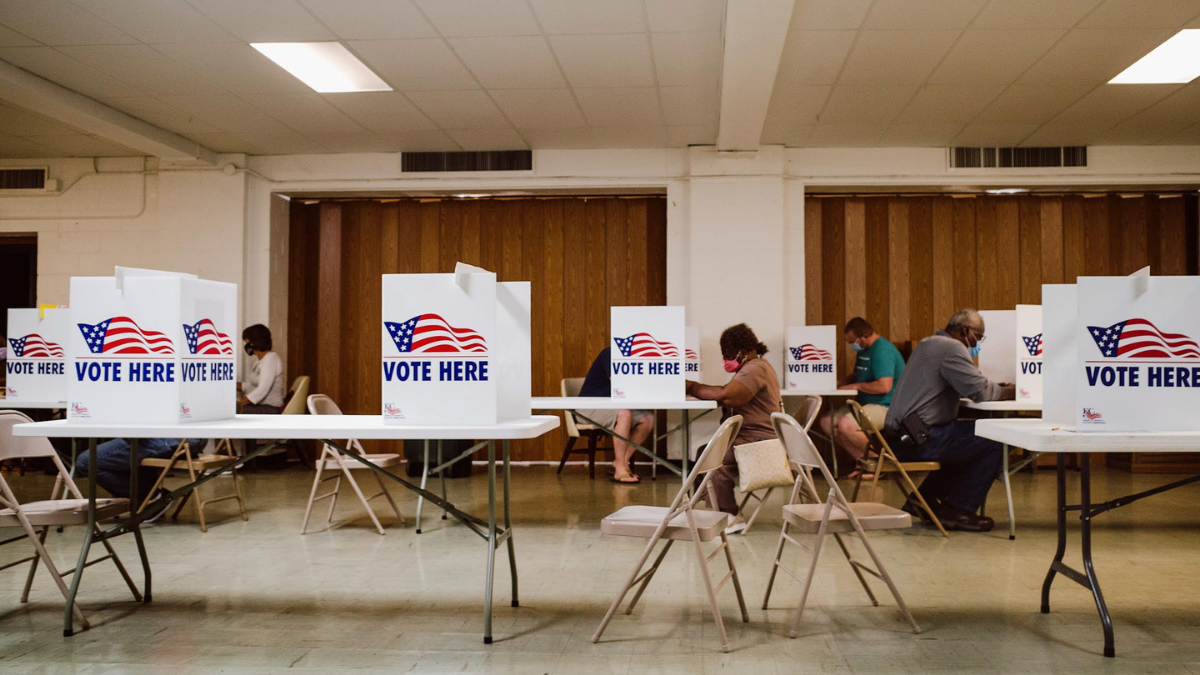
It’s one of the most common problems called into the Election Protection Hotline on Election Day: A voter shows up at their polling place with the intent of casting a ballot, when they are suddenly told by a poll worker that their name can’t be found on the voter lists.
But Denise Lieberman, an attorney with the Missouri Voter Protection Coalition, says voters should know that doesn’t necessarily mean you can’t vote. Poll workers can check if the voter is listed as “inactive” in the rolls.
“Those poll workers will have access to the inactive voter list,” she said, “and if you’re on the inactive voter list, you reactivate simply by affirming your identity and residency.”
It’s a situation that could potentially impact more than 30,000 registered voters within the Kansas City, Missouri, election jurisdiction who are classified as inactive voters — otherwise registered voters who the local election authority was unable to locate or get in contact with before Election Day.
According to a Beacon analysis of voter registration data in Missouri, about 10% of registered voters in the state are listed as inactive, and the Kansas City area has one of the highest percentages of inactive voters in Missouri — about 14%, according to September data from the secretary of state’s office. The counties that had higher percentages of inactive voters include Pulaski, Boone, Greene and Jasper.
Furthermore, a Beacon analysis found that more than 160,000 currently registered voters in Missouri who voted in the 2016 presidential election are now labeled inactive.

Inactive voters in Kansas City are those who the local election board has — through several notification attempts via mail — been unable to locate so far. These inactive voters may have moved from their last known address and didn’t alert their local election authority. Some might have died. Others may vote infrequently and didn’t respond to the mail sent by their local election board.
The bottom line: The people on the inactive voter list haven’t updated their voter registration, and their local election authority can’t figure out where they are.
“It’s a temporary status,” said Matt Ryan, voter protection director for Show Me Change, a coordinated effort by Misouri Democrats to elect Democrats on the ballot this year. “It’s a bit like purgatory.”
If an inactive voter shows up to vote at their polling place on Election Day, they can vote as long as they still live in the same county or election jurisdiction. If they moved to a new county, they would have had to re-register to vote with that local election board by Missouri’s voter registration deadline of Oct. 7.
Shawn Kieffer, Republican director at the Kansas City Election Board, said the voter will have to show an accepted form of ID — in Missouri, that can be a driver’s license, state ID, a student ID from a university or a current utility bill — and then will fill out a new voter registration affidavit with their updated address. A voter does not have to provide documentation proving their address.
If the voter is not at the right polling place that matches their new address, they can either go to the correct polling location or they can vote at the polling place they first visited using a ballot-marking device, a type of voting machine that can bring up the correct ballot corresponding to their updated address.
How inactive voter lists work
Having an inactive voter list is one way local election authorities maintain accurate voter registration lists.
“The inactive list is generally created as part of the list maintenance process,” said Michelle Kanter Cohen, senior counsel with the Fair Elections Center, a national nonprofit dedicated to voting rights.
At the federal level, the process of maintaining voter rolls is governed by the National Voter Registration Act. Passed in 1993, the NVRA established the regulations for states to maintain their vote rolls. This includes requiring states to conduct a voter roll maintenance program in an effort to remove people from voter rolls who are ineligible to vote; the manner in which election boards clean their voter rolls is up to their discretion, so long as it is uniform, nondiscriminatory and complies with the Voting Rights Act.
The NVRA also prohibits states from removing registered voters solely because they did not vote and from conducting voter purges within 90 days of a federal election. Furthermore, the Help America Vote Act of 2002 required statewide voter registration databases in each state.
According to Missouri election statutes, an election authority can label any voter inactive if the U.S. Postal Service notifies the board that the voter no longer lives at the last address filed with that election authority or canvassable pieces of mail are returned to the election board. These instances can trigger the election authority to determine the voter no longer lives at that address, thus moving them into an inactive status.
Here’s how that plays out in Kansas City:
For every election, the Kansas City Election Board sends registered voters a piece of mail as a way to conduct a canvass on their voter rolls. That piece of mail is not forwardable, so if it is returned to the elections office, officials will then send out a piece of forwardable mail in another attempt to locate the voter, Kieffer said.
“Once we have sent out two pieces of mail and they have come back or we’ve not heard from the voter, then we’re allowed to put them in inactive status,” he said. “And all that means is we can’t find them. We send them out a couple different pieces of mail, both forwardable and unforwardable, and have not heard from them. We don’t think they’re there.”
These mailings range from cards telling people where to vote to voter identification cards. If a voter ID card is returned to the local elections office, the board follows up another time.
“At that time, we use that as a canvassable piece of mail. And then when that comes back, then we follow up with a letter to saying, ‘Hey, we can’t find you. Please contact us, we want to update your address or your registration information,’’’ Kieffer said.
Moving? Tell your local election board
One of the most common ways a voter can slip from active to inactive is by not updating their voter registration information if and when they move. For Missouri residents, voter registration is closely tied to one’s address — it’s how voters receive crucial information like election dates, their polling place location and their voter ID card.
“Everything is run through your local jurisdiction. … That’s who keeps your rolls,” Ryan said. “… So when you move, you want to tell your new authority where you are.”
It’s why voter outreach groups, like the coalition VoteKC, stress the importance of checking one’s voter registration information — to ensure the information is accurate and keep the voter from potentially falling into inactive status. That kind of outreach has been made more challenging because of the coronavirus pandemic, said Christopher McKinney of VoteKC.
Instead, VoteKC has relied on a digital strategy to connect with voters and ensure their registration is updated.
“Just trying to get people to think a little more broadly about what it means to be prepared for Election Day or even prior to Election Day, prior to the voter registration deadline,” McKinney said. “You really have to think about, ‘Oh, you know what, I have moved.’ Because that’s something that a lot of people don’t consider.”
Young and inactive
While any voter can fall on their county’s inactive voter rolls, The Beacon’s analysis found that the classification disproportionately impacts younger voters — out of the 1.4 million people in their 20s and 30s who are registered voters in Missouri, more than 230,000 are inactive.
Even though people in their 30s make up the largest age group of registered voters in Missouri — about 17% — they also have one of the lowest percentages of active voters in Missouri. In fact, it’s lower than every other age group except people in their 20s.
Lieberman attributes this trend to the fact that younger people are more likely to move around than older voters.
“If they don’t update their voter registration address each time they move, that missed address could be what lands them on the inactive voter list,” she said. “And so you think about young people who may move sometimes every year to a new apartment or a new place and may not think to update their voter registration.”
But it’s not just younger voters who often find themselves on inactive voter lists. Low-propensity voters — people who vote infrequently — are also more likely to be considered inactive. Lieberman said missing multiple election cycles is another factor that can land someone on the inactive voter list.
“The less likely you (are to) vote,” Lieberman said, “the less likely your voter registration is to have your updated voting address and registration address on it.”
Why inactive voter lists matter
While inactive voters are still eligible to cast a ballot, they can also be at risk of being removed from a local election board’s voter rolls if they fail to update their voter registration information and have failed to vote in two consecutive presidential elections. If a voter is removed, or purged, from the rolls, then they are no longer a registered, eligible voter.
Kieffer at the Kansas City Election Board said the office conducts voter roll cleanups every two years by sending out pieces of unforwardable mail to inactive voters.
“We take all the people that are inactive, that have not voted in the last two federal election cycles, and then we’re allowed to actually purge them from our system,” he said. “At this point, we can’t find them.”
To maintain updated and clean voter rolls, states also rely on matching their voter rolls with data provided by agencies like the Postal Service and notifications from the Social Security Death Index and the Department of Corrections. Thirty states and the District of Columbia, including Missouri, also use the Electronic Registration Information Center to help improve the accuracy of their voter rolls by sharing voter registration information among states.
Ultimately, keeping a local election board’s voter rolls accurate begins with the voters themselves, Ryan said.
“If people move, it’s a good practice to notify the local election authority of that move and to do a change of address form.”
Celisa Calacal is the assistant editor at The Beacon. Follow her on Twitter or email her at celisa@thebeacon.media.
Alexis Allison is a freelance data journalist in Columbia, Missouri.
Sign up for The Beacon’s Election Spotlight
Do you have a news tip you think our reporters should look into? Do you have a question about voting? The Beacon’s Election Spotlight is a texting group connecting readers like you to a Beacon reporter. You can sign up by entering your number in the form below. By signing up for text alerts, you’ll hear directly from our journalists as we report on the election. We promise not to spam you.


Comments are closed.