


Nakia Hope-Paul remembers going to visit the Old Quindaro Cemetery ever since she was a little girl.
Her grandmother was buried there, alongside her ancestors who escaped enslavement across the river in Missouri.
Whenever she pays her respects, she admires the Signal Tree, which has stood watch over the cemetery since Quindaro was founded in 1854 in what is now northeast Kansas City, Kansas. Years ago, abolitionists would hang flags on the tree’s branches to warn people at the bottom of the bluffs about slave catchers patrolling the hillside.
“I think about the things this tree has seen,” Hope-Paul said.
More than 4,000 gravesites are recorded between two cemeteries in Quindaro, according to the Wyandotte County Historical Museum. You can find headstones for Civil War veterans, Native Americans, people who escaped slavery and abolitionists.
Walking among them, Hope-Paul said, she feels connected to the generations before her and those that will come after.
While neighbors like Hope-Paul take it upon themselves to tend to the gravesites and preserve Quindaro’s legacy, the cemetery is legally considered abandoned.
Cemeteries like it are scattered across Wyandotte County — 18 in total, with tens of thousands of graves. That’s unusually high compared to the rest of the state — Wichita only has two — and even the country.

Local historians and the local government don’t have a good answer for why.
The abandoned cemeteries pose a financial challenge for the Unified Government of Wyandotte County and Kansas City, Kansas, which is legally responsible for cleaning and maintaining them on a shoestring budget.
But at the same time, some residents say the cemeteries provide a unique way to learn about local history and to come together to care for the place they call home.
Keeping track of history
Each of Wyandotte County’s 18 abandoned cemeteries has a different story as to how it ended up under the mandatory care of the local government.
But generally, most of them go back to the 19th century, with burials dating as far back as the early-to-mid 1800s.
Amanda Martin, the executive director of the Wyandotte County Historical Museum, said the museum gets dozens of requests from people seeking more information about the cemeteries every month.
Some are checking to make sure the space their family owns is ready for a burial. Despite the absence of clear owners, many families continue to own deeds to burial sites at these abandoned cemeteries. And many others, including people across the country, are researching their family history and wanting information about their ancestors.
“Cemeteries are sometimes the place where they’re able to expand on known individuals in their family,” Martin said, “and actually learn birth and death dates because of headstones or because of cemetery records that we have.”
Questions like that lead to a lot of digging through dusty funeral books and hand-drawn maps.
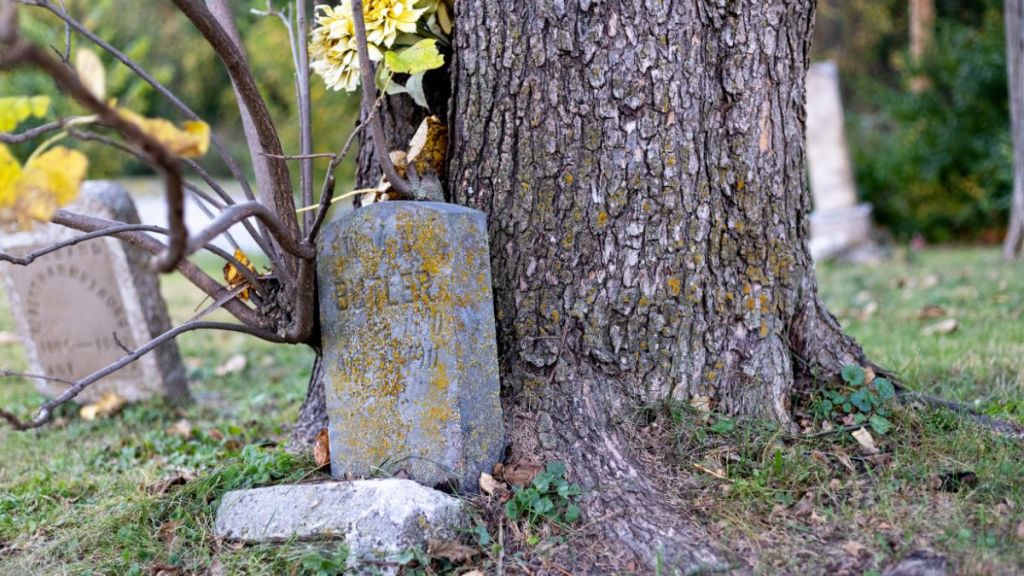
“Usually, it means actually going out to the cemetery,” she said. “If it’s unmarked, then we just have to go out to the cemetery and use that information, cross-reference it with people that are buried next to that person that might be marked graves.”
The museum, with the help of a volunteer, has been working on modernizing and digitizing nearly 80,000 records to get a searchable database.
They include ragtime composer James Scott and blues singer Ada Brown, who are buried at Westlawn. And several Native American leaders are buried at various abandoned cemeteries across the county, including Shawnee religious leader Tenskwatawa and Kansas Delaware leader Ne Con He Con.
Martin said getting ground-penetrating radar equipment would be a game changer because so many of the headstones have been buried in dirt and brush, and some burial sites might have migrated with floods.
Maintaining ‘abandoned’ gravesites
Kansas law considers a cemetery “abandoned” if it meets one of two criteria: if it goes for at least a year without maintenance like grass mowing, or if the company managing it skips the required paperwork for more than six months.
Once a cemetery is legally abandoned, it goes to the township or county where it’s located. In this case, that’s the Unified Government. They’re required to mow the lawn at least twice per year.
That’s a pretty low bar. And the Unified Government goes above and beyond that legal requirement, mowing every couple of weeks rather than every six months, according to Angel Ferrara, director of the Unified Government’s Parks Department.
Despite the Kansas law requiring such maintenance, the state doesn’t provide any money to the county for that purpose.
For most of Kansas, that’s not a big problem. Most cities have one or two abandoned cemeteries.
But Wyandotte County’s 18 total upward of 160 acres, with tens of thousands of individual graves.
“We try to do a lot of this work in the winter, when it’s slower,” Ferrara said. “We don’t have a big budget for that. We actually don’t have one at all. That ends up coming out of just the parks general maintenance budget.”
The Unified Government spends a little less than $200,000 per year on mowing the grass every two weeks.
But other costs creep up too — degrading fences, shrubs and grasses, a broken sidewalk here and there. The headstones themselves sink deeper into the dirt until they’re barely visible.
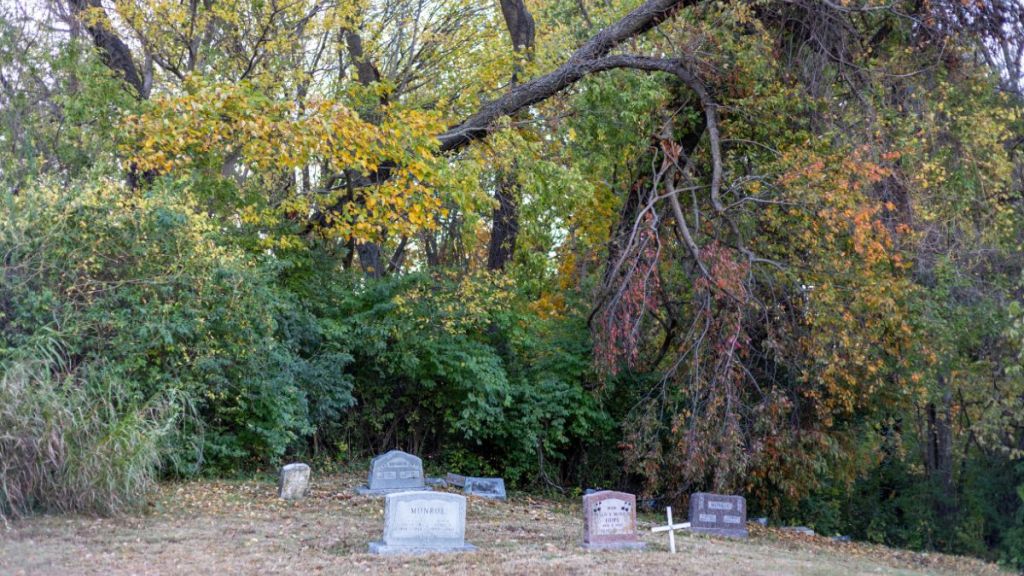
Throw in a damaging thunderstorm, like the one in August which knocked over a tree in the Old Quindaro cemetery and other trees across the county, and the maintenance needs start to get overwhelming.
Mayor Christal Watson brought these concerns up at a Board of Commissioners meeting in August, during a discussion about a proposed sales tax to get more funding to the Parks Department.
“We’re planning funding for all this other stuff,” Watson said after a presentation of proposed parks projects, “but we don’t even have enough funds to have dignity for those who we’ve lost. And that’s a tragedy to me.”
Watson told The Beacon that she’s eager to modernize the state’s abandoned cemeteries law, which impacts Wyandotte County harder than any other community in Kansas. For one, she’d like to see penalties for neglectful cemetery owners to prevent them from abandoning cemeteries in the first place.
Neighbors filling the gaps
Beyond the basic mowing, Wyandotte County residents have stepped up over the years to care for these gravesites.
“There is always the conversation that the UG should do more, the UG should do more. I completely understand it,” Hope-Paul said. “But at some point, as a community, we do have an obligation to one another, as well, and that’s how specifically Quindaro’s cemeteries were always maintained. It was by the community.”
For 170 years, Hope-Paul said, Quindaro residents have kept a close eye on the graveyard to make sure it remains dignified, clean and properly maintained.
If you go too long without cleaning headstones, the rock breaks down and you lose the names and dates to time.
The Concerned Citizens for Old Quindaro, of which Hope-Paul serves as president, is hosting a grave cleanup on Nov. 14 and is also starting an adopt-a-grave program.
The Wyandotte County Historical Museum hosts similar programs for cemeteries across the county.
Ferrara attended one of the grave-cleaning workshops hosted by the county, where she met a man who goes by the moniker KC Cemetery Man and cleans and repairs old headstones for free.
“He was saying, you know, ‘If you’re cleaning someone’s grave, say their name out loud,’” Ferrara said. “He was like, ‘I know it sounds weird, but you never know the last time their name was said out loud.’”
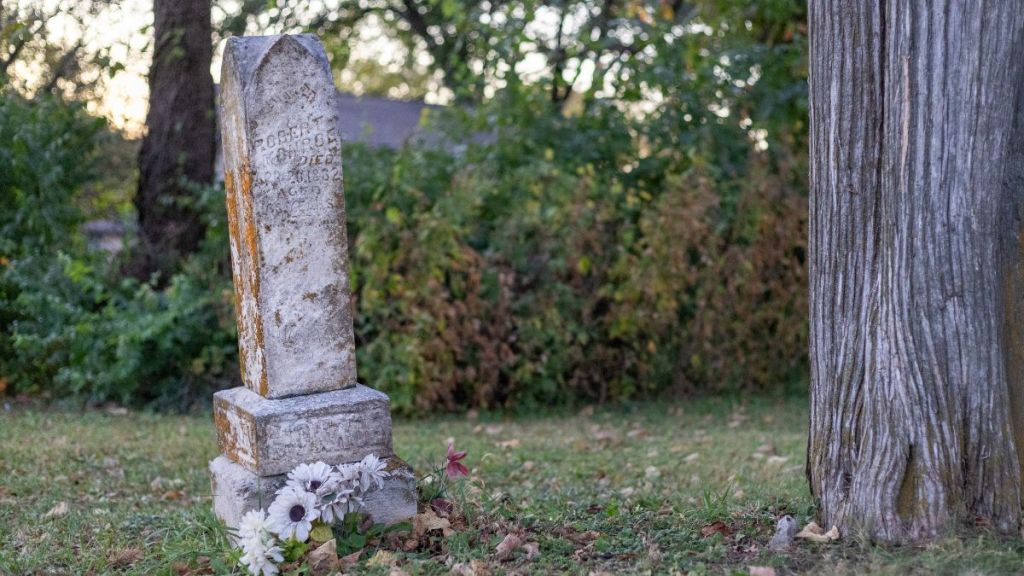
Hope-Paul said the cemetery makes her think a lot about legacy — the legacy of her ancestors who settled in Quindaro, the generations of people who kept their memories alive. And also the legacy she’s going to leave to her daughter, who will grow up knowing the stories that Hope-Paul heard from her own grandmother.
“People are always saying, ‘We’re doing this so that our children and our children’s children can have it,’” she said. “I’m literally the children’s children. And I’d like to continue their efforts, and I don’t take it lightly.”
The cemetery isn’t perfectly preserved, and some graves have been overtaken by the brush, but Hope-Paul said, “There is an unspoken pride about how sacred the ground is and an unspoken need to protect.”

