


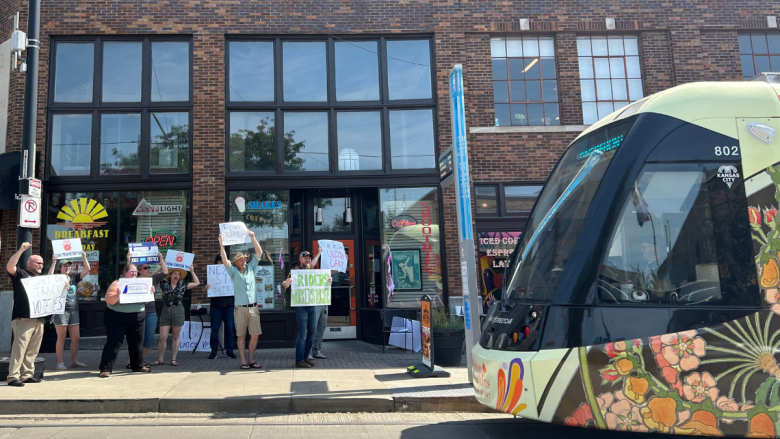
KC Streetcar operator Silas Batton saw an unusual sight as he rounded a curve in the River Market on Aug. 13.
Gathered were people with signs of support for streetcar workers voting on whether to join a union.
“It’s pretty awesome when you’re pulling up and you see a whole line of people holding signs, cheering you on,” Batton told The Beacon. “That’s a pretty rad feeling.”
Batton had voted before his shift, but was delighted to see the encouragement.
“As each streetcar came by, we would cheer on the operator, and get some friendly waves back,” said Allie White, Kansas City regional organizer for Missouri Jobs with Justice, which along with other workers groups turned up to show support.
Takeaways
- KC Streetcar operators, maintenance workers and maintenance technicians voted 41-11 to join Teamsters Local 955, with 69 workers eligible to cast ballots.
- The people who operate and maintain the streetcar are not city employees — they work for Herzog Transit Services, a private contractor based in St. Joseph.
- Workers seek a voice at the table to negotiate higher wages, formalized break schedules and paid sick leave among other priorities.
- Teamsters leader and workers say that streetcar riders should not notice changes in service.
By evening, the count was in. KC Streetcar operators, maintenance workers and maintenance technicians had voted 41-11 in favor of unionizing with Teamsters Local 955. According to National Labor Relations Board (NLRB) records, 69 workers were eligible to vote. Unionization won nearly 79% of ballots cast.
Batton — who’s worked as a streetcar operator since June — learned of the result midshift.
“I was just over the moon after that,” Batton said.
The vote still needs to be officially certified by the NLRB. But after that is done, union representatives can negotiate a contract with the streetcar workers’ employer, Herzog Transit Services. The private contractor operates and maintains the streetcar for the KC Streetcar Authority.
Streetcar workers’ reasons for wanting to join a union are straightforward.
Batton said pay starts at $20.99 an hour for operators, and they would like higher wages. There are no formal paid sick days outside of accrued paid time off. Break schedules are also inconsistent and often shrink when the system gets busy. Between two extensions of the streetcar and record ridership during the World Cup, the system has been busy.
“They honestly just wanted a voice in the workplace,” said Jerry Wood, president of Teamsters Local 955.
The campaign was quick and relatively quiet.
Workers organized themselves and approached the Teamsters four months before the vote. Herzog mounted little resistance, though the union filed a charge with the NLRB over a manager’s one-on-one meetings with employees. The Kansas City Council passed a special action voicing support for the unionization effort the day of the election.
Herzog did not respond to requests for comment from The Beacon.
Riders of the streetcar shouldn’t notice much change after the vote for unionization.
“They should not. No,” Wood said when asked whether the public would see a difference. Batton said the unionization effort was about “back-end issues” that don’t affect the public. Wood did note that a union contract could make open jobs easier to fill and improve employee retention.
After the vote is certified by the NLRB, the streetcar workers and their union representatives will turn their attention to negotiating an employment contract.
“I expect we will be at the table within a month,” Wood said.
Who streetcar workers work for
“Everybody is surprised when I say we don’t work for the city,” Batton said.
The structure of the KC Streetcar has three layers. Kansas City owns the physical infrastructure. The KC Streetcar Authority, a nonprofit created in partnership with the city, oversees the system. The authority hired Herzog Transit Services, a rail operations and maintenance contractor based in St. Joseph, to operate and maintain the streetcar system.
“There’s very few employers that do this kind of work,” Wood said.
Herzog is also contracted to run the Oklahoma City streetcar, and the Omaha Streetcar Authority identified Herzog as its likely pick to operate and maintain that city’s future streetcar line.
Tom Gerend, executive director of the KC Streetcar Authority, did not take a formal position on the unionization vote but issued an emailed statement after the election.
“The KC Streetcar Authority greatly appreciates the contributions of all our employees and contractors who have helped make our system successful over the past ten years,” Gerend said. “We value those partnerships and look forward to continuing to support one another as we build on that success together. We will continue to respect our employees’ voices as we always have and will defer to the required legal process as it unfolds. Together we remain focused on providing safe, reliable and high-quality streetcar service to our community.”
What workers want
Batton came to the streetcar from a warehouse job at a distribution center. He enjoys the work with the streetcar and enjoys his co-workers. But living on the starting pay has been something of a struggle.
“I’m a big believer that if a job is worth doing, it’s worth paying for your rent, groceries and bills,” Batton said. “Right now, I live in a house with two roommates and I’m still barely making ends meet.”
Batton cited increased pay and sick leave as two things he’d like to see out of a union contract. His starting wage is $20.99 an hour, working four 10-hour evening shifts. For comparison — they are separate entities with separate unions — unionized small-bus operators at the Kansas City Area Transportation Authority start at $24.11 an hour. The Beacon reported in 2022 that a contract with Amalgamated Transit Union Local 1287 lifted KCATA starting pay from $17 to $23 an hour.
“Unionization strengthens solidarity among workers and promotes mutual respect, dignity and fairness,” City Councilman Kevin O’Neill said in introducing the council’s special action supporting the union vote. “But more importantly it brings the middle class up a notch or two.”
According to the Bureau of Labor Statistics, union members had median weekly earnings of $1,404 compared to $1,174 for nonunion workers in 2025.
Wood said that workers told him that their wages “didn’t keep up with inflation.” The subject of breaks also often came up in his conversations.
Operators don’t have standard breaks. According to Batton, they run a loop along the 6.5-mile route, then wait at an outpost while the next operator takes the streetcar out. These breaks are called “fallbacks.” The length of the fallback depends on how many operators are lined up to take their turn driving the streetcar. A single-worker buffer equates to about a 10-minute break for a single fallback; two is a double fallback or about a 20-minute break.
“When it’s single fallbacks, you maybe have enough time to go to the bathroom and get back out,” Batton said. “Most of the time it’s doubles, which you have enough time to eat, but you’ve got to wolf it down.”
If a passenger spills something, Batton says operators have to clean it up, which is one of several things that can eat into their fallback break time.
“When they get busy, they are having trouble getting their breaks in,” Wood said.
Workers also get accrued paid time off but not formal sick days. Batton said that if you call in sick that is considered an “occurrence” that may eventually trigger discipline if too many pile up, but he hasn’t heard management clearly define how many is too many. He said some workers have come in sick.
The streetcar workers have begun filling out bargaining surveys to formally set a list of what the workers would want from a contract. He said pay, sick leave, formalized break schedules and healthcare changes are among his personal priorities.

Union campaign
Streetcar workers had been unionized before under the International Brotherhood of Electrical Workers, and then chose to decertify. This time they formed a committee themselves and considered their options before choosing to join the Teamsters.
“The workers actually formed a committee and formed a union the way it should be done,” Wood said. “They saw the power they have, and they saw how they can use that power to improve their working conditions.”
Support spread from worker to worker. Batton began wearing a blue-and-yellow “Teamsters Organized” wristband after attending a meeting about the unionization effort that was mentioned by a co-worker.
Wood said the unionization effort was relatively straightforward. He said Herzog didn’t bring in outside labor attorneys, as is often a practice when a company wants to keep their workers from organizing.
“They really didn’t bring in union busters or anything during the campaign,” Wood said.
Batton described the process as largely noncombative between management and employees.
“We’re not looking to make any enemies with this,” Batton said.
That doesn’t mean that nothing happened.
Wood and Batton both took note of what could be perceived as “soft union-busting” activity. Teamsters filed a charge with the National Labor Relations Board over a one-on-one meeting where, according to Wood, a manager “pushed the limits.”
Batton was a little worried as a newer employee but was not pressured about his vote.
“I’ve been wearing my wristband and buttons,” Batton said. “I’ve been pretty openly in support of unions and I don’t think anybody from management ever said anything to me about it.”
What it means for an expanding streetcar system
The vote to unionize comes after the busiest stretch in the streetcar’s history.
Between June 11 and July 11, there were 838,826 streetcar passenger trips, which was a four-week record. According to the KC Streetcar Authority, its five busiest days fell during the World Cup with the busiest being July 11, when Kansas City hosted its final match of the tournament.
“My very first two days operating at all were during the busiest days of the event,” Batton said. He was in training during the bulk of Kansas City hosting the World Cup.
In addition to record ridership, the streetcar system has also seen two expansions open since October 2025, bringing the current line to 6.5 miles.
But more streetcar tracks may be on the way.
Studies have been conducted for three more possible extensions — crossing the Missouri River to North Kansas City, an east-west route along 39th Street, and an eastward route connecting to the 18th and Vine Jazz District.
Wood said workers see the growth coming and want rules in place first.
“They know it’s expanding,” Wood said. “They’re going to be hiring more people … and they want some control before it gets too large.”
Keeping people is another priority.
Batton said he’s watched “one or two” trainees drop out and “a couple” of certified operators leave or be let go. Wood saw similar retention issues across four months of union organizing, and said a contract could help slow turnover.
“If you keep expanding and you don’t get us enough people to do this job, how are we going to keep up?” Wood said.
Batton likes watching the streetcar grow and sees it as a necessary element of the city. He hopes to see that growth while still working operating the streetcar.
“I got hired on with the intention of ‘I want to stay here for a long time,’ so I’m hoping that happens,” Batton said, listing off what could help make that a reality as “… a livable wage, good benefits, good people. And I feel like with the union, I’m going to get those things.”

