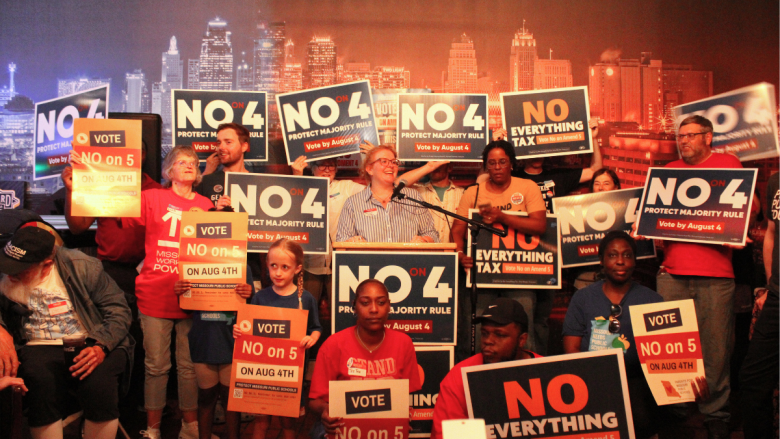
Missouri voters turned out for Tuesday’s primary election in large numbers, overwhelmingly rejecting top Republican priorities at the ballot box.
Takeaways
- Missouri voters split the ticket on statewide issues, approving Amendments 1 and 2, but resoundingly defeating Amendments 4 and 5, which would have changed the citizen-led initiative process and eliminated the state income tax, respectively.
- Opponents of Amendments 4 and 5 credited collaboration among a broad coalition of industry groups, activists and parents for the success of their campaigns.
- Secretary of State Denny Hoskins also announced during the primaries that his office had ruled a challenge to gerrymandered congressional maps used for the primaries was unconstitutional, setting the stage for more legal fights.
Voters split the ticket on statewide issues, approving Amendments 1 and 2 while resoundingly saying no to Amendments 4 and 5. Amendments 4 and 5 were rejected by 80% of voters, and every single county rejected the pair.
The Associated Press called all four issues at 8:15 p.m., barely an hour after the polls closed.
Here’s what the approvals and rejections mean for each measure moving forward.
- Amendment 1: The state will continue to collect the 0.1% sales tax that funds Missouri state parks and water and soil conservation, keeping the overall state sales tax rate at 4.225%.
- Amendment 2: In Jackson County, the only county affected by this amendment, the county assessor will now be an elected position. Residents will have their first opportunity to elect their assessor in 2028.
- Amendment 4: Its defeat means that the state’s initiative petition process will remain the same, with measures — regardless of whether it was placed on the ballot by the legislature or citizen-led — needing only a simple statewide majority for passage.
- Amendment 5: The state’s top income tax rate will remain at 4.7% unless previously passed triggers are met, and legislators will still have to go before the voters for any state sales tax changes.
Republican Gov. Mike Kehoe and Missouri Promise, the political action committee sponsoring the campaigns for Amendments 4 and 5, expressed disappointment with the results but said that the work to cut taxes is far from over.
“While we are disappointed by today’s result, our commitment to lowering taxes for Missouri families and strengthening our state’s economy remains unchanged,” Missouri Promise spokesperson Joe Lamie said in a statement regarding Amendment 5. “Governor Kehoe deserves credit for thinking big, and we will continue to work alongside him to reduce the tax burden on hardworking Missourians and advance policies that help our state grow and prosper.”
Meanwhile, representatives from the American Civil Liberties Union, labor groups, the Missouri Budget Project, the Realtors and Parents for Missouri Public Schools celebrated, crediting their collaboration for the defeat of Amendments 4 and 5.
“We certainly had over a dozen organizations that were participating in voter engagement work, talking to voters based on the relationships that they had and who people trusted to hear from,” Missouri Jobs with Justice Executive Director Caitlyn Adams said. “We had several organizations that we’ve seen in the last few weeks come out — industry groups, the Realtors, labor unions, grassroots organizations, elected officials Republican and Democrat — and it was a megaphone against these issues.”
But along with the celebrations came an understanding that the work wasn’t finished, with November elections on the horizon and the possibility that the legislature could try again next year.
“I would like to not spend every cycle defending things that we’ve already won,” Adams said. “The Missouri General Assembly really needs to learn that they need to uphold the will of the voters,” or else the coalition should go into the November elections making sure people know which politicians have been undermining their will and create consequences for them at the ballot box, she said.
Amendments 4 and 5 drive voter turnout
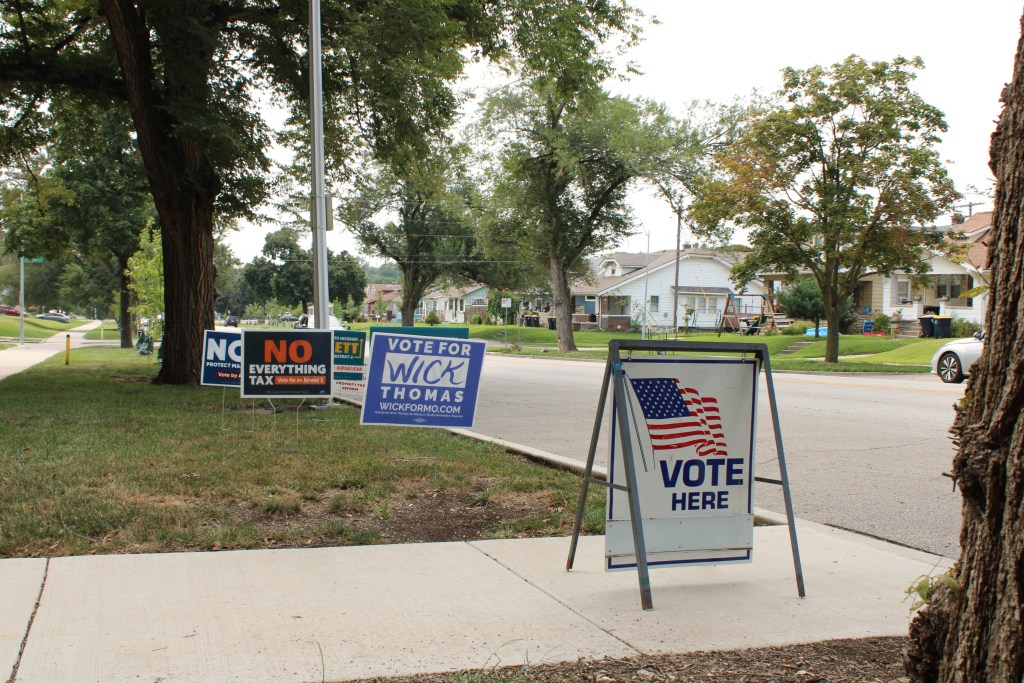
As voters headed to the polls, two issues were continuously cited as the most important topics people voted on — Amendments 4 and 5. The two amendments were expected to draw the most attention as groups both for and against spent millions of dollars to flood the airwaves with ads before the primaries.
Statewide voter turnout is expected to be about 32%, higher than usual for the August primaries.
People who said they were consistent voters during the primaries and those who vote infrequently noted that this year’s primary was especially crucial to ensure their voices were heard on those two topics.
Jessica McClellan, a resident in Kansas City, said her votes on Amendments 4 and 5 were “for the people and better democracy,” adding that the people should be the ones to decide on issues like taxes.
Others, like resident Delores Brown, said that they voted no on Amendment 5 because they didn’t see any benefits from its passage.
The amendment “would nail you one way or another,” Brown said.
Scott Charton, spokesperson for the Missouri Realtors’ Missourians for Fair Taxation and Missourians for Fair Governance campaigns, said in a statement that the overwhelming disapproval across the state was a testament to the unpopularity of the issues.
“The people have spoken. The people spoke loudly, clearly and overwhelmingly,” Charton said in a statement. “Amendments 4 and 5 have been soundly defeated — and buried so deep in citizen rejection that they should never come back. … And our fellow Missourians sent a powerful message to Jefferson City: The people are in charge, the majority rules and every citizen’s vote counts equally.”
Map challenge unconstitutional
With three hours left before the polls closed, two decisions on initiative petitions by Secretary of State Denny Hoskins made ripples on an already busy day.
At a press conference, Hoskins claimed that an initiative petition to place the Republican-backed “Missouri First” map on the November ballot was unconstitutional. The map, which split Kansas City into three congressional districts and was used to draw boundaries for the August primary, would remain in place, he said.
Hoskins said the decision was based upon his and Attorney General Catherine Hanaway’s interpretation that the Missouri Constitution does not authorize referendums on congressional redistricting, saying that redistricting powers rest solely with the Missouri General Assembly.
The Missouri Constitution does not expressly state that it bars or allows challenges to redistricting through initiative petitions or referendums.
Hoskins did not say if the petition had gathered enough valid signatures to force the vote, saying it was a “moot point” because of his decision on its constitutionality. Previous reports indicate that the petition would likely have enough valid signatures.
Along with claims that the petition was unconstitutional, Hoskins said that the deadlines for the certification “didn’t make sense” because Aug. 4 was the last day he had legally to rule on the signatures, the same day as the primaries.
“If the People Not Politicians are not happy with the deadlines, then they need to contact their state rep and state senator and ask them to file a bill in order to change the deadlines,” Hoskins said. “I am simply following the Missouri Constitution and Missouri state law that specifies those deadlines as today.”
The secretary of state is not obligated to wait until the deadline to verify the signatures. Hoskins said he waited to make the decision until his office had more information and a legal opinion from Hanaway.
Hoskins announced during the press conference that he had ruled Respect MO Voter’s initiative petition 2026-16 — which would have prevented lawmakers from weakening the initiative petition process and from overturning citizen-led measures after passage — to be insufficient as well because it violated the single-subject rule, which requires that laws and ballot issues pertain to only one main subject.
He also claimed that it was insufficient for violating the U.S. and Missouri constitutions because it would prevent itself and other amendments from being reconsidered.
Less than an hour after the press conference concluded, People Not Politicians Missouri, the group behind the Missouri First map referendum efforts, announced it had filed a lawsuit against the decision, the latest in a long line of litigation.
“Secretary of State Hoskins is making a last desperate attempt to silence the people’s voice in Missouri,” People Not Politicians Missouri Executive Director Richard von Glahn said in a statement.
“We’ve fought back against politicians for the last year, and we won’t stop now. There are more than enough signatures, verified by election authorities, to qualify the referendum,” according to the statement. “Courts have consistently held that congressional redistricting is subject to state constitutional provisions including the right to a referendum. People will have the final say in November and the chance to vote no to politicians’ desperate power grabs.”
The pending legal battles over the decisions could take months to resolve if the state drags its feet, von Glahn said during a press conference on Aug. 5. But von Glahn and attorney Chuck Hatfield said they anticipate the case being moved toward the top of the docket because of a Sept. 8 deadline for courts to make final changes to the November ballots.
Depending on the result, it could throw the validity of the August congressional primaries into doubt and require a redo, an outcome that would have been completely preventable, Hatfield said.
“This is a mess that Denny Hoskins created,” Hatfield said. “He intentionally delayed his certification. He caused this problem, and I look forward to seeing how he’s going to fix it.”