


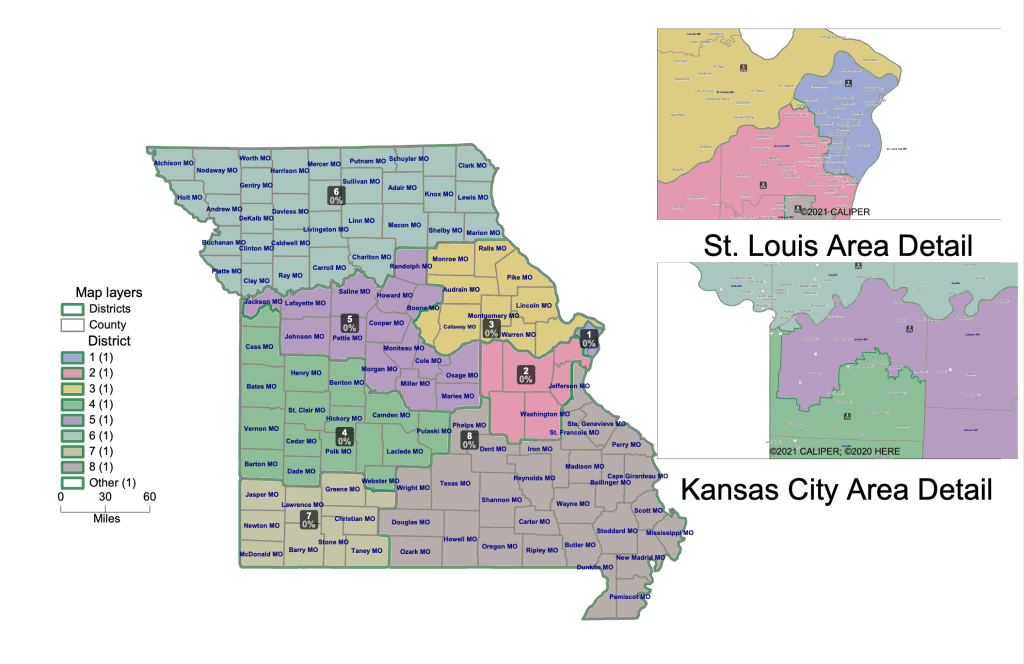
Missouri Gov. Mike Kehoe today signed into law a new congressional map that is widely expected to unseat U.S. Rep. Emanuel Cleaver, a Kansas City Democrat.
“I was proud to officially sign the Missouri First Map into law today ahead of the 2026 midterm election,” Kehoe said in a press release announcing the signing, which was closed to the media.
“Missourians are more alike than we are different, and our values, across both sides of the aisle, are closer to each other than those of the congressional representation of states like New York, California, and Illinois,” he added. “We believe this map best represents Missourians, and I appreciate the support and efforts of state legislators, our congressional delegation, and President Trump in getting this map to my desk.”
The new map was proposed by the governor in his August call for an extraordinary session. Kehoe and his allies — including Republican Rep. Dirk Deaton of Seneca, who sponsored a bill with Kehoe’s proposed map — repeatedly affirmed that the governor’s team had created it.
Even so, the governor took more than two weeks to put pen to paper on the bill creating the new districts.
Missouri’s new congressional map
The delay may have been related to multiple legal challenges to the new map.
The NAACP is challenging the governor’s authority to call an extraordinary session on redistricting, while another lawsuit filed by a private law firm on behalf of residents from across the state has challenged the legality of redistricting halfway through the traditional census cycle.
The only time Missouri has redistricted outside of the 10-year census cycle was in 1965 after a U.S. Supreme Court decision — which required districts to have roughly equal populations — forced Missouri and more than a dozen other states to redraw their maps. Whether redistricting outside of the 10-year cycle without a court order is constitutional is still up for debate.
Another lawsuit was filed by the Missouri ACLU on behalf of a group of Kansas City-area residents whose districts were changed by the new map, including labor organizers Terrence Wise and Ashley Ball.
In that case, ACLU lawyers argue that the new map violates the Missouri Constitution’s redistricting timeline as well as its requirement that districts be compact, citing concerns about a precinct in Kansas City being included in two districts under the new map.
In response to concerns about the precinct, Kehoe said the issue is the result of a Census Bureau error by which two precincts were given the same identification number. In a statement to the Missouri Independent, Kehoe said this issue does not mean voters are in multiple congressional districts.
As for the overall legality of the redistricting effort, Kehoe said at a press conference Thursday that “we’ll let the courts decide on that.”
“We wouldn’t have went into this without feeling like we had good advice on that,” Kehoe said. “I’m comfortable with the folks that we’ve been working with. I really believe they’re very good on these issues, and we think we’ll withstand all those challenges.”
In addition to the court challenges, the new map faces a challenge from a campaign by an organization called People NOT Politicians. Organizers with the group are working to collect signatures to force the new map to be put on a future ballot for a referendum.
If the group can get 110,000 signatures by December 2025, the new map will not be able to go into effect until it is passed by a majority of voters statewide.
KBIA’s Harshawn Ratanpal contributed to this story.
