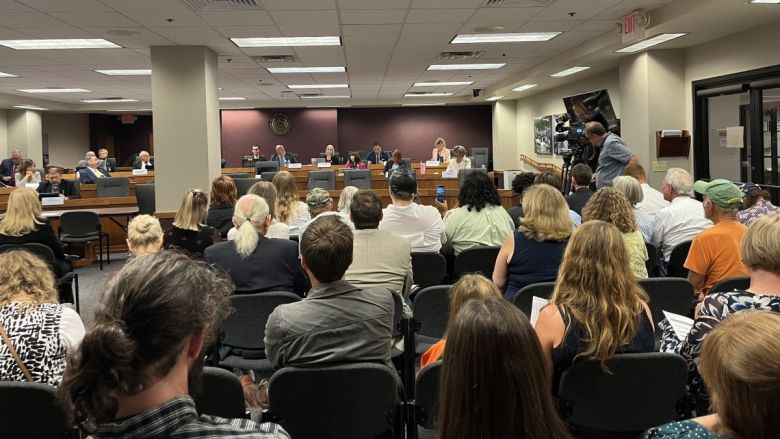
Dozens of residents and lawmakers filled a committee room in the basement of the Missouri Capitol on Thursday to express their views on Gov. Mike Kehoe’s congressional redistricting plan.
The Missouri House’s new Special Committee on Redistricting passed the bill by a partisan split of 10-4 after nearly six hours of testimony and questioning, despite there being a strict three-minute time limit on public comments.
The extraordinary session was called by Kehoe in late August in a news release that also unveiled his Missouri FIRST Map, a proposed congressional map that would change the boundaries of six of the state’s eight districts.
Proposed Map
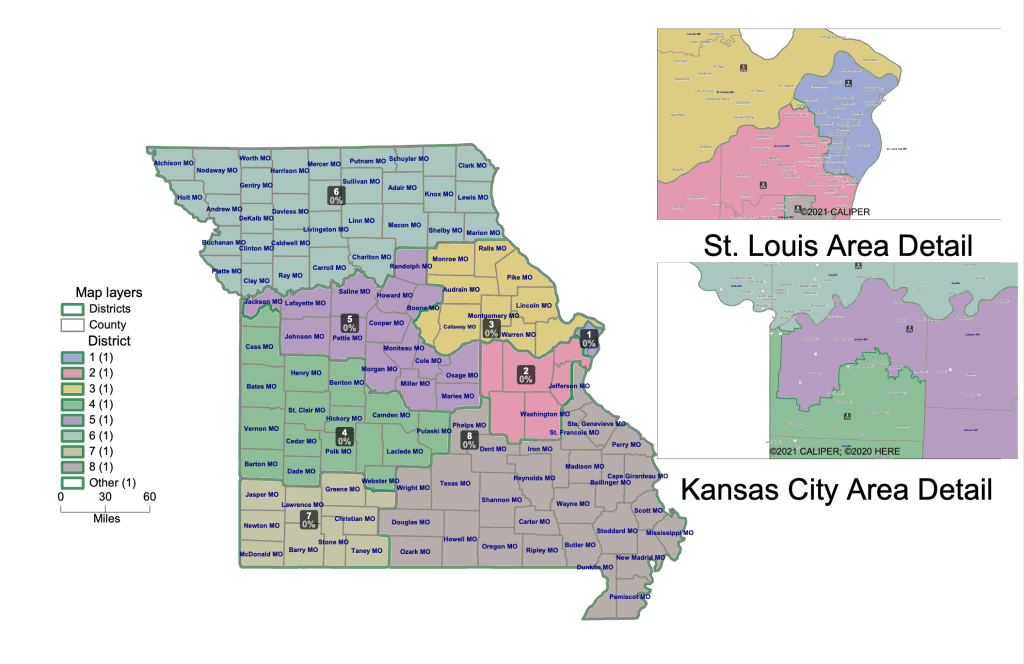
That map divides most of Jackson County between two districts, with the northern half of the county pulled into a district that stretches into eastern Missouri and includes Jefferson City and parts of Columbia.
The southern half of the county, as well as neighborhoods between State Line Road and Troost Avenue, would be part of a district stretching into the southern part of the state, ending just north of Springfield.
A small area of land in Jackson County northeast of downtown Kansas City would also be pulled into a district covering the northern third of the state.
Kehoe’s redistricting plan comes in response to a nationwide Trump administration push designed to preserve the Republican Party’s narrow majority in the U.S. House of Representatives ahead of the 2026 midterm elections. In Missouri, Republicans have their eyes on U.S. Rep. Emanuel Cleaver’s district in Jackson County, which they believe they can flip.
In his announcement of an extraordinary session, Kehoe lauded his proposed map for preserving two districts as they currently are and splitting fewer counties and municipalities than the current map.
The new map was included in a bill carried by Rep. Dirk Deaton, a Seneca Republican, who presented his bill to the committee Thursday and argued that a change is needed.
“Many, like myself, argued for and voted for a map much more like this Missouri FIRST Map that is being presented here for consideration today,” Deaton said, referring to the 2022 vote on the state’s current map.
Current Map
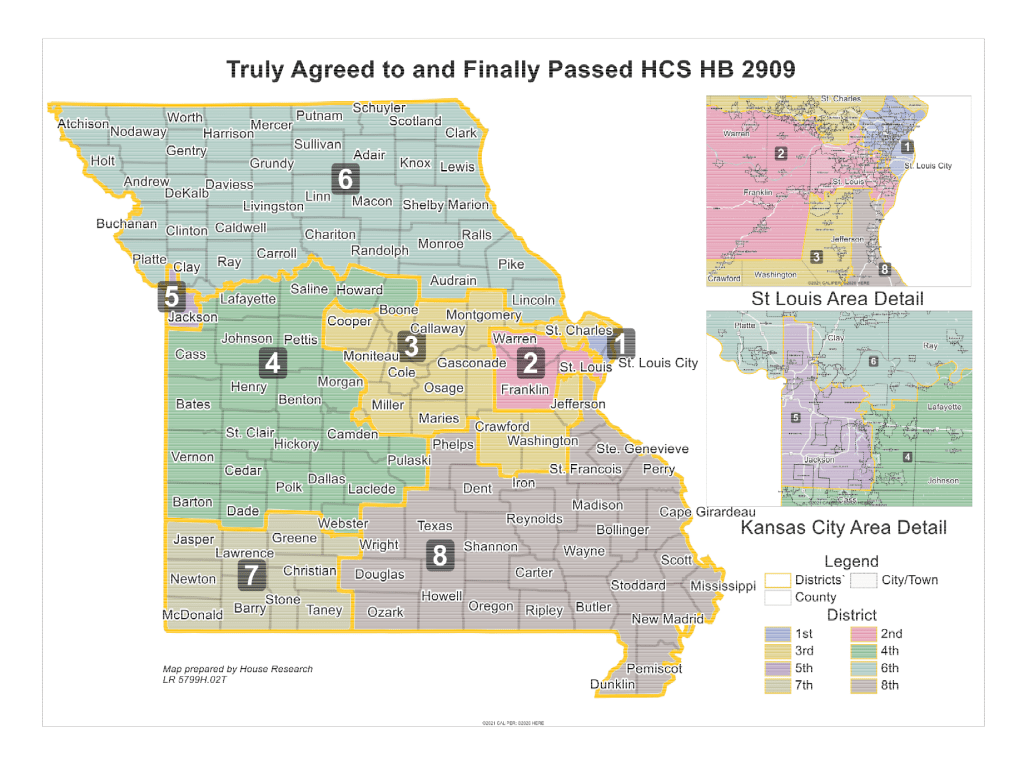
“When we hear people (talking about bills) in committee or on the floor, they talk about, ‘This is a reform.’ It’s an admission that we didn’t get it right this time,” he added. “I think it would be the same with this Missouri FIRST Map. It’s an improvement, it’s a reform of our current congressional map, and it’s one that will put Missouri first and is a superior map than the one we have today.”
Rep. Mark Sharp, a Kansas City Democrat serving as the ranking member of the committee, countered that the new map “is about carving up communities and silencing voters.”
“My city, representative, Kansas City, hangs in the balance right here, right now. I can’t tell you how angry I am. This type of policy is morally corrupt and inexcusable. It will not end well, not for this General Assembly, not for our state. Because if we continue down this road of dividing communities for partisan gain only, other states will follow.
Rep. Mark Sharp, D-Kansas City
“Redistricting is fundamentally a political question, and we’re political actors,” Deaton replied.
As for the question of whether it is legal for lawmakers to redistrict in the middle of a census cycle, Deaton cited a part of Missouri law that states: “Such districts may be altered from time to time as public convenience may require.”
Rep. Kem Smith, a Democrat from Florissant, countered that those lines were in a section of the law about redrawing state legislative districts, not federal ones. The section on federal redistricting does not mention any permitted changes outside of the typical census period, she said.
That section “also speaks to redistricting and so you have to read them in harmony together. Both are true at the same time,” Deaton said.
Demographic data for Missouri redistricting
When asked by House Minority Leader Ashley Aune, a Kansas City Democrat, whether he could provide demographic data for the new districts, Deaton said he would be “happy to provide that information to the committee.”
When Aune suggested Deaton share the data and the committee take a recess to review it before continuing, Deaton replied, “I can tell you what it said.”
“This (map) has an as-precise-as-possible population (split between districts),” he said. “And I don’t want to put words in their mouths, but (the governor’s office’s) memo said that, as they understood it, it appeared to meet the (legal requirements).”
“It’s the job of the members of this committee to take a vote on it today. They will be asked to vote on it today without that information,” Aune said. “We were told by the chair that the purpose of being here today is to receive public testimony. On what, gentleman? On what?”
“On the Missouri FIRST Map,” Deaton replied.
“On just this graphic that we have in front of us?” Aune said, holding up a sheet with the map printed on it. “We’re just supposed to trust you and the governor that the best minds are on it and the data is all correct?”
Deaton said a software model generated the maps with legal requirements in mind. He added that it was not clear whether the new map would give Republicans an advantage over Democrats.
Senate President Pro Tem Cindy O’Laughlin, a Republican from Shelbina, told The Beacon in a statement that her “priority is ensuring Missouri’s representation in Washington reflects the values of our conservative majority at home.”
The statement echoed the governor, whose news release said he was calling for an extraordinary session “to ensure our districts and Constitution truly put Missouri values first.”
Rep. Kathy Steinhoff, a Democrat from Columbia, asked Deaton: “How does it change the values reflected in Washington, D.C., if it isn’t changing seats from Democrat to Republican?”
“My hope would be that, next year … Missouri sends eight Republicans to Congress,” Deaton said. “Now, I don’t know if this is going to happen or not under our current map or under a new map.”
Pushed by Steinhoff about the partisan split of the state, Deaton replied, “There’s no constitutional requirement that there be proportional political party representation in Congress.”
‘Made in Missouri, for Missouri’
The governor’s decision to call for an extraordinary session comes after he and other state officials were reportedly pressured by Trump administration officials to redraw the state’s congressional map to give Republicans an advantage in the 2026 midterms.
During the hearing, Democrats raised concerns that the extraordinary session and new map were the result of that pressure and not Missouri Republicans’ independent desire to draw new districts.
“In my six years here, I’ve seen a lot of changes, but I hardly recognize this body anymore. Since 2020, this body has changed, and not for the better,” Sharp told Deaton. “In 2022, representative, this plan had no path forward. None. So what’s changed? And when did it change?”
“One person changed it, representative, and not for Missourians, not even for Republicans, but for raw, political power,” he added.
According to the release from the governor’s office, the proposed map “was drawn and created by his team in Missouri.”
Deaton reiterated that message during the hearing, telling committee members “this map was made in Missouri, for Missouri.”
After another back-and-forth between her and Deaton, Aune said: “This Missouri FIRST Map was drawn in D.C. It was handed down by the federal government, and y’all are going to do the bidding of the federal government.”
“Gov. Kehoe said that he drew the map, that it was made in Missouri, and Gov. Kehoe has never lied to me. I’ve taken him at his word,” Deaton said.
Public testimony
While most of the testimony on Thursday came from residents and advocates opposing Deaton’s bill, the new map did receive support from Missouri Right to Life, a statewide anti-abortion group.
“Missouri Right to Life’s involvement in this is specifically because we work to pass pro-life legislation,” said Susan Klein, a representative of the organization. “We work to support pro-life legislators at the state and federal levels, and we support a process that would increase those numbers in order for us to help protect women, children and babies.”
Sarah Starnes, a Kansas City resident, spoke against the legislation, telling lawmakers that under the proposed map, “for the first time in my life, I’ll be a rural voter, even though I’ve lived in the house I’ve owned in the heart of Kansas City, Missouri … for almost 30 years.”
“I love my rural neighbors, who live very distant from me. But I couldn’t tell you much at all about, for example, the cost of soybeans, or farm subsidies,” she said. “Despite our common values and universal goals, such as love of family, good jobs, education, health care and the preservation of our individual freedoms, our communities have some significantly different concerns.”
During her testimony, Starnes pointed to a thin strip of land in Jackson County along State Line Road that is separated from the rest of Kansas City on the proposed map.
Voters there “are probably the most prolific Democratic voters in the metro area … They’re turning out in large numbers every election,” Starnes said. “With the new map, this community would be put in a district that goes south to just two counties from Arkansas (and) separated from neighbors who share common interests and public policy priorities.”