


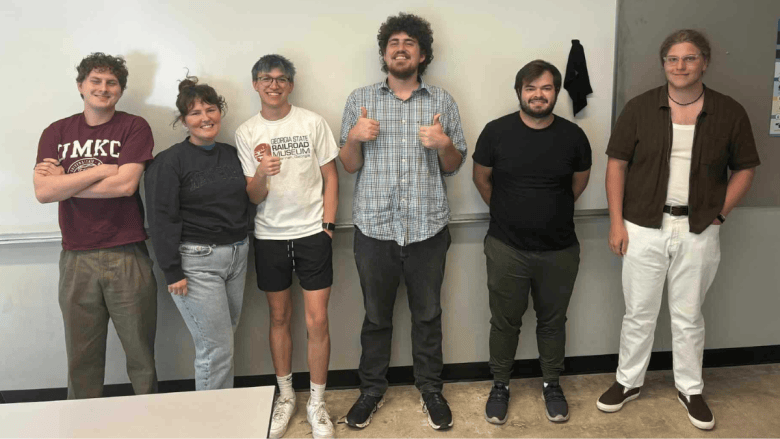
The Beacon’s Community Journalism Lab representative, Robert Stone and our local government reporter, Josh Merchant, recently sat down with Urban Planning and Design Students at the University of Missouri-Kansas City to hear what future city planners think about some of Kansas City’s biggest challenges. Students shared their perspectives on housing, transit, development incentives and how the city’s choices affect everyday residents.
The transit listening session took place at UMKC’s Katz Hall on Sept. 3, 2025. The event was part of The Beacon’s ongoing series of community listening sessions designed to ground our reporting on the priorities and lived experiences of communities across the region.
Kansas City is at a crossroads with rapid growth, new and revitalized transit projects such as the KC Streetcar, and conversations about housing affordability. The students, many preparing for careers in urban planning and development, offered insight into what’s working, what isn’t and what questions need to be asked.
Key themes
- Affordable housing and development pressures
The group had mixed opinions about whether city-led efforts to preserve housing affordability along the streetcar corridor will succeed. The majority suggested private organizations may be better positioned to keep housing costs down.
Students also discussed the barriers to building housing that falls between luxury apartments and single-family homes. Zoning, fire codes and aesthetic issues were flagged as challenges along with financial pressures that favor very large or very small projects.
- Transit expansion and equity
Students discussed the need for more east-west transit. While the city has studied it, political resistance and cost concerns have stalled progress. Students wondered how the city can expand access without gentrification or displacement.
- Vacant lots and redevelopment challenges
Students expressed concern about how property owners hold onto unmaintained vacant lots land without developing it. Students questioned whether policies like a vacancy tax could make a difference to prevent blight and nuisance lots.
- Tax increment financing
Tax increment financing is a development incentive that allows developers to redirect new tax revenue generated by a project to help pay for public improvements in a designated area.
Students were wary of its use to subsidize large shopping districts, noting that some projects feel underused despite the investment. They were also curious what a true win for TIF looks like and suggested that more transparency may be needed.
Why it matters
The common themes raised by UMKC students reflect wider community concerns: housing affordability, access, equity and accountability in urban development. These challenges are central to Kansas City’s growth and to whether longtime residents will benefit from it.
The students made it clear that development in Kansas City can’t just be about building bigger and expanding. It has to be about building smarter, fairer and with the community in mind.
If you have a story idea or idea for a community listening session let us know on our website or email our community manager at estrella@thebeacon.media.


