


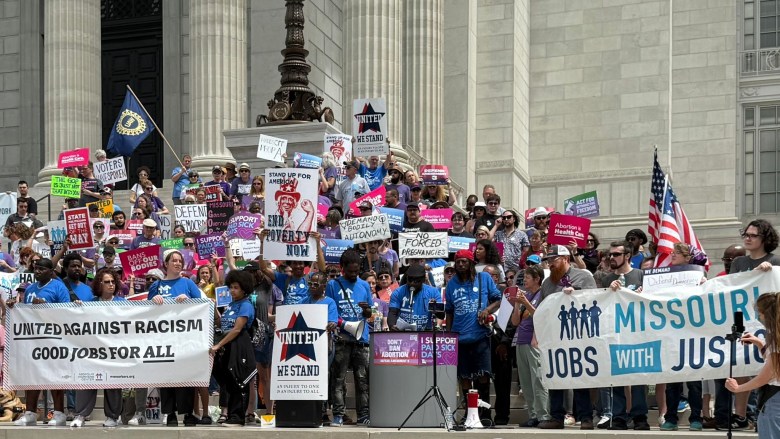
The Missouri Senate was seven hours into a filibuster on abortion access Wednesday when Sen. Adam Schnelting stood to speak.
“I have a privileged motion to move to previous question,” said Schnelting, a St. Charles Republican.
With that, Wednesday’s hourslong Democratic filibuster — and months of debates, filibusters and negotiations — came to an end.
Shortly thereafter, the Senate passed a measure that would put abortion access on the ballot, just months after Missouri voters approved a constitutional amendment enshrining abortion access in the state constitution. It passed by a vote of 22-11, with Springfield Republican Sen. Lincoln Hough joining Democrats in opposition.
Less than 20 minutes later, Schnelting made the same motion again, closing debate to allow for the Senate to pass — by a vote of 22-10 — a bill repealing paid sick leave provisions from a statute also passed by voters just months earlier.
Schnelting’s motion — moving to “previous question,” or “PQ” — hadn’t been used in the Missouri Senate in five years, or in a regular session in almost 10 years.
It’s used to override a filibuster, end debate on an issue and force a vote. It’s used sparingly in the Senate, where it is seen as antithetical to the chamber’s tradition of unlimited debate.
‘Every day will be miserable for the other party’
Schnelting’s motion was so unprecedented that even the House sponsors of the abortion and paid sick leave bills weren’t sure it would happen. But during their filibuster Wednesday, Democrats reflected on what was to come.
“The Missouri Democrats are standing on the issues … voters overwhelmingly passed in November,” said Sen. Patty Lewis, a Kansas City Democrat. “We’re not giving up the floor, but we know what’s going to happen — they’re going to take our ability to represent the voters away at any moment. But I’m holding my head high.”
Senate Democrats had for weeks been involved in negotiations with their Republican colleagues to try to find a compromise on paid sick leave.
But according to Sen. Nick Schroer, a Republican from Defiance, “goalposts were being moved” in those negotiations, which ultimately “hit a logjam.”
The PQ has traditionally been reserved for instances when senators insist on filibustering a bill indefinitely without engaging in meaningful negotiations, according to Sen. Maggie Nurrenbern, a Kansas City Democrat.
“I honor, I respect, I understand that there are times when folks would say, ‘Well, they’re not willing to negotiate,’ so we have a rule, a procedural motion that can be made,” Nurrenbern said during the filibuster. “That has never been the case on this one.”
Democrats made significant concessions to try to prevent the paid sick leave provisions from being completely gutted, according to Nurrenbern.
“Every minute of this day, we’ve given another thing to say, ‘Let’s not go down this path.’ I feel like I have thrown the kitchen sink at a compromise and we have been told, ‘That’s not enough,’” she said. “Today, the Republican supermajority is going to say: ‘We don’t care about them. We don’t care about the will of Missouri voters. We are gladly going to come onto this floor and overturn the will of Missouri voters.’”
This session has been marked by a significant increase in bipartisan cooperation and efficiency, Nurrenbern said, adding, “I am still a little flabbergasted with how much got across the finish line.”
It’s “because folks were willing to sit down and meet in the middle that we were able to do that. Democrats and Republicans and the Freedom Caucus — everybody would come to the table and work on these things,” Nurrenbern said. “That is not going to be the case next session. Mark my words: Every moment of every session of every day will be miserable for the other party.”
What bills did Senate Republicans pass with the PQ?
The two bills passed by the Senate using a PQ will put an abortion question on the November 2026 ballot and repeal paid sick leave provisions put into law by Proposition A.
The abortion question was proposed by House Republicans in order to help “clarify” what Missourians voted for when they passed Amendment 3 in November 2024. Opponents of the amendment argue it misled voters.
The bill puts a proposed constitutional amendment on the November 2026 ballot, though Gov. Mike Kehoe could move it to an earlier ballot.
The amendment would repeal the language added by Amendment 3 and ban abortions except in the case of medical emergencies, fatal fetal anomalies, rape and incest. But opponents of the amendment argue the ballot language is misleading because it doesn’t explicitly say it would ban elective abortions.
The paid sick leave bill removes all references to paid sick leave in a law created by the passage of Proposition A. Unlike Amendment 3, which amended the state constitution, Proposition A created a law, which makes it easier for the legislature to amend or repeal it.
Proponents of the bill argue that Prop A’s sick leave provisions would be untenable for small businesses and hurt the state’s economy. Opponents argue the provisions are needed to support low-income workers who currently have to choose between not being able to pay the bills and going to work sick.
Proposition A’s paid sick leave provision went into effect May 1. Because the House was not able to pass an emergency clause, the repeal will go into effect Aug. 28. Until then, businesses across the state will have to comply with the rules and allow their employees to accumulate paid sick leave hours.
