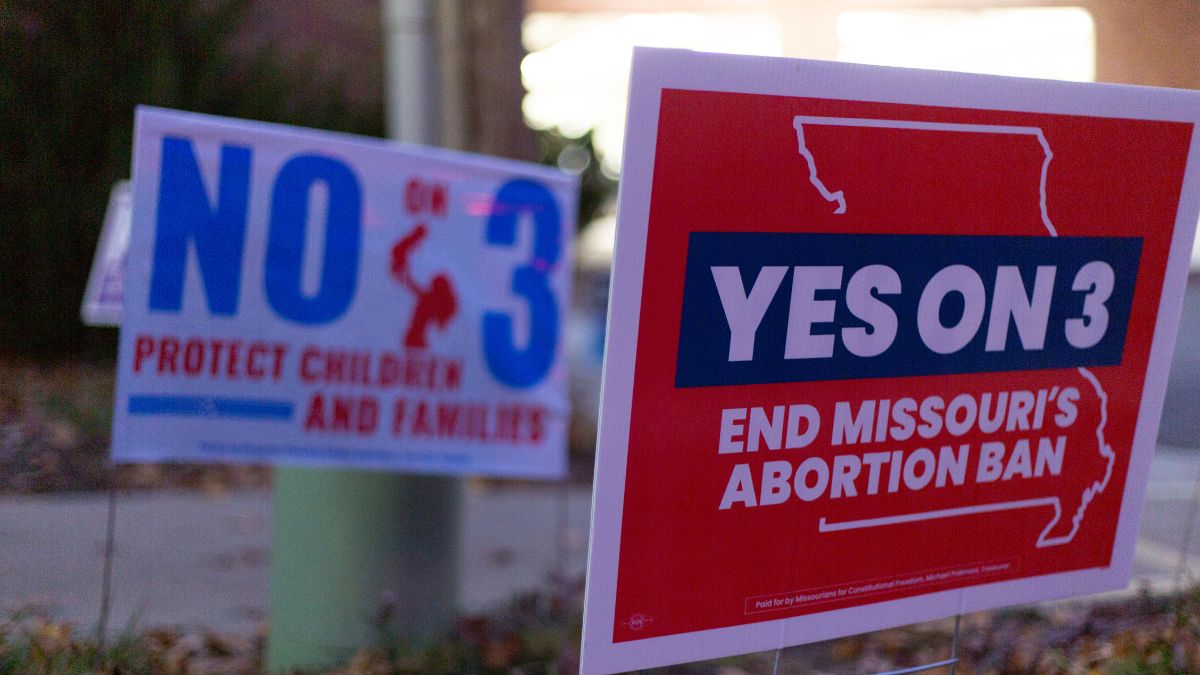
Missouri’s abortion access landscape has shifted dramatically in recent years. In 2022, it became the first state in the nation to ban abortions. Just two years later, its voters narrowly approved Amendment 3, enshrining abortion access in the Missouri Constitution.
Within weeks of that vote, lawmakers in both the Missouri House and Senate filed dozens of abortion-related bills, including proposals to codify the legal rights of fetuses and others to put a constitutional amendment on a future ballot asking voters to limit access to — or ban — the procedure.
Of those bills, one is “currently the only vehicle that’s being considered,” according to the bill’s sponsor, Rep. Ed Lewis, a Moberly Republican.
Lewis’ bill, House Joint Resolution 73, would put a question on the November 2026 ballot asking Missouri voters whether they want to amend the state constitution to:
- Guarantee access to care for medical emergencies, ectopic pregnancies and miscarriages;
- Ensure women’s safety during abortions;
- Ensure parental consent for minors;
- Allow abortions for medical emergencies, fetal anomalies, rape and incest;
- Require physicians to provide medically accurate information;
- And protect children from gender transition.
HJR 73 has passed the Missouri House as well as a Senate committee, but Lewis said it faces an uphill battle to get across the finish line before session ends May 16.
A state divided
Amendment 3 was passed by more than 1.5 million Missouri voters, or about 51.6% of the total vote.
Like many issues, abortion divided urban and rural areas, with Amendment 3 drawing most of its support from more urban, liberal regions of the state: four Kansas City-area counties; St. Louis city and two neighboring counties; and Boone County.
Lewis said that just because the amendment was passed by some of the state’s most populous regions, it doesn’t broadly reflect the will of all of the state’s people.
“It was 51.6%. There were only (eight) counties that approved it. (Eight) counties out of 114. So when they say, ‘Well, you’re ignoring the will of the people,’ I’m not ignoring the will of the people. Not in my county,” he said. “My county — and, in fact, (almost) every county north of I-70 but not touching it — voted against it. It’s not where the will of the people is.”
Branson Republican Rep. Brian Seitz said he also lives in an area of the state “that is very pro-life and did not vote for Amendment 3.”
“Were the rural voices heard through the vote on Amendment 3?” he asked.
Even in more rural, Republican-leaning areas, a significant section of voters cast their ballots in favor of the amendment. In Wright County, which had the lowest pro-Amendment 3 turnout, the ballot question still received a “yes” vote from 20.4% of voters.
The vote on Amendment 3 came after a gridlocked state legislative session in spring 2024. Republican infighting killed the body’s efforts to change the initiative petition process to require not only a statewide majority to approve a constitutional amendment, but also majorities in five of the state’s eight congressional districts.
Had that passed, it would have required Amendment 3 — and other questions on the statewide ballot — to receive more support from the state’s redder, more rural areas.
Though it didn’t cross that proposed threshold, Amendment 3 still received bipartisan support, according to Diane Meeker, president of the Missouri chapter of the National Organization for Women.
“If you look at how many people voted in favor of Amendment 3, then look at the numbers by how many people voted for a political party or candidate, the numbers of people who voted for Amendment 3 are far beyond the people who voted for Democratic candidates,” Meeker said.
“This is proof that there’s cross-partisan support for women and other pregnant people having control over their own fertility and being able to consult with their doctor instead of there being a straight-up ban,” she added.
Republicans seek ‘compromise’
Many state Republican lawmakers agreed that they wanted to make abortion less accessible, but how to do that was more divisive.
Some wanted to ban the procedure entirely, while others wanted to limit access. One senator even stepped down from a committee because his opposition to a bill’s rape and incest exceptions would have risked killing the bill completely.
Lewis said he and many of his constituents don’t believe there is “any reason to kill an infant in the womb,” but also said he is “not trying to make legislation for my personal position.”
“I’m trying to make legislation that the majority of the people in the state of Missouri will support and agree with, and a total abortion ban is not that,” he said.
So in January he filed a joint resolution — like a bill, but used to propose constitutional amendments — that included a set of changes he believed “would get the highest number of people to vote for it,” regardless of their political affiliation.
When House Republicans’ main abortion bill ran into obstacles, they turned to Lewis’ bill, with a working group taking control of the legislation, a body Lewis said he “wasn’t selected for.”
Seitz is part of that working group, along with others who “have been involved in the pro-life movement for decades.”
“As we got together to discuss this issue, we reached out to some groups,” he said. “We reached out to Missouri Right to Life. I’m sure some doctors were reached out to. I wasn’t involved in all of that process.”
The working group “wiped out” Lewis’ initial legislation and changed it to match the language that St. Charles Republican Sen. Adam Schnelting had used in his bill, Seitz said.
Lewis said most of the language matched his initial proposal, with a few “tweaks,” including removing a requirement that Missourians seeking an abortion because of rape or incest report the crime to the police before getting an abortion, which had also been part of Schnelting’s bill.
Seitz, who serves as the bill’s handler, said that while he believes “rape and incest are crimes and should be reported … it’s up to (victims) to report that.”
“It’s not something that they need to be pressured into. We don’t want anyone, just because they want an abortion, to say ‘I was raped’ or ‘incest took place’ or something like that,” Seitz said. “We also don’t want to force women into a situation they are not comfortable with, so we removed that piece from the legislation.”
Clarifying voters’ intentions
Seitz and Lewis said their bill — as well as its revisions — represents a “middle position” that will help to “clarify” what Missouri voters were voting for when they approved Amendment 3.
“I think (Amendment 3) was presented very disingenuously in that there was … something about ‘Do you think that Missouri women should have the very best of health care?’ Well, of course. We all agree with that,” Seitz said.
“But did people know 100% of what they were voting for? Or were they simply voting for the exceptions of rape and incest and life of the mother?” he added. “We’re going to present it to them in much clearer language so they can confirm what they voted for.”

That clarification is needed, Lewis said, because “people didn’t understand the other implications, the unintended consequences” for pregnant people and children.
“Amendment 3 removed the ability of a mother that goes in for an abortion procedure to sue in the case of medical malpractice,” he said. “It removed all the legal constraints on how (physicians) had to be certified and licensed, and who could perform the procedure.”
The amendment allowed the Missouri General Assembly to regulate abortion after the point of fetal viability — generally considered to be around the 24-week mark — as long as it did not prevent abortions “needed to protect the life or physical or mental health of the pregnant person.”
HJR 73 would reinstate several “targeted regulations of abortion provider” statutes, also known as TRAP laws, which were previously struck down by a Missouri judge who deemed them unconstitutional.
Opponents of Amendment 3 have argued it also legalizes sex-change surgeries for minors, though legal experts have dismissed the idea because the amendment’s language focused on “reproductive health care” with an accompanying definition that did not include gender-affirming care.
Even so, HJR 73 “protects children from gender transitions” by banning gender transition surgeries and the administration of puberty blockers or “cross-sex hormones,” according to Seitz.
“I know (voters) went in and thought they were voting for abortion rights, but how far do those rights go, to take away safety factors for women, to take away reporting from the doctors, to take away the right for children to grow into adulthood before they make adult decisions?” Seitz said. “That’s not what the Missouri voters voted for.”
Limit on abortions after rape and incest
Another debate within the Republican caucus has been the resolution’s 12-week limit on abortions following rape or incest.
House Speaker Jon Patterson of Lee’s Summit, a physician, was the only Republican to vote against the final passage of HJR 73. At a press conference afterward, he told reporters he had concerns about the time constraint.
“We know that people that are younger, people that are of lower socioeconomic status (and) people that are Black or Hispanic oftentimes find out later on,” he said.
“If you find out you’re pregnant at seven weeks and you’ve been raped, you would have to (firstly) deal with that trauma — which I can’t imagine, and I won’t even try — (and) at that point, you would have to make a decision about whether you want to proceed with the pregnancy or have an abortion,” he added.
He said that between the time needed to process that trauma, make a decision about how to proceed and then try to get an appointment with a doctor, there was a “serious debate” to be had about whether the remaining few weeks before the 12-week deadline would be enough.
Seitz said the limit was a compromise — while he “believe(s) that life begins at conception,” he and other lawmakers opted for the 12-week limit “because that is still within the first trimester.”
Overturning — or clarifying — the will of the people?
Meeker said many of her organization’s members have reached out to express anger “about the fact that the legislators are trying to overturn” Amendment 3.
“They’re like, ‘OK, we voted for it. Now let’s move onto the next issue. … Wait, now we have to go back and do this again? That’s not fair. We already settled it,’” Meeker said. “I’m hearing a lot of ‘It’s already settled. Why do they keep doing this? Why do I keep having to protest this?’”
“I’ve been seeing a lot of responses that connect the abortion rights (debate) with a pattern of the Republicans in the state legislature ignoring or overturning the will of the voters,” she added.
Lewis called that argument “a red herring.”
“Who’s going to vote on this? Voters. If they don’t want it, they’ll reject it. It will be the will of the people if they vote for it,” he said.
Amendment 3 “got 51.6%. Now, if we put this in there and it gets 65%, what will be the will of the people?” he added. “It could get 45%, and at that point, I’d say, ‘Well, the will of the people is to kill children.’ But I don’t think it is.”
While proponents of HJR 73 said Amendment 3’s ballot language was misleading, opponents of the resolution have argued the new proposed ballot language would mislead voters, too.
The resolution would repeal the language added to the constitution by Amendment 3 — and ban elective abortions outside of the listed exceptions — but that piece was not included in the proposed 50-word description that would appear on a future ballot.
Asked about this concern, Seitz replied: “Well, (the bill includes) elective abortions for medical emergencies, ectopic pregnancies, miscarriages … fetal anomalies, rape and incest. Those are elective abortions, and this provides for those.”

Lewis said the ballot language wasn’t clear on that aspect but said “it should be.” His version of the bill had included a sentence clarifying that it would “replace the current language.”
“I’d be completely honest,” Lewis said. “Is this (bill) perfectly honest? It’s not dishonest. It’s just not being as forthright as I would be. Tell them the truth. People will vote for this if you tell them the truth.”
In his comments to the press following his vote against the resolution, Patterson said one of his motivating factors was a belief that his constituents wouldn’t support the legislation.
“When I looked at the language of the resolution, I didn’t think it was something my constituents would be in favor of,” Patterson said. “I don’t think they would be in favor of a repeal.”
Pushback from the right
While some Missourians pushed back against the resolution because it would restrict access to abortion, others have attacked it for not restricting it enough.
Wes Scroggins, executive director of Abolish Abortion Missouri, said he and the organization’s other members are “abortion abolitionists” who “believe all life is sacred and of equal value.”
“Therefore, taking the life of any innocent child is sinful and wrong. And that’s really what HJR 73 … does,” Scroggins said. “It has exceptions for children who are conceived through rape and incest and those that have fetal anomalies. Basically, the resolution states that it is permissible to kill these children and to take their life. That is just evil.”
Scroggins said that even though HJR 73 repeals the language added by Amendment 3, “it will not prevent the killing of one child in the state of Missouri.”
When Missouri’s trigger law implementing a near-total abortion ban went into effect, clinics across the state stopped offering the procedure.
“So women, instead of going to the clinics, just ordered those pills and did it at home (or) simply drove a few miles across the state line … and aborted the baby there in abortion clinics,” he said.
Because HJR 73 does not criminalize abortion, even if it repeals Amendment 3, “we’re simply back to that state that we were in in 2023 and 2024 where we’re still killing, as our numbers show, 14,000-plus Missouri children a year,” Scroggins said. “It saves no child at all.”
Abolish Abortion Missouri’s 14,000 estimate was created by combining data about out-of-state travel for abortion care and in-state use of abortion pills, Scroggins said.
Asked about the opposition from anti-abortion advocates, Seitz replied, “There may be pushback from the right from those that believe, as I do, that life begins at conception.”
“I use this (analogy) for people on the right: If a house is burning down and there are 10 people in the house, but you can only save nine, and there’s nothing else you can do to save that one, you save the nine,” he said. “That’s our responsibility, and I think the voters will agree.”
Looking ahead
If passed by the Senate, the resolution would not need Gov. Mike Kehoe’s signature to be put on the November 2026 ballot, though Kehoe could push for it to be included on an earlier ballot.
If it goes on a ballot and voters approve it, “it would impact people the way these abortion bans usually do,” Meeker said.
“For one, it wouldn’t stop abortions, it would just make them less safe, because when abortion is outlawed and people still need abortions, then they have no choice but to turn to illegal means, because all the safe means would be outlawed,” she added.
Meeker said there were also some concerns among abortion-rights advocates that a provision in the resolution prohibiting public funds from being used to pay for abortions could be construed as preventing public-sector employees from using their health insurance to cover their abortions.
Whether HJR 73 will be passed before session ends is still an open question, and it all comes down to a procedural quirk of the Missouri Senate called a “previous question.”
Unlike the Missouri House, the state Senate’s rules allow for filibusters, and the only way to break one and proceed to voting is to motion for a previous question. But Lewis said that in the five years he’s worked in the statehouse, he’s never seen one used.
That means that when the resolution is brought up for debate on the Senate floor, it can and will be filibustered and sidelined indefinitely unless Senate leadership breaks with its own precedent.
“The question is whether it’ll get done. I wouldn’t lay any bets on it,” Lewis said. “Do the Republicans have the desire to break a filibuster? I think they do. But that doesn’t mean they will. I mean, would I say there’s a 50% chance? I hope it’s that high.”
Whether or not this effort succeeds, Meeker said an organization called Respect MO Voters “is gathering signatures to put on the ballot in 2026 an amendment that would ban politicians from overturning the will of the people, (requiring it to) have a huge supermajority to undo anything that the voters had approved.”