


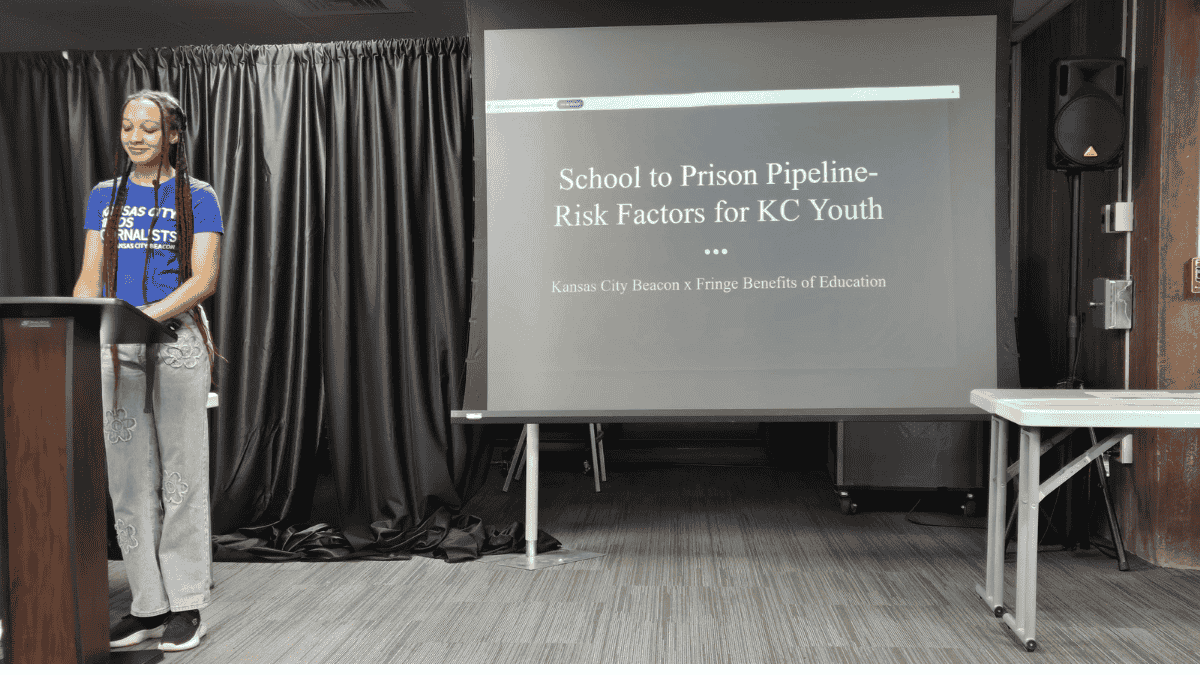
On Feb. 8, Community Journalism Lab representative Eden Barnes, in partnership with Fringe Benefits of Education, held a community listening session at Kansas City Kansas Community College. Our lab invited college students to discuss their experiences with youth risk factors – and how those factors could lead to future criminality or incarceration if left unaddressed. Discussion topics ranged from early childhood education experiences to high risk factors and concluded in brainstorming solutions.
Eden opened the conversation with a slam poem about how it can feel to be a student in today’s K-12 classrooms. The “school to prison pipeline” refers to youth who experience punitive punishment in schools who become increasingly enmeshed in the criminal justice system. This is often reflected in schools through zero tolerance policies and suspensions, as further explored by the Center for Public Justice. Locally, you can see this theory play out in sending students to the Alfred Fairfax Academy as an alternative disciplinary school.
Attendees shared how their earliest experience of systemic oppression was through institutional discipline in school, with some citing experiences as early as elementary school. Some mentioned that those experiences had a lasting impact, leaving them quiet and hesitant to build trusting relationships with their peers and teachers.
Community members noted that a child’s home life could contribute as risk factors for juvenile delinquency based on their own observations and experiences. The risk factors mentioned at the session are also cited by the U.S. Department of Justice. Examples cited were feelings of abandonment by parents, peer pressure and exposure to gangs, whether it’s through a family member or neighborhood, drug and alcohol use and/or a general lack of supportive parents and community investment. The presence of law enforcement in many K-12 schools also contributes to the pipeline, as many de-escalation tactics and disciplinary measures used against students are done with unnecessary force and fear.
Potential solutions discussed during the session included increasing teachers salaries and resources for parents. Some attendees acknowledged parents try their best with their children, but that additional support for those parents on how to raise their child could be beneficial. Attendees also brought up how teachers need mentorship to successfully intervene as these risk factors present themselves, especially as more younger teachers enter the workforce and are often not equipped with the proper training. Another need addressed was training on how to work with disabled, neurodivergent or mentally ill students, whose behavior or lack of progress has often been regarded as individual failures rather than a symptom of a lack of resources and necessary support. The consensus from the group was that a deeper investment in community growth, youth success and sense of self-worth should be a bigger priority.

