This story originally indicated that Mike Halow declined comment. A public relations firm representing him later said that was his father, who has the same name.
Aimee Gromowsky was puzzled when she found a flier in her mailbox asking her to apply for a cannabis dispensary license.
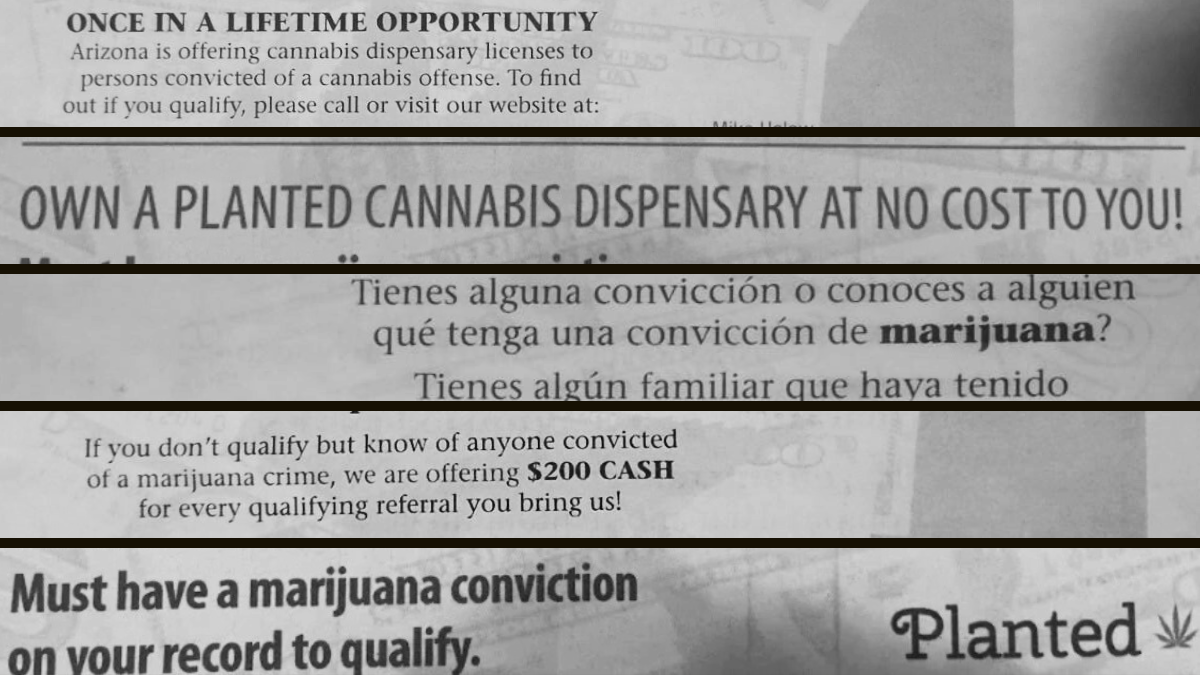
In bold letters on one side, it read: “ONCE IN A LIFETIME OPPORTUNITY.”
Gromowsky, a Kansas City lawyer, is a licensed marijuana cultivator and lives in a school district that qualifies them for a cannabis microbusiness license. Gromowsky told The Beacon she tried to contact the company, called Planted, last year and tried to visit its website to understand why she received the advertisement.
“I think I called or tried to visit the website, but never got through to anyone,” Gromowsky said. “I just wanted to find out how I got on their mailing list.”
That flier is one facet of a broader national trend of companies with a foothold in the fast-growing cannabis industry recruiting people as fronts to apply for dispensary licenses — the kind reserved for people most harmed by laws that criminalized marijuana.
Missourians in that situation have been sought by out-of-state operators working within Missouri Division of Cannabis Regulation guidelines to create a system that undermines the program’s purpose: to give minorities, veterans and other groups a fair shot at a foothold in the legal weed business.
At least one out-of-state convicted felon is listed as the designated contact for over 40 Missouri microbusiness applications meant to be set aside for smaller operators who face some kind of social or historical barrier to starting a business. He had the help of a Phoenix-based lawyer and an Arizona cannabis consulting firm.
The same players found in Missouri’s program can be traced back to Arizona’s 2022 microbusiness lottery. Of the 26 licenses Arizona awarded to applicants from groups that suffered disproportionately from the generations-long war on drugs, an Arizona cannabis business consultant said, only two licenses remain in the hands of the original applicants. The others were grabbed by that state’s corporate dispensaries.
The Missouri Department of Health and Senior Services Division of Cannabis Regulation has reviewed the latest round of lottery winners and determined 25 qualified. Only seven of the 24 dispensary winners and 18 of the 33 wholesale facility winners were eligible.
Applicants had to meet at least one of seven requirements, such as spending time in jail for nonviolent marijuana offenses or status as a disabled veteran.
The division’s chief equity officer issued the review on Oct. 10 that found problems like not providing enough documentation to prove the majority owner met the eligibility requirements.
That report says those 32 applicants can submit records or information demonstrating why their licenses are eligible and should not be revoked.
The flier
The flier Gromowsky got came decorated with images of hundred-dollar bills. One side was in English, the other in Spanish. It featured the company name Planted and listed a website, a QR code and a Missouri area code.
Nearly identical postcards have popped up in Utah, North Dakota and Illinois.
In February 2023, a Utah cannabis regulator called the business proposition a scam and urged people to not call the number or visit any websites associated with the material.
North Dakotans also got similar mailers from a company named Planted Cannabis, according to a March 2023 article from InForum, a newspaper based in the Fargo-Moorhead area. The director of consumer protection for the North Dakota attorney general told residents to be cautious about contacting the company.
Planted Cannabis owner Mike Smith told InForum that he was recruiting people to open dispensaries in Illinois through the state’s Cannabis Social Equity Program. He denied that his recruitment tactics were a scam attempt.
The website, QR codes and phone numbers on the postcards have since been deactivated.
In Arizona, the flier included the same aspects as the other states’ mailers — and an added name: Mike Halow.
Arizona social equity program
In 2021, Anavel Vasquez and her long-term partner, Rene Mendoza, got a postcard from Planted, listing Halow’s name and an address. They thought it might finance their children’s college educations.
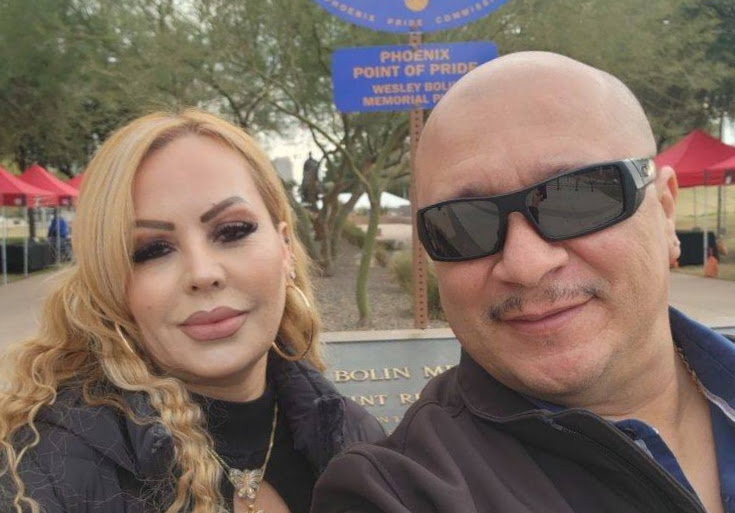
Vasquez was eligible for Arizona’s social equity licensing program because of a family member’s previous marijuana conviction, her ZIP code and her income. She said Planted offered to cover the state’s $3,000 application fee and open the dispensary at no cost to her. On April 8, 2022, Vasquez’s application was drawn for a license through a randomized lottery system.
“I didn’t know anything about these licenses other than what they told me over the phone before and after we won,” Mendoza said.
Mendoza is a former firefighter who now teaches CPR and does remodeling work. Vasquez works as a salesperson at a clothing retail store. The couple have three sons, ages 15, 20 and 22.
“We thought we were financially fixed and could put our kids through college,” Mendoza said.
Now Vasquez is no longer the majority owner of the business, and her company sued Halow and others, saying he took the license.
She argued that Halow is ineligible to hold the license because he does not meet the criteria set by Arizona’s Social Equity Ownership Program. The program requires that the majority shareholder have an income below a certain threshold and was negatively impacted by previous marijuana laws.
A recent ruling from the Maricopa County Superior Court ruled in favor of Halow and stripped Vasquez’s license.
Halow’s LinkedIn profile lists his objectives as “championing social equity within the cannabis landscape, offering invaluable mentorship, resources, and support to empower underrepresented candidates through the intricate licensing process.”
Missouri round two
Halow wasn’t the only Arizonan taking an interest in Missouri’s microbusiness program.
Jessica Hale, a former Arizona cannabis attorney, is the registered agent for at least 18% of the 2,083 Missouri second-round microbusiness applications. A registered agent is an individual or company appointed to receive legal documents for a business.
Her name appears on 241 applications, and 43 of them also list Halow.
Cannabis Business Advisors, a Phoenix-based cannabis consulting group, also used Hale’s services to establish businesses in Arizona, listing the firm’s founder and CEO and its marketing and project coordinator as designated contacts for 95 applications.
“We help people with their applications,” CB Advisors’ marketing and project coordinator, Sabrina Barkdull, told The Beacon. “We’re in communication with the department on their minimum standards eligibility process.”
In Missouri’s first round of microbusiness lottery, CB Advisors was linked to 400 dispensary applications, according to the Missouri Independent investigation last year.
The group, along with Hale, was also connected to six revoked microbusiness licenses, and it is appealing those revocations. An Independent investigation found that five of the revoked licenses are connected to Halow and are being appealed with the legal representation of St. Louis-based law firm Armstrong Teasdale.
CEO and founder Sara Gullickson said in an email to The Beacon that CB Advisors finds its Missouri applicants legally. “I can’t share internal processes or client information.”
In Missouri’s second round of applications, Hale is also the registered agent for 51 businesses that listed another contact, Danielle Popov, including a winning dispensary in the St. Louis area.
Hale did not respond to requests for comment.
Popov and Halow have posted Facebook photos of each other since 2012. In Popov’s most recent public photo with Halow from 2020, they are with two children. And in a 2022 court case against Halow and Popov in Maricopa County, Arizona, a judge ordered them to pay $4,368 in rent.
Popov could not be reached for comment.
The Beacon also identified Brandon Halow, who has ties to Hale, on 67 applications and one winning dispensary in mid-Missouri.
Brandon Halow and Jessica Hale, the Phoenix attorney, also worked together in July to create an Arizona domestic LLC, Legal Solutions, where he is listed as the manager. Brandon Halow did not respond to repeated requests for comment.
Mike Halow was convicted in 2004 of aggravated assault causing serious bodily injury in El Paso, Texas.
But in Missouri, Mike Halow’s felony does not disqualify him from being a microbusiness owner.
A disqualifying felony offense would bar an individual from being an owner. But if “more than five years have passed since the person was released from parole or probation, and he or she has not been convicted of any subsequent felony criminal offenses,” they can be listed as an owner on a microbusiness application.
The state also has rules regulating multiple ownerships.
An owner is an individual with 10% or more voting or financial interest in a microbusiness.
According to Missouri’s DHSS, an “applicant may not have an owner who is also an owner of an existing medical, comprehensive, or another microbusiness marijuana facility license.”
Mike Halow, according to his LinkedIn bio, holds numerous cannabis licenses across multiple states.
John Labate, an Arizona cannabis business consultant, said people who operate in multiple states have an advantage over individuals seeking to open a dispensary or wholesale facility.
“They can probably hire an attorney. They could maybe even hire a consultant to do the application for them,” he said. “They’re just better armed to win these licenses. They know they know how to navigate the system.”
In Arizona, Labate said, microbusiness licenses can sell for $10 million. He said that can leave smaller competitors feeling outgunned.
“I can imagine that any of those people would feel cheated,” Labate said. “A really intelligent, savvy operator is going to get the best deal for themselves.”
Mendoza and Vasquez are considering whether to appeal the ruling in their Arizona lawsuit against Mike Halow. Mendoza said Missourians looking to open a microbusiness dispensary or wholesale facility should be wary of potential partners.
“Anybody who tells you they will put money upfront, they will help you open up a business, it’s all a lie,” Mendoza said. “It’s a scam. Just do it on your own.”