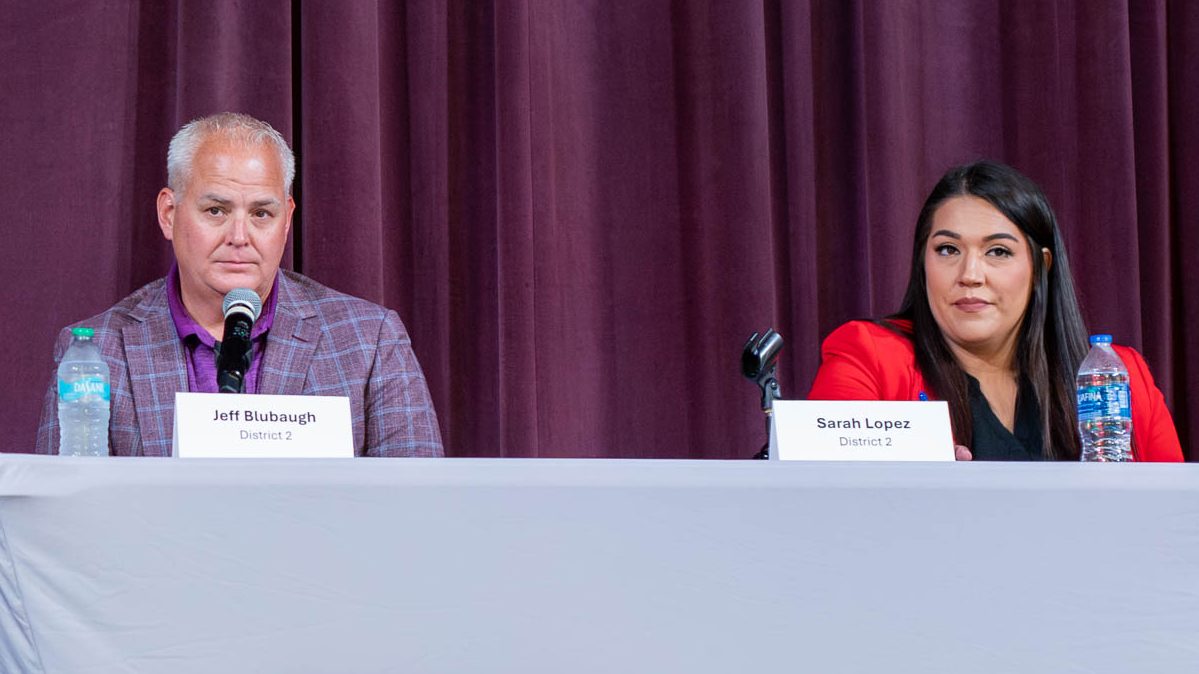
Sarah Lopez faces her first challenger as District 2 Sedgwick County commissioner. Her opponent, Jeff Blubaugh, returns to the political arena just months after his term on the Wichita City Council ended.
Residents in southwestern Wichita, Haysville and Clearwater will cast their vote for either Lopez, a Democrat, or Blubaugh, a Republican. Advance voting will begin on Oct. 16 and wrap up with in-person voting on Nov. 5. You can find your polling place here.
The Beacon reached out to both candidates to discuss their priorities for office and the direction of the district. Answers have been lightly edited for length and clarity.
Who are the candidates?
Democrat Sarah Lopez
Lopez, a first-term commissioner, won a contentious race in 2020 against then-incumbent Michael O’Donnell, who was embroiled in a series of political scandals during much of the campaign.
Lopez won by 264 votes and, for the last two years of her term, has been the sole Democrat on the commission.
Lopez’s professional background is rooted in health care. She spent 15 years at Ascension Via Christi hospital, starting in a clinical care role before moving to IT and business management positions. She lives with her husband and five children in Haysville.
Republican Jeff Blubaugh
Blubaugh has spent more than a decade in local politics.
He was a member of the Goddard School Board before making an unsuccessful attempt at the Kansas House of Representatives District 97 seat in 2012. In 2013, he was elected to the Wichita City Council to fill a partial term in District 4 and won two full terms in 2015 and 2019. He served two years as vice mayor.
Blubaugh worked in sales for Cessna for 17 years. He’s spent more than two decades as a real estate broker working across Sedgwick, Harper, Sumner and Kingman counties. He lives with his wife and four children in Wichita.
What do you see as the central issues facing District 2? Are those issues unique to your district and how will you plan to put your constituents’ needs on this issue at the forefront in the coming term?
Blubaugh: On day one, I will be addressing real property tax relief and a fair property tax assessment process. The property tax assessment process is broken and needs to be overhauled for both residential and commercial property. If you own a commercial property and you appeal your tax assessment value at the municipal court or Board of Tax Appeals you have a less than 1% chance to get your value reduced. County commissioners took a similar approach as it approved a $563 million budget for next year, a 6% increase in spending over the current budget. They did lower the mill levy by about one-third of a mill, but to give you context that’s $4.14 a year on a $100,000 home. The current mill levy reduction doesn’t even cover a cup of coffee at Scooters. Total spending is still up 6%, including a 3% pay raise for county commissioners making over $100,000 a year already.
Lopez: Our taxpayers need major tax relief. To do that responsibly, we must significantly reduce the cost of the vital public safety and infrastructure services our families and businesses count on while maintaining their effectiveness. It can’t be business as usual in government. We must find opportunities for functional consolidation of county and city services to eliminate duplication and streamline processes to reduce the cost of vital public services and improve quality. It also simplifies customer service, no more figuring out who to call to resolve an issue.
Also, mental health services in Kansas are ranked last nationally and we’ve talked about the need for a mental health hospital in our region for years. I took a leading role in this project and we break ground on this desperately needed Regional Mental Health Hospital next year. This is a massive step, but the need is great and our work continues.
Name a recent action taken by the Sedgwick County Commission that you support. If (re)elected, how will you keep forward momentum on that issue?
Blubaugh: I support Sedgwick County adding the much needed public safety dollars back in the budget. When 911 positions were only being filled at a rate of 60%, it put our community safety at risk. We need to ensure 911 dispatchers receive the necessary training and guidance to lead and prepare our first responders to address emergency situations. I will ensure public safety funding will never be underfunded.
Lopez: Sedgwick County is building the Regional Mental Health Hospital in south Wichita that will be run by the state of Kansas. As vice chair of the governor’s task force responsible for guiding the project forward, I’m committed to ensuring the utmost safety of this brand-new, state-of-the-art facility and developing our local workforce to provide these valuable services with hundreds of high-paying jobs right here in south Wichita.
I also lead on the effort to implement the county’s policy of eight weeks paid parental leave for both parents of a newborn, adoption or foster placement. Making sure our county government is a family-friendly workplace and community is extremely important to me. It wouldn’t be enough to say we value employees and their families, we’ve shown it with our actions. Our departments report the policy is working well and our employees and new hires appreciate that family comes first.
This year’s budget process lowered the mill rate, but saw cuts to some county services in order to respond to a $5 million deficit. Are there areas of county operations that you would like to see further investment in during the next budget cycle or that you would protect from additional cuts?
Blubaugh: They did lower the mill levy by about one-third of a mill, but to give you context that’s $4.14 a year on a $100,000 home. The current mill levy reduction doesn’t even cover a cup of coffee at Scooters. Total spending is still up 6%, including a 3% pay raise for county commissioners making over $100,000 a year already. I would like to see the county focus on core services like public safety and roads versus growing government.
Lopez: The deficit resulted from a significant wage increase for our sheriff’s department after the budget process had been finalized. When I came into office four years ago, the county was facing a serious staffing shortage (65% staffing levels across the board) that was negatively impacting public services. I know county services are only as good as the people who provide them, so I’ve worked with my colleagues to raise pay and improve benefits for all county employees, raising staffing levels to 90% on average today.
At the same time, I’ve expected efficiency and financial accountability to be able to cut the mill levy property tax rate the last two years to the lowest county mill levy in nearly 30 years. We have a strong, financially responsible budget and no more cuts will be necessary. In fact, Sedgwick County has a rare AAA credit rating thanks to our financial discipline.
Do you support consolidation of services between the county and local communities? If yes, where do you see opportunities for consolidation? If no, why not?
Blubaugh: I think consolidation should start first with the city of Wichita and then look into opportunities with the other 19 cities in Sedgwick County. I think HR, parks, maybe even more fire consolidation should be looked at more. I don’t believe in privatization efforts that benefit the third party more than the county or the city should be done. I voted against the parking plan for downtown Wichita because I believed this was more of a “cash grab” for the third party than a benefit to the city.
Lopez: Functional consolidation is a top priority for me. As I previously mentioned, consolidation is the key to improving the quality of public services and making serious, sustainable tax relief possible over the long run. Sedgwick County and the city of Wichita are creating a blue-ribbon panel of local community members and experts to explore all opportunities for consolidation of county and city services. I don’t believe in business as usual for our local government, so I’m committed to seeing meaningful steps towards functional consolidation in my second term.
Before joining the commission, I was a health care IT professional working with teams to find innovative solutions for complex problems with the expectation to come in under budget and on deadline. My professional experience carries over into my work at Sedgwick County, and consolidation is the type of innovative solution we need to improve services and lower the cost of government.
What would you say are the most important differences between you and your opponent?
Blubaugh: I have proudly served a majority of District 2 for almost 11 years on the Wichita City Council, including two terms as the vice mayor of Wichita, and I served on the Goddard School Board. My education and experience provide me with a great set of tools to address the issues of the county without a training curve. Outside of my local government experience, I have lived and worked in the district for three decades. Seventeen years working for Cessna Aircraft/Textron, 22 years as a real estate broker, and my master’s and bachelor’s degrees from Friends University provide me [with] a strong background to understand the issues of the district and to provide common-sense solutions.
My opponent has not lived in the district nearly as long as I have and I think it is because of this she doesn’t understand the district as well as I do. She recently called the revenue-neutral rate law “irresponsible.” The thousands of District 2 residents I have talked to at the doors and community events seem to feel the revenue-neutral law is the only thing standing between them and exorbitant property tax increases, even though oftentimes it is not enough. It’s not irresponsible to have a revenue-neutral law that empowers citizens to exercise their First Amendment rights, it is irresponsible to tax seniors and working families out of their home.
Lopez: It isn’t what we say, it’s what we do that matters. Our track records in office make the choice clear. I led Sedgwick County out of a staffing crisis while also cutting the mill levy property tax rate two years in a row. I’ve taken an active, leading role in bringing in over $200 million of new investment and hundreds of well-paying jobs to the county, the majority of both in District 2. I don’t play politics with services our families and businesses count on, I work with large, bipartisan coalitions towards real solutions.
Over 11 years, my opponent never cut the mill levy and still led Wichita into a budget crisis, leaving a $55 million deficit and city staff reporting to the current council that cuts to public safety are unavoidable. He even admitted to other councilmembers he did nothing to improve quality of life in south Wichita.