



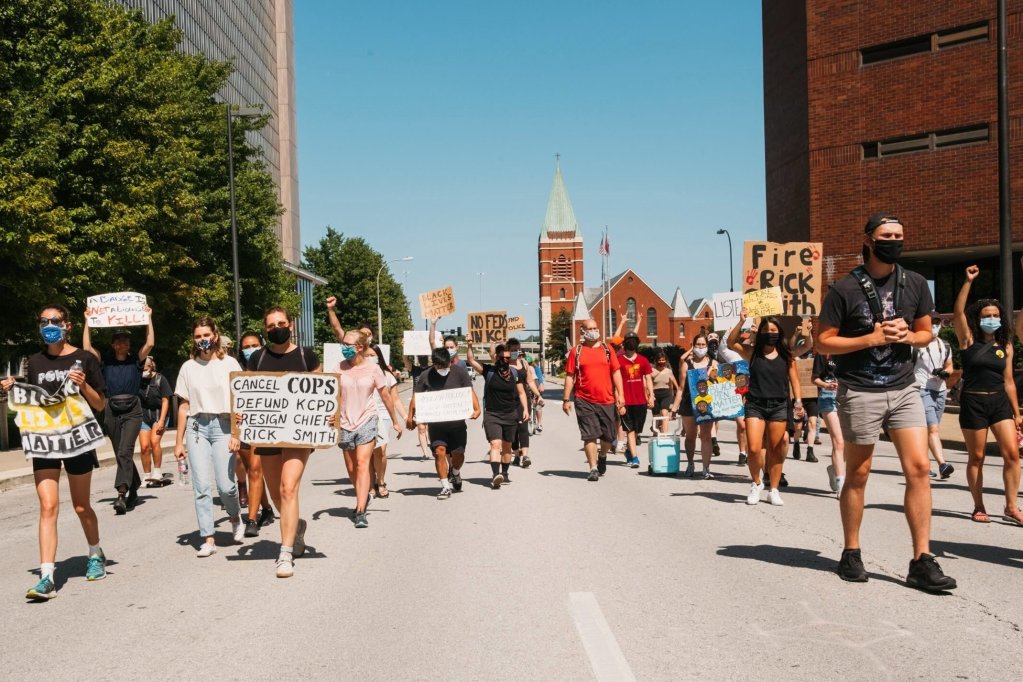
Amid mass protests against police violence in Kansas City and throughout the nation, one three-word phrase keeps coming up: “Defund the police.”
But what does it actually mean? The Beacon spoke to local activists to explain the thinking behind the phrase that has caught national attention. There’s a spectrum of ideas being discussed by activists nationwide — from redistributed funding to completely abolishing police departments — after the May killing of George Floyd by Minneapolis police officer Derek Chauvin.
So far, there have been no substantive efforts to defund law enforcement by local governments in the Kansas City area or by the Kansas City (Mo.) Board of Police Commissioners, which controls the KCPD. But other cities across the U.S. have taken steps to reduce the role of the police in their communities.
Calls to defund the police are rooted in critiques that police departments receive exorbitant funding that should instead be reinvested into programs that directly aid the community. It is that dichotomy — of a police department with too much money and social programs with too little — that local activists like Joshua Drake Taylor want to change.
“We actually want those funds to go toward different types of social services and communities that would help the community with its hardships, instead of just putting it all straight into the Kansas City Police Department,” said Taylor, who’s involved with BlackRainbow, a grassroots organization made up of young Black people in Kansas City that’s “dedicated to the liberation of all oppressed peoples.”
Proponents of defunding, and even abolishing, police say now is an opportunity to both end police brutality and transform public safety.
“‘Defunding the police’ is really about imagining a future in a world where we do not rely on police forces to organize and facilitate so much of our daily lives,” said Jenn Jackson, a political science professor at Syracuse University who studies Black politics.
Money, money, money
When KC Tenants launched its tenants hotline in late March, the purpose was to aid Kansas City residents experiencing housing crises during the first onslaught of the coronavirus pandemic. Run by volunteers from KC Tenants, the hotline received more than 200 calls within three months from tenants looking for resources at a time when businesses ground to a halt under stay-at-home orders, leaving thousands of workers jobless and without income in a pandemic.
Tara Raghuveer, director of KC Tenants, said the existence of the hotline, and the fact that it was staffed solely by volunteers, reflects the current lack of resources for tenants and reveals one of many funding gaps the city could invest in.
“We had to set up a hotline because during the COVID crisis, there was no one for tenants to call when they were facing unbearable circumstances related to housing.”
Tara R.
“It should not be our responsibility to have a hotline that tenants across the city can call into,” Raghuveer said. “We had to set up a hotline because during the COVID crisis, there was no one for tenants to call when they were facing unbearable circumstances related to housing.”
Groups who want to defund KCPD, like KC Tenants, point to the agency’s $273 million budget for this fiscal year , saying Kansas City taxpayers spend too much on policing without receiving a return on their investment: the combined funding for transit, parks and recreation, health and medical care, and housing services are less than the Police Department.
In Kansas City, as a result of decades of state control over the Police Department, the city is required to spend at least 20% of its general fund on the department. In the latest budget, the KCPD takes up 38% of the general fund.

A breakdown of the KCPD’s budget shows more than 80% is spent on personnel, including officer wages, benefits and overtime pay. The city’s adopted budget for the KCPD included an increase of $7.3 million in wages and benefits and the addition of 10 new police officers. Increases in these personnel services account for the department’s largest expense each year since the 2012-2013 fiscal year.
From 2012 until the most recent budget, the department’s budget increased from $204 million to $273 million.


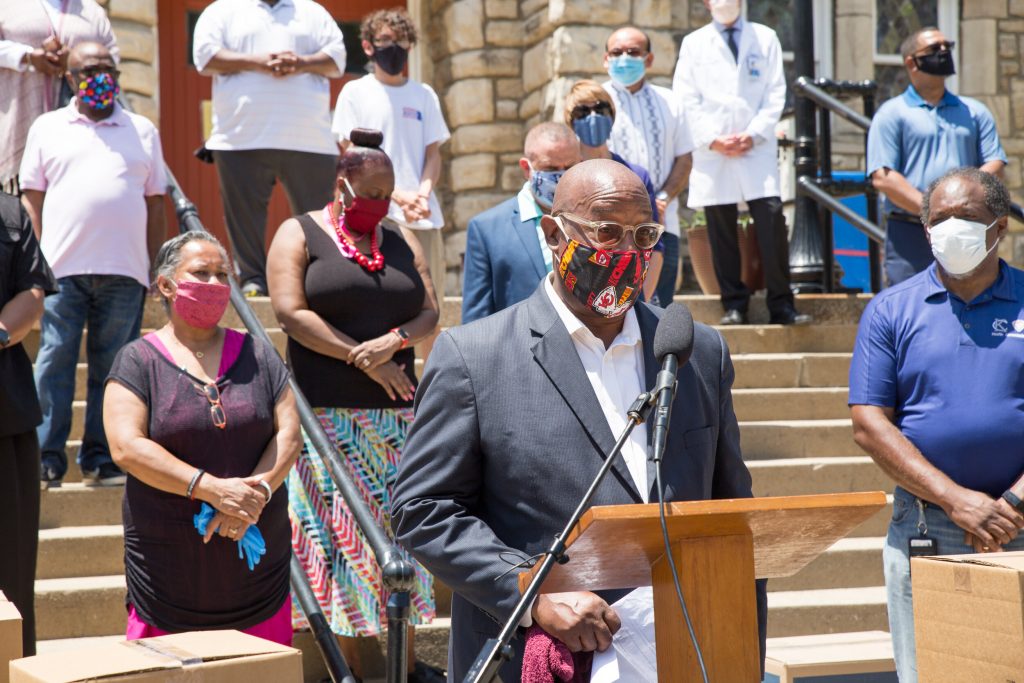


“The myth that there isn’t enough money to support programs that benefit the livelihood of all Kansas Citians is exactly that: It’s a myth,” said Mason Andrew Kilpatrick, a member of KC Tenants. “There is actually plenty of money to go around.”
Last December, the passage of the Tenants Bill of Rights meant the creation of the Office of the Tenant Advocate. KC Tenants requested $1.2 million from the City Council to fund the division. It received $327,764 to fund two positions.
‘More numbers than 911’
Those advocating for police reform say law enforcement wields too much power over the communities they are tasked with policing. In addition to violent crime, police officers are often the first responders to nonviolent incidents, like individuals experiencing a mental health crisis.
“The police are not in the best position to respond to somebody who’s having a mental health crisis,” said Ken Novak, professor of criminal justice and criminology at the University of Missouri-Kansas City. “They’re just not. Sometimes they do it well. Sometimes they don’t.”
All KCPD officers receive crisis intervention training following a mandate by Chief Rick Smith in 2017, said KCPD’s public information officer, Sgt. Jacob Becchina. The department also has a social services program and employs a Crisis Intervention Training squad of one sergeant and six officers. Becchina said when a CIT-trained officer responds to someone with a mental health issue and a report is filed, the CIT department conducts a follow-up to try to connect the person with community mental health services.

But proponents of defunding believe in finding other alternatives, especially since some police encounters lead to violence.
“There should be more numbers than 911 that I can call for help,” said Jenay Manley, a leader at KC Tenants.
For a group that works closely with tenants in crisis in Kansas City — and whose own members have intimate experience with housing insecurity and homelessness — defunding the police is about prioritizing people over property, Manley said.
Some housing issues fall under the purview of the KCPD via the department’s Crime-Free Multi-Housing Program. Becchina said the two officers in the program meet with rental and multifamily housing property owners to discuss crime prevention and establish “a less susceptible environment to crime.”
Becchina added that, while police officers do not directly deal with housing evictions, police reports can be used by landlords to support an eviction.
“The people who are closer to the problems are closer to the solution.”
Jenay Manley, KC Tenants
What have other cities done?
So far, there have been no substantive efforts to defund or abolish law enforcement locally. But several cities across the U.S. have taken steps to reduce the role of the police in their communities.
Residents in Camden, New Jersey, disbanded their local police force in 2012; a new Police Department took its place soon after. In the years since, crime has dropped in a city that used to see high rates of violent crime. However, issues with policing and inequality still persist.
In the wake of mass protests following the police killing of George Floyd, activists have focused their efforts on city budgets. On June 26, a month after Floyd’s death, the Minneapolis City Council voted in favor of a proposal to dissolve its current Police Department and establish a department of community safety and violence prevention. The proposal creates a ballot measure that residents will vote on this November.
At the start of July, the Los Angeles City Council voted to slash $150 million from the Police Department’s $1.8 billion budget. In New York City, home to the largest and most costly police department in the country, several proposals have been pushed to make significant cuts to the NYPD’s $6 billion budget.
In Eugene, Oregon, an emergency response system called CAHOOTS — Crisis Assistance Helping Out on the Streets — provides free service to any person in a crisis. Instead of relying on the police, Cahoots sends a medic and a crisis responder equipped with medical supplies. According to a recent NPR story, the program takes care of about 20% of local 911 calls.
Some elements of a community-oriented public safety force exist in Kansas City: The Public Safety Ambassadors in the Downtown Community Improvement District, which encompasses downtown Kansas City and the River Market, are trained in de-escalation, do not carry guns, and are publicly funded.

Sean O’Byrne, director of the Downtown and River Market Community Improvement Districts, said the ambassadors handle quality-of-life issues, adding that they will connect those experiencing mental health problems to service providers. Also called “the Bumblebees” because of their black and yellow uniforms, the ambassadors coordinate with the KCPD; O’Byrne said focusing on quality-of-life issues is one way to alleviate pressure from police.
“Our goal is to get them off of the streets and into structured clinical care, and that’s why we have such a good network with the human service providers,” O’Byrne said of people experiencing crises. “Community policing is just that, it’s policing. It’s taking care of the community.”
‘Closer to the solution’
Some critics of defunding police point to high crime rates, including the high homicide rate in Kansas City, as evidence that the city needs a robust police force. Recently, Kansas City, Missouri, Mayor Quinton Lucas requested that Missouri Gov. Mike Parson send additional resources and tools for law enforcement and prosecutors to address violent crime. As a result, the Department of Justice is launching a new initiative, Operation Legend, that will bring federal law enforcement officers to Kansas City.
Novak said that while he doesn’t fully support defunding the police, he agrees with reducing the responsibility of police and moving money from police departments to other areas like schools.
“When we talk about root causes of crime, it’s all things that are beyond the scope of the police,” Novak said. “Greater funding for mental health, for schools and education, those will likely pay bigger dividends down the road.”
Novak said one way to analyze the role of the police is to think about policing like a hospital.
“Do we want cops to be emergency room doctors only?” he said. “Or do we want them engaging in preventative medicine? I think we would agree that it’s better to try to prevent the disease than to treat it after it occurs.”
“And that’s why we have different types of doctors. This is why you have your general practice versus your ER doctor. The ER doctor is not in a good position to be preventative. We kind of need both.”
Caroline Sarnoff, executive director of the Justice Collaboratory at Yale University, says one of the most effective ways to prevent crime is to prioritize the trust and fairness in relationships between authorities and people.
“If people feel that authority is legitimate, they are more likely to comply with the law versus a deterrence theory,” Sarnoff said. “So it’s not so much about the swiftness and severity of punishment, it’s actually about individuals’ perceptions of authority, like the police.”
For Manley, divesting from police and our current prison system and investing in systems of care means holding people accountable for harm they cause — and providing them with the necessary support.
“We don’t throw people away,” Manley said. “It doesn’t solve the problem because they come back, and they should. They should come back better with help and support.”
In Kansas City, solutions to reimagine public safety must include input from those most affected by policing, she said.
“The people who are closer to the problems are closer to the solution,” Manley said. “So there is no way to solve it without coming to the community and actually having a conversation and letting us take the lead.”
Celisa Calacal is the assistant editor at The Beacon. Follow her on Twitter or email her at celisa@thebeacon.media.
